CSU East Bay · Music Department
MUS 302 · What to Listen for in Music
Module 1: Orientation and Methodology · Listening Guide · Track 1 of 4
Track 1 Sam Cooke, "A Change Is Gonna Come" (1964)
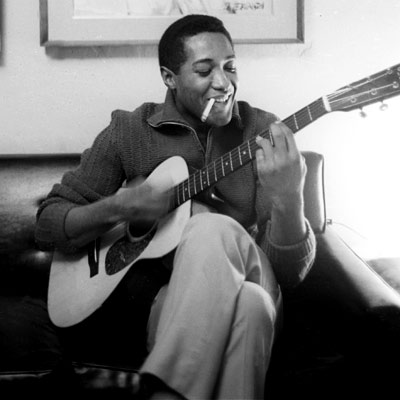
Context
Cooke before the song: gospel, crossover, and the business of being Black in 1950s music
Samuel Cook (he added the "e" when he turned to ) was born in Clarksdale, Mississippi in 1931, the son of a minister. The family moved to Chicago when he was a small child, part of the we read about in the framing reading. He began singing in church as a six-year-old and joined the Highway QCs as a teenager. In 1950, at nineteen, he became lead singer of , one of the most important groups of the postwar era. The Soul Stirrers had pioneered, under Cooke's predecessor R.H. Harris, a vocal style that pushed gospel toward the emotional intensity that would later be called , including the addition of a second lead voice, leaps, and what music historians describe as a approach that broke from the smoother before it. Cooke's , with its agility, its built-in catch on certain vowels, and what biographer Peter Guralnick has called its "effortless" ability to reach high notes without straining, made him a sensation on the through the early and mid-1950s. Young women began showing up to gospel concerts to see him in particular, which was new.
In 1956, Cooke recorded a secular song called "Lovable" under the Dale Cook, attempting to test the secular pop waters without alienating his gospel fan base. The pseudonym did not fool anyone. In 1957, after leaving and signing with the small Los Angeles label , Cooke released "You Send Me" under his own name. It went to number one on both the and charts, knocking 's "Jailhouse Rock" out of the top spot. He was twenty-six years old. The was complete, but it cost him: many in the gospel world felt he had abandoned the church, and the gospel community largely turned away. As Bobby Womack, Cooke's protégé, later put it, the assumption at the time was that "if you serve God, you serve God. You can't turn around and sing a pop song." Cooke's response was to bring as much of the gospel vocabulary into pop as the industry would allow, which turned out to be a great deal.
Between 1957 and 1964, Cooke had thirty hits. He signed with in 1960. He also did something unusual for a Black artist in this period: he founded a record label, SAR Records, and a publishing company, Kags Music, taking unprecedented control of the business side of his career. Most of his RCA-era hits, songs like "Chain Gang," "Wonderful World," "Twistin' the Night Away," and "Another Saturday Night," were lighthearted dance tunes or romantic ballads that crossed over to white audiences without engaging directly with the racial conditions Cooke and his audiences were living through. He was, on records, a sweet soul singer. In life, he was something more complicated. He had been refusing to play since at least 1961, when he and walked off a Memphis stage rather than perform for an audience where Black patrons had been forced to the back and sides of the auditorium.
Shreveport, Dylan, and the writing of the song
In late summer and early fall of 1963, Cooke heard . According to Guralnick and to Cooke's own contemporaneous statements, the song shook him. He was, he told friends, both moved that a young white singer would write so directly about American racism, and ashamed that he himself had not. He began performing "Blowin' in the Wind" in his own sets almost immediately. He also began thinking about what kind of song he might write if he were going to put his civil rights convictions on a record.
On October 8, 1963, Cooke and his touring entourage drove into Shreveport, Louisiana, for a performance at the Municipal Auditorium. Cooke had called ahead to reserve rooms for himself and his wife Barbara at the Holiday Inn North on North Market Street. The reservation had been confirmed by phone. When Cooke and his brother Charles arrived in person, the desk clerk, seeing that they were Black, claimed there were no rooms available. Cooke confronted the clerk and demanded to see the manager. His wife Barbara, sensing how dangerous the situation was, told him "they'll kill you." Cooke, by multiple accounts, replied: "They're not gonna kill me. I'm Sam Cooke." His wife responded that to the people in front of them, he was just another Black man. The group drove away to the Black-owned Castle Motel across town, blaring their car horns and shouting in protest. Police were waiting for them when they arrived. Cooke, his brother, his wife, and his bandmate Roy Crain were arrested for disturbing the peace and held until they posted bond of $102.50 each. The Shreveport Times ran the arrest as front-page news the next day under the headline "Negro Singer Arrested Here." The New York Times picked up the wire story. Cooke performed that night at the Municipal Auditorium anyway.
The Shreveport incident did not happen in isolation. Earlier that year, the by the , killing four Black girls in their Sunday school class. Civil rights leader had been assassinated in his driveway in Jackson, Mississippi. Police had used fire hoses and dogs on Black children protesting in Birmingham. Martin Luther King Jr. had delivered the "I Have a Dream" speech at the just weeks before Cooke's arrest, including a line that condemned exactly the kind of treatment Cooke had just received: "as long as our bodies, heavy with the fatigue of travel, cannot gain lodging in the motels of the highway and the hotels of the cities." According to Guralnick, Cooke wrote the bulk of "A Change Is Gonna Come" during the Christmas season of 1963. He told friends the song came to him almost in a dream, fully formed, and that something about its weight unsettled him. When he played a tape of it for his protégé Bobby Womack, Womack told Cooke it sounded "like death." Cooke replied: "That's kind of how it sounds like to me. That's why I'm never going to play it in public." He performed the song live only once in his lifetime, on The Tonight Show in February 1964.
The recording: René Hall and the orchestral choice
Cooke recorded "A Change Is Gonna Come" on January 30, 1964, at RCA Studios in Hollywood. The was René Hall, a Louisiana-born musician who had been working with Cooke for years. Cooke, who was famous in the studio as a perfectionist who controlled every detail of his , did something he had never done before: he handed the song to Hall and gave him complete latitude. "I'm going to leave that up to you," Cooke said. Hall, in interviews quoted in the Louisiana Endowment for the Humanities encyclopedia 64 Parishes, said: "I wanted it to be the greatest thing in my life. I spent a lot of time, put out a lot of ideas, and then changed them and rearranged them."
What Hall composed was an arrangement that resembled a film score. Eleven violins, a French horn, a , and a small , organized into what musicologist Mark Burford has described as a structure where "each verse features different instrumentation." The opening overture is played by the full orchestra. The first verse is dominated by the rhythm section. The second verse brings in the strings. The third verse pulls the strings back and adds . By the song's climax, the entire orchestra is swelling beneath Cooke's voice. This use of orchestral language was a significant choice. Most civil-rights-era of 1963 and 1964 were written and performed in folk idioms (Dylan, , ) or in gospel idioms (the freedom songs of the ). Cooke's decision to make his protest song in the language of mid-century pop was a claim about who the song was for, and about who got to make serious art about racial injustice. As music journalist Tom Maxwell has put it, the song refused the option of being "a folky style, one which works well for gathering around the guitar at a protest march." It demanded a different kind of audience and a different kind of attention.
Cooke's usual drummer, John Boudreaux, was so intimidated by the orchestral arrangement that he refused to leave the control room. The drum part was played instead by Earl Palmer, who happened to be working a session next door. The recording was completed in a single session.
Reception, death, and afterlife
"A Change Is Gonna Come" first appeared on Cooke's album Ain't That Good News, released in early 1964. It was not released as a single until December 22, 1964, two weeks after Cooke had been killed. Cooke was shot on the night of December 11, 1964 at the Hacienda Motel in Los Angeles by the motel's manager, Bertha Franklin, after he forced his way into her office, partially undressed, looking for a young woman named Elisa Boyer who had fled from his motel room and called the police saying he had attacked her. Franklin was acquitted on the grounds of self-defense after a coroner's inquest, and the case was officially closed as justifiable homicide.
When the single was prepared for release, the second verse and chorus ("I go to the movies, and I go downtown…") were cut, reportedly to make the song more acceptable to white radio. The song was a modest hit by the standards of Cooke's career, peaking at number nine on the and number thirty-one on the pop chart. But it became something larger than a chart position. The adopted it almost immediately. It was added to the Library of Congress's in 2006. It has been recorded by more than five hundred artists, including Otis Redding, , the Fifth Dimension, and many others. In Rolling Stone's January 2025 list of the hundred best protest songs of all time, it was ranked first.
Burford, writing in Slate, argues that what makes the song central to American music is the way it brings the gospel vocal tradition's authority into a secular and political context: as gospel secularized into soul, the musical sounds that had confirmed the unity of a church congregation became musical agents capable of generating new and expansive communities united for a moment by a song. The strings and horns, in this view, do something that the gospel choir had done in the church: they create the sense of a collective gathering around a single voice, of independent musical lines coming together in shared purpose. Cooke moved that gathering from the sanctuary to the radio.
Things to listen for
The song is in the of , in , which means each has four main and each beat divides into three smaller pulses. Think of the underlying as a slow rocking motion, three small beats inside each big beat. This is the of slow gospel and slow soul ballads. It is also why the song feels like it is moving in waves rather than steps. The is about 65 , around the speed of a resting heartbeat. Let those structural facts sit underneath everything else you notice.
First, the of Cooke's voice. Listen to how controlled it is in the early verses, and how that control changes as the song builds. The training is gospel. The smoothness is pop. Cooke spent a decade as the lead singer of the Soul Stirrers learning a vocal style that emphasized clarity, agility, and what musicologists call , the technique of moving a single syllable across multiple notes. You hear melisma in his signature "whoa-whoa-whoa" inside the word "know" in the chorus: the syllable lifts and dips across three or four notes before resolving. That is gospel, brought into pop. Listen also for the catch in his voice on certain syllables, the small rasp that gospel calls . Cooke could and could not turn it on at will. By the final verse, the grain is everywhere, and the smoothness has burned off. The voice has aged in the course of three minutes.
Second, the and how it changes verse by verse. This is the structural argument of the recording, and arranger René Hall designed it carefully. The opening is the full orchestra alone. Verse 1 is dominated by the rhythm section (drums, bass, piano), with strings underneath and Cooke's voice in front. Verse 2 brings the strings forward. Verse 3 (the verse cut from the radio single, about going to the movies) brings in the horns. The bridge ("Then I go to my brother") is carried by timpani and strings, with the strings shifting into G minor, the song's only sustained move into a . Verse 4 brings the French horn back as a melody instrument. The final chord is held by the entire ensemble. This is texture as architecture: each verse is a different musical room, and the song moves you through all of them. Hall called it a movie score. He was not wrong.
Third, the and the bridge. The song uses verses and a recurring chorus ("It's been a long, a long time coming, but I know a change gonna come, oh yes it will") rather than the building-without-return structure of, say, 's "I'm So Lonesome I Could Cry." Where Williams accumulates verses without relief, Cooke gives you the chorus as a place to gather hope each time, and then takes it away. Pay particular attention to the , which is the section that begins "Then I go to my brother." The bridge is a contrasting middle section: a moment of harmonic and melodic departure from the main material. Cooke and Hall use the bridge to do something specific. The strings shift to G minor (the song has been in B-flat major) and play a G minor , an upward sweep of three notes from the chord, sustained beneath the line "knockin' me back down on my knees." This is the song's only sustained move to a minor key. It is the moment where the hope of the chorus gets answered with rejection. After the bridge, the song returns to the home key for the final verse, and the reaffirmation of the chorus is harder to believe and harder to give up.
Fourth, the . Listen for at least three specific gesture moments and what each one does. The first is the small crack in Cooke's voice on "I'm afraid to die" in the second verse. It is small. It is unforgettable. The strings underneath do not swell to cover it; they hold steady, leaving the crack exposed. That restraint is a production choice. Hall could have written a sweeping orchestral response in that moment. He chose to let the voice break in the open air. The second gesture is what musicians call , the technique of singing slightly behind the beat to communicate exhaustion or hesitation. Cooke does this throughout the song, particularly in the verses, where he lets phrases lag behind the underlying rhythm before catching up. It is part of why the song sounds tired. The third gesture is the timpani roll that leads into the climactic chord change in the third verse, a low rumble that builds and then releases into the band. The timpani is not decoration. It is the song's heart pounding.
Reflective question
Cooke could have made this song in many ways. He could have made it as a gospel song, with a choir behind him. He could have made it as a , with a small band. He could have made it as a folk song, with an acoustic guitar. He chose to make it with strings and horns, in the language of mid-century pop orchestration. Why? What does that choice say about who he was speaking to and what he was asking of them?
Sources for this section
Burford, Mark. "Sam Cooke's 'A Change Is Gonna Come' Is a Civil Rights Anthem." Slate, October 18, 2016. (Mark Burford is professor of music at Reed College and the author of Mahalia Jackson and the Black Gospel Field.)
DeAlwis, Adoria. "'A Change Is Gonna Come.'" 64 Parishes, encyclopedia of the Louisiana Endowment for the Humanities. Accessed via 64parishes.org.
Guralnick, Peter. Dream Boogie: The Triumph of Sam Cooke. Little, Brown, 2005. (The standard biography.)
Hickey, Andrew. "Episode 122: 'A Change Is Gonna Come' by Sam Cooke." A History of Rock Music in 500 Songs (podcast and transcript). Detailed verse-by-verse analysis of the orchestral arrangement.
Maxwell, Tom. "How Sam Cooke Reimagined the Protest Song and Created a Civil Rights Anthem." Produce Like a Pro, 2023. Useful on the recording session itself.
National Public Radio. "Sam Cooke and the Song That 'Almost Scared Him.'" All Things Considered, February 1, 2014.