CSU East Bay · Music Department
MUS 302 · What to Listen for in Music
Module 1: Orientation and Methodology · Listening Guide · Track 4 of 4
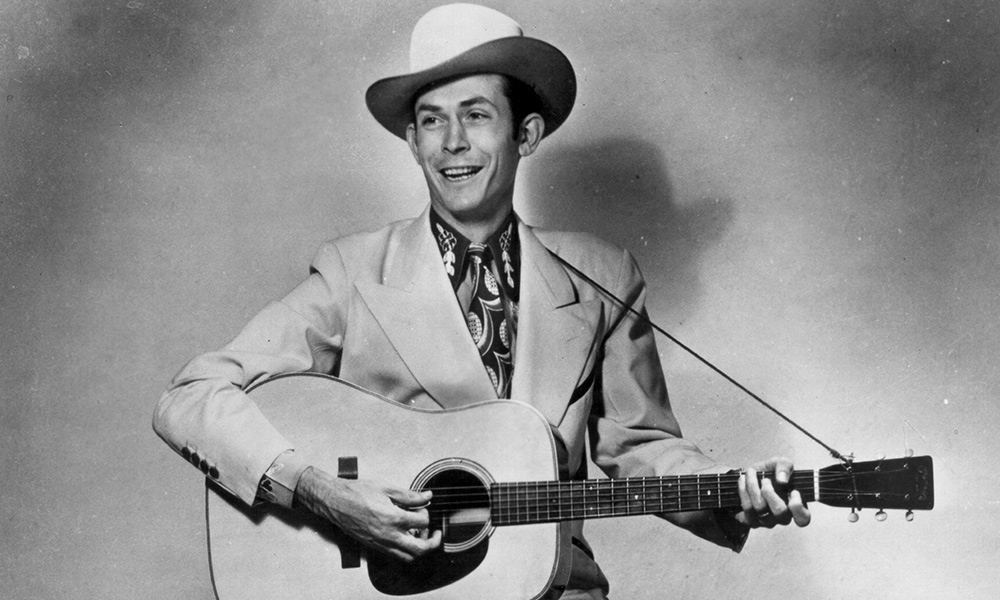
Track 4 Hank Williams, "I'm So Lonesome I Could Cry" (1949)
Context
Williams before the song
The country singer the world would come to know as was born Hiram King Williams on September 17, 1923, in Mount Olive, Alabama, the son of a logger who would soon enter a Veterans Administration hospital and largely disappear from his children's lives. His mother Lillie ran rooming houses and moved the family between Mount Olive, Georgiana, Greenville, and eventually Montgomery in pursuit of work. Williams was born with , a congenital spinal condition that caused him chronic back pain throughout his life and would eventually contribute to the alcohol and morphine dependencies that killed him at twenty-nine. He bought his first guitar from his mother for $3.50 on installment, and he learned to play by attaching himself to a Black street musician named Rufus Payne, who went by the nickname Tee Tot.
Williams started performing on local Alabama radio at thirteen. He won a 1937 talent contest at the Empire Theater in Montgomery that got him a regular slot on the WSFA radio station. He formed his first version of the in 1938. He spent the war years working in in Mobile, Alabama, and Portland, Oregon, occasionally returning to performing. In 1944 he married Audrey Sheppard, who became his manager and frequent vocal partner. She was an ambitious woman with limited musical talent and a turbulent personal life with him, and she was central to his career until their divorce in May 1952. In 1946, Audrey insisted they go to Nashville to meet the music publisher Fred Rose at the recently formed firm . Rose became Williams's effective producer, songwriting collaborator, and business mind. Williams signed with in 1947. By 1949 he was a national star: "Lovesick Blues" reached number one on the country chart and stayed there for sixteen weeks, and Williams joined the , where he performed an unprecedented six encores of the song on his debut. He had no fewer than seven country hits in 1949, of which "I'm So Lonesome I Could Cry" would be one.
Tee Tot
Williams's musical inheritance came from two sources he was open about. The poetic structure of his songs (their image-driven verses, their natural-world metaphors) came from the that came down through and the rural South, the inheritance of his Welsh, Scotch-Irish, and English ancestors. The phrasing in his voice (the way he bent and lingered on notes, the way he let his voice catch) came from his teenage apprenticeship with , an African American street musician.
Payne was born in 1884 on the Payne Plantation in Sandy Ridge, Lowndes County, Alabama. His family moved to New Orleans when he was six, and there he learned guitar, blues, and . He returned to Alabama in 1915 and worked as an itinerant performer, playing in clubs, , and on the streets of small Alabama towns including Greenville, Georgiana, and Montgomery. According to Alabama blues historian Alice Harp, who tracked down the location of Payne's grave in 1999, Payne played both for Black audiences and at the homes of well-to-do white families, who hired him for tea parties and social events.
Around 1933, when Williams was about ten years old, Payne and the Williams family met in Georgiana, where Williams's mother was running a boarding house and Payne was performing on the street. Williams started following Payne around, persuading him to teach him guitar. The arrangement that emerged was specific to its time and place: Williams's mother fed Payne in exchange for the lessons, and the two of them sat under the high front porch of the Williams house, out of public sight. Leona Simmons, a local historian at the Hank Williams Museum in Georgiana, told the Alabama Press-Register: "Whites didn't follow blacks around then. It just wasn't done. That's why they ended up under the house. He was hiding out." The lessons covered chords, , bass turns, and the blues phrasing that would become a permanent feature of Williams's voice. In 1937 Payne moved to Montgomery at Williams's suggestion. He died there at a charity hospital on March 17, 1939, at age fifty-six. Williams, a teenager by then, did not learn of his death. When Williams returned to Greenville in 1951 for a concert and tried to find his old teacher, friends told him Payne had been dead for twelve years. Payne was buried in an unmarked grave. Williams told the Montgomery Advertiser that year that Payne had given him "all the music training I ever had."
's history is rarely told this way. The standard narrative of country music as the music of the rural white South often elides the central role of Black musicians like Tee Tot, of figures like (the first Black star of the Grand Ole Opry), of the constant musical exchange between Black and white communities in the same Southern towns. Williams's open acknowledgment of his debt to Payne is itself unusual in mid-century country music, where the blues-derived elements of the music were often performed without attribution to their source. When you hear Williams sing "I'm So Lonesome I Could Cry," you are hearing both traditions in him at once: the imagery is Anglo-Celtic, the phrasing is Black Southern blues, and they have been folded together so completely that you cannot separate them.
The recording
Williams recorded "I'm So Lonesome I Could Cry" on August 30, 1949, at E.T. Herzog Recording Studios in Cincinnati, Ohio. The session musicians were not the Drifting Cowboys but a group of studio professionals associated with the Pleasant Valley Boys: Zeke Turner on lead , Jerry Byrd on , Louis Innis on , Tommy Jackson on , and Ernie Newton on upright bass. Williams played acoustic guitar and sang. The recording has no drums.
According to Colin Escott's 1994 biography Hank Williams, Williams had originally written the song to be recited rather than sung, in the style of his alter ego , a MGM used for his moralistic spoken-word recordings. Williams thought the song was "too genteel" to set to music. Friends and fellow musicians convinced him otherwise. The arrangement at Herzog Studio was deliberately sparse to preserve the spoken-word weight of the lyrics: Byrd's steel guitar and Jackson's fiddle each play simple, mournful lines that paraphrase the vocal melody, leaving large amounts of space around Williams's voice. Escott described Byrd's solo as "of unusual simplicity, paraphrasing the melody to haunting effect, subtly adjusting tone and volume."
Williams's marriage to Audrey was disintegrating during the period he wrote the song, and biographers have generally agreed that the song's sense of hopeless loneliness draws on the personal turmoil of that relationship. The song is in slow waltz time (3/4), and structured as four sung verses with two instrumental verses interspersed, with no chorus, each verse using a similar pattern of nature imagery (a whippoorwill, the moon, a falling star, a robin) to mirror an interior emotional state.
The single, the death, the afterlife
MGM released "I'm So Lonesome I Could Cry" in November 1949 as the of "My Bucket's Got a Hole in It," reportedly because operators preferred uptempo songs and a slow ballad would be wasted on the A-side. The single was a success: "My Bucket's Got a Hole in It" reached number two on the Billboard country chart. "I'm So Lonesome I Could Cry" did not chart on its own, but it became, by far, the more famous of the two songs over the decades that followed.
Williams's life accelerated toward catastrophe. His back pain led to a deepening dependence on alcohol and morphine. The Grand Ole Opry fired him in August 1952 for habitual drunkenness. Audrey divorced him three months earlier. He married Billie Jean Jones in October 1952. On the night of December 30, 1952, after a doctor in Knoxville injected him with vitamin B12 and morphine and he had been drinking heavily, Williams climbed into the back seat of a powder-blue 1952 Cadillac to be driven by an eighteen-year-old chauffeur named Charles Carr to a New Year's Day concert in Canton, Ohio. He never woke up. Williams was officially declared dead at 7:00 a.m. on January 1, 1953, in Oak Hill, West Virginia, of heart failure. He was twenty-nine years old.
The song's afterlife is enormous. It has been recorded by hundreds of artists, including (who introduced it during his 1973 Aloha from Hawaii television special as "probably the saddest song I've ever heard"), Johnny Cash and Nick Cave (a 2002 duet on American IV: The Man Comes Around), B.J. Thomas (whose 1966 cover reached number eight on the ), Al Green, the Everly Brothers, k.d. lang, Townes Van Zandt, and many others. , in his autobiography Chronicles, Volume One, wrote about hearing Williams as a young teenager: "Even at a young age, I identified with him. I didn't have to experience anything that Hank did to know what he was singing about. I'd never heard a robin weep, but could imagine it and it made me sad." Williams was inducted into the inaugural class of the in 1961. In 2010, the Pulitzer Board awarded him a for songwriting. Rolling Stone ranked "I'm So Lonesome I Could Cry" number 165 on its 2021 update of the 500 Greatest Songs of All Time, one of only two songs on the list from the 1940s.
Things to listen for
The song is in the of E , in (), at a of about 112 . The 3/4 meter is the same meter as a Viennese waltz, three per measure with the strongest emphasis on beat one. ONE-two-three, ONE-two-three. In popular music, 3/4 is rare; you can spend years listening to American , rock, and and barely encounter it. Williams is reaching back to an older tradition: the parlor song, the church hymn, the country waltz. The choice of 3/4 in 1949, when the rest of the country was moving toward backbeat-driven 4/4 and rhythm and blues, is a deliberate retreat into musical territory that already felt old when Williams used it. The slow waltz pulse contributes to the song's hesitant, almost stumbling rhythmic feel: the song does not march forward; it sways. The harmonic language is the simplest in the listening guide. Three chords (E, A, and B, the of E major, the same -- relationship we just met in DeSanto) and they barely move from one to the next. Where Cooke and Hall constructed an orchestral architecture in B-flat, Williams and his small band sit on three chords for two minutes and forty-nine seconds. The song does not need more.
First, the of Williams's voice. There is a catch in it, a kind of cry built into the sound. It is not a polished voice. The roughness is part of the meaning. Listen for how he holds notes and lets them break. Compare this to the way Cooke uses in "A Change Is Gonna Come." Cooke is gospel-trained: his break is theatrical, controlled, allowed to happen at specific moments while the smoothness holds the rest of the time. Williams's break is constant, woven into the basic sound of his voice. The roughness is not a departure from a smoother Williams; the roughness is the voice. This timbre is shaped by two specific traditions. From the Anglo-Celtic ballad tradition Williams inherited the technique of dropping suddenly between vocal registers (chest voice into head voice and back), which you can hear in his work on the word "cry" at the end of phrases. From his lessons with Tee Tot, Williams inherited the blues practice of bending pitches just slightly off the written note and letting individual syllables linger in a way that pulls against the strict meter underneath. The combination is what made him sound, to mid-century white American audiences, like the voice of a particular kind of suffering they recognized as their own.
Second, the is the thinnest in the listening guide. Williams's voice. Jerry Byrd's steel guitar. Tommy Jackson's fiddle. Zeke Turner's lead electric guitar (used sparingly). Louis Innis on rhythm guitar. Ernie Newton on upright bass. No drums. No piano. Five musicians plus the singer. Compare this with the eleven violins in the Cooke recording, the twelve-piece ensemble in the Cruz, even the six or seven-piece Chess on DeSanto. The Williams arrangement is so spare that you can hear individual instruments breathe between phrases. That sparseness is not a limitation of 1949 country recording technology; it is a deliberate aesthetic choice. The Drifting Cowboys, Williams's regular touring band, were not on this session. The Cincinnati session musicians (the Pleasant Valley Boys plus Jackson and Newton) were chosen specifically for their ability to play less, not more. The space around the voice is part of the song. So is the silence after each line, the pause that lets the lyric land before the next image arrives.
Third, the is what music theorists call , also known as . The song has only one repeating musical idea: a sixteen- verse, sung four times with different lyrics each time, plus two more times played as an on guitar in place of singing. The structure runs: verse 1 (sung) → verse 2 (sung) → verse 3 (instrumental, played by guitar) → verse 4 (sung) → verse 5 (instrumental) → verse 6 (sung). The methodology reading drew this in Figure 2 as the same A returning across six positions: the same shape, returning, with different words inside (or, in the third and fifth positions, no words at all). The song shares this simplicity with most folk ballads, with most blues (which uses a similar strophic principle inside its 12-bar structure), and with hymns. It does not share it with most pop after the 1960s, where alternation took over. Listen to what the form does to you. Each verse arrives sounding the same as the last and ends the same way (with the title line, or close to it). There is no chorus to gather hope at, no to take you somewhere new, only the loneliness, returning, and returning, and returning, with a different image each time. The form is the loneliness.
Fourth, the of the steel guitar as second voice. Pay attention to Jerry Byrd's steel guitar through the whole song. It does something specific: between Williams's vocal lines, the steel guitar plays a brief answering phrase, often paraphrasing the melody Williams just sang. Biographer Colin Escott (in his 1994 biography) described Byrd's playing as "of unusual simplicity, paraphrasing the melody to haunting effect, subtly adjusting tone and volume." This is between voice and instrument, the same principle that organizes salsa (Cruz) and preaching, here used with two voices instead of two groups. The steel guitar functions as a second singer, in conversation with the first. When Williams pauses, the steel guitar fills. When Williams sings, the steel guitar holds back. The two voices alternate without ever competing. The steel guitar itself, played horizontally with the strings raised above the body and a metal slide moving smoothly between pitches, can produce a crying, almost vocal sound that no other instrument quite matches. In the hands of a great steel guitarist (and Jerry Byrd was one of the great steel guitarists), the instrument becomes a wordless singer, capable of communicating grief, longing, or stillness. Williams and Byrd worked together through Williams's career. This recording is one of their finest collaborations.
Reflective question
Williams's phrasing is shaped by the blues, which he learned from a Black musician named Tee Tot. His poetic vocabulary is shaped by older Anglo-Celtic ballad traditions. The song you are hearing is American because both of those traditions met in him. How does knowing this change what you hear, if at all? What do you make of the fact that country music's history is rarely told this way, that the contributions of figures like Tee Tot are often left out of the story even when the music itself carries those contributions forward?
Sources for this section
Escott, Colin. Hank Williams: The Biography. Little, Brown, 1994 (revised edition 2004). The standard biography, drawing on extensive interviews with people who knew Williams.
Momodu, Samuel. "Rufus 'Tee Tot' Payne (1884–1939)." BlackPast.org. Scholarly biographical entry on Payne by a historian, with extensive citations.
Greenville Advocate. "Tee-Tot a mentor to legendary musician." May 12, 2017. Local Alabama coverage of the Payne story, citing Alabama blues historian Alice Harp.
Alabama Press-Register. "Hank Williams mentor buried in obscure grave." August 10, 2006. Includes interviews with Hank Williams Museum staff in Georgiana.
Wikipedia. "I'm So Lonesome I Could Cry." Heavily sourced article on the song, drawing on Escott's biography and contemporary recording session documentation.
Wikipedia. "Hank Williams" and "Death of Hank Williams." Drawing on multiple biographical sources, useful for cross-checking dates and events.
Britannica. "Hank Williams." Standard encyclopedic biography by Jeff Wallenfeldt.
Hank Williams Museum, Montgomery, Alabama. Online biographical materials, accessed at thehankwilliamsmuseum.net.
Dylan, Bob. Chronicles: Volume One. Simon & Schuster, 2004. Source for the Dylan quotation on hearing Williams as a young listener.