CSU East Bay · Music Department
MUS 302 · What to Listen for in Music
Module 3: Latin Diasporic Traditions · Listening Guide · Track 3 of 5
Track 3 Santana, "Oye Como Va" (1970)
Context
Carlos before the song: Autlán, Tijuana, the Mission
was born in 1947 in , a small town in the Mexican state of Jalisco, the middle of seven children. His father, José Santana, was a working violinist, and Carlos started on the violin at five before switching to guitar at eight. In 1955 the family moved to on the US-Mexico border, where, as a teenager, Carlos played in the strip clubs and bars of the Tijuana Strip and absorbed American and from US radio stations across the line: T-Bone Walker, , John Lee Hooker, and the Tijuana guitarist Javier Bátiz, who became his most direct local model.
The family moved north to San Francisco in 1961 to follow steady work; Carlos joined them in 1963 after a stretch as a working club musician in Tijuana. They settled in the , the heavily Mexican-American neighborhood that had been forming since the 1940s as Mexican migrants displaced by the Bay Bridge construction relocated south from Rincon Hill. Carlos attended Mission High School, graduated in 1965, was naturalized as a US citizen the same year, and started the Santana Blues Band in October 1966. The Bay Area rock-and-blues scene was already in full bloom; in 1968 the band, by then known simply as , came to the attention of , who would become their manager and their gateway to the .
Woodstock and the Mission: the only Latin act on the bill
Carlos Santana stepped onto the Woodstock stage on the afternoon of Saturday, August 16, 1969 with no record yet released. The band was on the bill for one reason: Bill Graham, who managed both and the in addition to Santana, had made it a condition of getting the Airplane and the Dead that the festival also book his unknown Mission District clients. Santana's set ended with "Soul Sacrifice," an extended instrumental anchored by Michael Shrieve's drum solo, and the performance, captured in the 1970 documentary film, made the band an overnight national phenomenon. Their self-titled debut album was released within days of the festival and rose to number four on the Billboard 200.
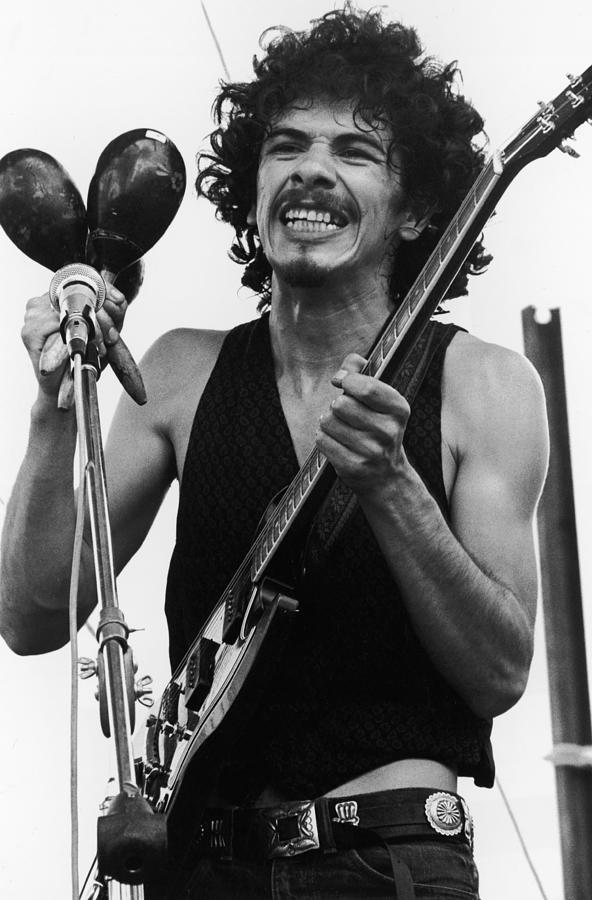
By 1969 the Mission was the cultural and political center of Mexican-American San Francisco; this was also the moment of the founding of the institutions that would define Bay Area for the next half-century. The bilingual newspaper El Tecolote launched in 1970, the Galería de la Raza in 1971, the Mission Cultural Center for Latino Arts in 1976. A Mexican-American guitarist from Mission High standing in front of half a million people upstate as the only Latin act on a bill of mostly white rock musicians was making a political argument by being there, and the photograph of him with his Gibson SG and a pair of maracas, grinning at the microphone, was already in circulation the day after his set ended.
The recording: Wally Heider's, Fred Catero, the classic lineup
Santana entered in San Francisco on April 17, 1970 to start the album that became . The classic Woodstock-era lineup was intact: Carlos on lead guitar and vocals, on the and lead vocals, David Brown on bass, on drums, Michael Carabello on , and on and conga, with the percussionist and vocalist contributing additional percussion and the Spanish backing vocal heard behind Rolie's lead on this track. The producer was Fred Catero. Sessions wrapped on May 2; the album came out on Columbia on September 23, 1970 and went to number one.
Carlos has explained the decision to cover Tito Puente in plain terms. Living on Potrero Hill in San Francisco, he heard Latin music on a Spanish-language AM station at two in the morning: , Ray Barretto, . "I knew immediately it was a party song, like 'Louie, Louie,'" he said of "Oye Como Va." His arrangement keeps the song's underlying form intact (the same A Dorian tonality, the same Am7 to D9 , the same essentially pulse) and replaces the voicings with electric blues-rock instrumentation: distorted guitar in place of flute, Hammond organ in place of brass, drum kit added beside the timbales and congas. The song became the album's second hit single after "Black Magic Woman" and one of the founding documents of .
Reception and afterlife: Puente's anger and gratitude, the song goes global
Tito Puente's reaction is part of the song's history. He was, at first, irritated that a young Mexican-American rock band had had a hit with a song he had written eight years earlier. The irritation, by his own retelling, lasted exactly as long as it took for Santana's royalty checks to start arriving; the Library of Congress's preservation essay on Abraxas reports that he then called Santana and joked that he should steal another one. The Santana version is now the version most American listeners know. "Oye Como Va" was inducted into the Latin Grammy Hall of Fame in 2001, and Abraxas was selected for preservation by the Library of Congress in 2015 as a recording of "cultural, historical, or aesthetic significance" to the United States.
Things to listen for
First, the . The most immediately audible difference between this recording and Track 1 is the instrumental palette. Where Puente's 1962 charanga voiced the melody on flute and the harmonic interjections on a brass and saxophone section, Santana voices the melody on a single distorted and the harmonic vamp on the Hammond B-3 organ. Listen to what kind of voice this gives the same melody (warmer? grittier? more vocal? more declarative?) and to how the Hammond's drawbar timbres relate to the brass section it replaces. Carlos's electric guitar is doing two distinct jobs at different points in the recording: paraphrasing Puente's flute melody at the head, then improvising over the vamp during the solo. Listen for which of those two jobs sounds more like the Puente original and which sounds more like a Bay Area blues-rock guitarist arriving at a new conclusion.
Second, the . Santana compresses a roughly twenty-piece Latin orchestra into seven musicians. Listen for what survives the compression and what does not. The percussion section (timbales, conga, drum kit, plus Carlos's maracas at the top) is the load-bearing element; without it the song would not register as Latin music at all. The piano from the original is still there but is now played on the Hammond organ. The brass section is gone entirely, replaced by the guitar's lead lines. Compare this directly to the orchestral texture of Puente's "Oye Como Va": same song, three times the players, four distinct instrumental layers (, brass, lead flute, lead violin) instead of three (rhythm section, organ, guitar). What does each version gain in the trade, and what does each version lose?
Third, the . The form is essentially the same as Track 1: a vamp-based dance song built on a short repeating chord cycle, with a sung head, instrumental solos over the vamp, and a return to the head. Listen to how the solo sections are now rock-style (Carlos's electric guitar solo, then Rolie's Hammond organ solo) rather than the flute and saxophone solos of the Puente original. The vamp form is exactly what makes this transmission possible: it is open enough to host any soloists. A through-composed song, with verse, chorus, bridge, and an arranged ending, would be much harder to translate from a Latin orchestra to a rock combo. The vamp lets each band put its own voices in the hot seat without changing the song's underlying skeleton.
Fourth, the of the cross-track comparison. Listen to Track 1 immediately before or after this one. Same melody, same key (A Dorian), same Am7-D9 vamp, same essential cha-cha-chá pulse underneath, recorded eight years apart on opposite coasts by musicians from different traditions for different audiences. Where do you hear continuity, and where do you hear a deliberate break? The continuity is mostly structural (the chord cycle, the basic tempo range, the percussion-led groove); the break is mostly timbral and cultural (the brass-and-flute charanga of New York Cuban-Puerto Rican dance music versus the guitar-and-organ blues-rock combo of San Francisco's Bay Area Mexican-American scene). The framing reading argued that Latin music in the United States is most usefully heard as a continuous dialogue between traditions and generations rather than as a fixed set of styles. This pair of recordings is the dialogue happening across eight years and the entire width of the country.
Reflective question
The single most consequential thing Santana's arrangement does is keep the song's vamp form intact while changing almost every other surface. Pick one specific moment in the recording (a solo entry, a transition between the head and the vamp, a percussion break, a return to the chorus, the moment Rolie's organ steps forward) and argue from that moment about what the form makes possible. The framing reading proposed that the same song traveling between communities can do entirely different cultural work in each context. What kind of cultural work is the Santana arrangement doing that the Puente arrangement is not, and what stays constant across both versions because the form lets it?
Sources for this section
"Abraxas (album)." Wikipedia, accessed 2025. Source for the September 23, 1970 release date, the April 17 - May 2, 1970 recording dates at Wally Heider's, the Fred Catero production credit, and the full personnel listing including Rico Reyes's backing vocal on this track.
"Oye Como Va." Songfacts; "Gregg Rolie." Wikipedia, accessed 2025; "Gregg Rolie." Ultimate Santana. Sources for Gregg Rolie singing the lead vocal on the Santana version, with Rico Reyes on backing vocal.
"Artist: Rico Reyes." SecondHandSongs. Biographical anchor for José Rico Reyes (1945-2002), singer and percussionist, member of the Santana band's percussion section 1970-1972.
"Carlos Santana." Wikipedia, accessed 2025; "Carlos Santana." Encyclopedia.com (from Contemporary Musicians); "Carlos Santana." Hollywood Walk of Fame; "Carlos Santana." Britannica; "Carlos Santana - Age, Songs & Woodstock," Biography.com. Sources for Carlos's birthplace (Autlán de Navarro, Jalisco, July 20, 1947), the 1955 family move to Tijuana, the early-1960s family move to San Francisco's Mission District, his 1965 Mission High graduation, his 1965 naturalization, and the formation of the Santana Blues Band in October 1966.
Hunter, Dave. "Fretprints: Santana's Abraxas." Vintage Guitar, March 2026. Source for the studio session details (Wally Heider's, April 17 - May 2, 1970, Fred Catero producing), the equipment Carlos used, and Carlos's quote about hearing Eddie Palmieri, Ray Barretto, and Tito Puente on a Spanish-language AM radio station at two in the morning while living on Potrero Hill.
"Abraxas (Santana, 1970)." National Recording Preservation Board essay, Library of Congress, 2015. Source for the analytical description of "Oye Como Va" as built on a continuous syncopated vamp, the 2015 LoC preservation selection, and Tito Puente's joke about being disgruntled until the royalty checks arrived ("Puente supposedly then called Santana and begged him to steal another song").
"Santana: 50 Years of Peace & Music." Bethel Woods Center for the Arts. Source for Bill Graham's role in forcing Woodstock to book Santana as a condition of getting Jefferson Airplane and the Grateful Dead, and Michael Shrieve's recounting of the band's pre-record touring profile.
"Latinos in La Misión: A Story of Resistance and Community." KQED, 2024. Source for the Mission District's emergence as a Mexican-American neighborhood through the 1933 Bay Bridge construction's displacement of the Rincon Hill barrio, the postwar shipyard migration, and the neighborhood's character by the 1960s.
"Mission District, San Francisco." Wikipedia, accessed 2025. Source for the 1940s-1960s Mexican migration into the Mission, the founding dates of El Tecolote (1970), the Galería de la Raza (1971), and the Mission Cultural Center for Latino Arts (1976).
Hooktheory, "Oye Como Va" by Santana, theorytab analysis; songbpm.com, "Oye Como Va" by Santana. Sources for the key (A Dorian), the tempo (128 BPM), the meter (4/4), and the album-version runtime (4:17).