CSU East Bay · Music Department
MUS 302 · What to Listen for in Music
Module 4: Asian American Traditions · Listening Guide · Track 3 of 5
Track 3 The Jets, "Crush On You" (1986)
Context
From Tonga to Salt Lake City to Minneapolis
The Jets are of Maikeli ("Mike") and Vaké Wolfgramm, who immigrated to the United States from the in 1965 with their oldest son LeRoy, then a one-year-old, and Mike's father. The family's path is a specifically migration story. The Wolfgramms were Mormons in a country that had become, over the long arc of LDS missionary work that began in 1891, one of the most heavily Mormon countries in the world; by the 1970s, about nineteen percent of Tonga's population had converted to the LDS Church, "a greater percentage than the Church could claim in any other nation in the world." The flow of Tongan Latter-day Saints to Utah followed the institutional gravity of the church: by the 2010s, Salt Lake County would have the largest Tongan American population of any US county, and Utah would have the largest Tongan population of any state. The Wolfgramms followed that path, settling first in San Francisco (where the older immigrant Tongan community concentrated), then moving to Salt Lake City in the late 1960s. By 1976 the older children were teenagers, and the family had begun performing as the Polynesian Pearls, a Polynesian-style stage show fronted by Vaké Wolfgramm. The Pearls toured the regional circuit out of Salt Lake City through the late 1970s and early 1980s; at some point in the early 1980s, a Midwestern hotel chain that had been booking Hawaiian-themed entertainment hired the Pearls and the family relocated to Minnesota to keep up with the touring schedule. When the hotel chain went bankrupt and the bookings dried up, the family was stranded in the Twin Cities. Rather than return to Salt Lake City, the Wolfgramms made Minneapolis their permanent home.
The migration story matters for what happens next, because Minneapolis is not the obvious place a Pacific Islander family band would land. There is no significant Tongan American community there. The standard Tongan American geography in the 1980s was Salt Lake City, the Bay Area (especially East Palo Alto and San Mateo), Los Angeles County, and Hawaii. The Twin Cities had none of that institutional context. What the Twin Cities did have, by 1985, was the and the producer infrastructure that came with it. The Wolfgramms' arrival there was an accident of the touring circuit, and their breakthrough was an accident of the sound that happened to be in the air when they got there.
The family band as economic strategy
By 1982, broke and out of touring gigs in Minneapolis, the Wolfgramm siblings regrouped as a Top 40 club band called Quasar (the name borrowed from a then-popular brand of television sets). The Polynesian-stage-show format had run its course; what the kids could do, after years of performing together, was play the contemporary pop and R&B repertoire local clubs wanted to hear. Quasar started pursuing the Minneapolis manager Don Powell, repeatedly enough that, in Powell's later account, "they finally got me in a moment when I couldn't say no." Powell saw the act at the Sheraton Northwest in Brooklyn Center, signed on as manager, renamed the band The Jets after the 1973 Elton John song "Bennie and the Jets," and took the recording to MCA Records, the label that was then home to the other big youth-oriented acts of the mid-1980s, and . The Jets' self-titled debut album was released October 14, 1985. The eight siblings on the record ranged in age from 11 to 20.
The family-band-as-economic-strategy story is older than the Jets. and were the explicit reference points (Mike and Vaké had been watching variety-show clips of those acts when they decided to start their own family band, by Moana Wolfgramm's later account); the DeBarges, then signed to , were the closest contemporary parallel; the family-band model offered a way for an immigrant family with seventeen children and limited capital to pool talent and labor and present a unified marketable act. What the Jets added, when MCA picked them up, was a specifically family on a major-label pop release at a moment when the chart had no other Pacific Islander pop acts on it. They were also, simultaneously, the breadwinners for a household of nineteen people. The economic stakes of the recording career, in other words, were not abstractly about cultural representation; they were directly about whether the band could keep eight working musicians and their parents and their nine younger siblings housed and fed in Minnesota. The band reportedly grossed $12 million between 1985 and 1990, much of which the siblings later said they did not see, and the Jets eventually filed for bankruptcy and fired Powell over the financial relationship. The labor and the takings did not match.
The Minneapolis sound in 1985 and 1986
The Minneapolis sound was at its peak when the Jets arrived. had released Purple Rain in 1984; the album spent 24 weeks at #1 on the Billboard 200 and the title track and two other singles ("When Doves Cry," "Let's Go Crazy") all hit #1 on the Hot 100. Jam and Lewis, who had been fired from Prince's protégé band the Time in 1983, were producing Janet Jackson's Control in 1985 and 1986 (Control was released on February 4, 1986, six weeks before "Crush On You"). The sonic vocabulary was specific: heavy use of programmable (especially the LinnDrum and the Linn LM-1), bright digital and analog in the foreground, tightly arranged vocal harmonies, clean and slick production, and a lyrical and visual aesthetic that mixed and with overt sexuality (in Prince's case) or with squeaky-clean teen romance (in the Jets' case).
The Jets' debut album was produced by Don Powell with David Z (born David Rivkin), the engineer who had cut Prince's earliest demos in the mid-1970s and who had engineered Purple Rain. David Z was, by industry consensus, one of the central architects of the Minneapolis sound; the band's connection to him was the production-side equivalent of geographic accident becoming aesthetic resource. Two outside hit-machine writers were brought in to write and co-produce key singles: Jerry Knight (an R&B vocalist, songwriter, and producer who had been a member of Raydio with Ray Parker Jr.) and Aaron Zigman (a pop and film composer who would go on to score The Notebook). Knight and Zigman wrote "Crush On You" and co-produced it with Powell and David Z. The Jets, in other words, were a family band of teenage performers who came to a major label with their own personnel and arrangement skills already in place; the production team and the songs themselves were assembled around them, in the local studio infrastructure that had built Prince's catalog.
What a Top 10 hit meant in 1986
"Crush On You" was released on March 12, 1986, as the second single from the debut album. It climbed steadily through the spring and entered the Top 10 in early summer, peaking at #3 on the Hot 100 for two weeks (the chart weeks ending June 21 and June 28, 1986), behind Patti LaBelle and Michael McDonald's "On My Own" at #1 and Billy Ocean's "There'll Be Sad Songs (To Make You Cry)" at #2. On the R&B chart it peaked at #4. The album itself reached #21 on the Billboard 200 and was eventually certified platinum.
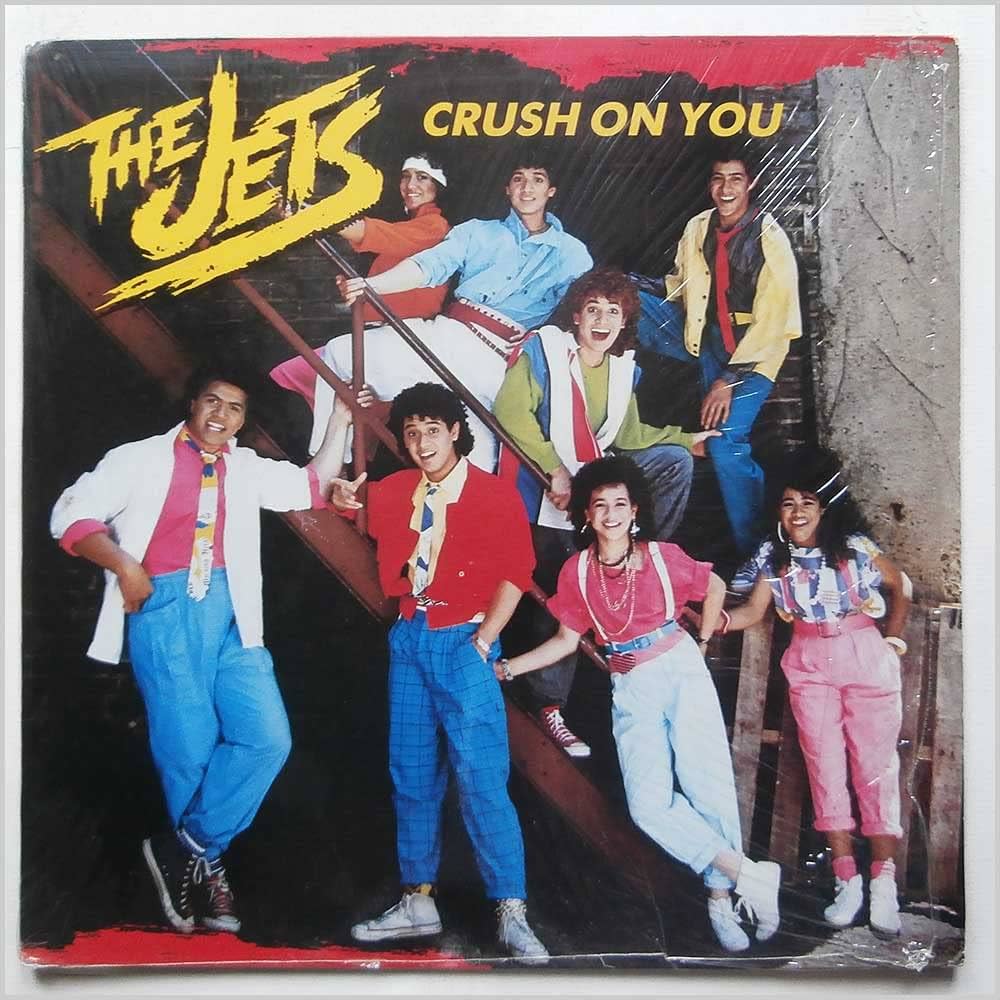
What Wang's Smithsonian framing names is the demographic fact that the chart positions encoded: The Jets were the first group of descent to crack the pop Top 10. Far East Movement's "Like a G6," the next AAPI act to do so, would not arrive until 2010, twenty-five years after the Jets' debut. The framing reading for this module argued that one of the modes of political work in Asian American popular music is "presence": showing up in the cultural picture at all, in venues and chart positions and national imagination that had not had room for the community before. "Crush On You" is the cleanest case in this module of presence as political work, and the cleanest case of presence detached from representation. The song is not about being Tongan, or Pacific Islander, or LDS, or about immigration. It is about a teenage crush. The video and the sleeve image you are looking at are deliberately a generic mid-1980s American pop image; the family was read by audiences variously as Latino, mixed, or simply "ethnic," and the LDS and Tongan specifics are not carried into the music itself. The way the band entered the Top 10 was by fitting themselves to the existing pop format, and the chart position was the argument.
Things to listen for
The song is in the of D-flat (also written C-sharp major), in , at a of 120 : the standard mid-tempo dance-pop pulse of the mid-1980s. The album version runs 4 minutes 30 seconds; the music-video edit you are listening to runs 3 minutes 41 seconds. Lead vocals are by Elizabeth Wolfgramm, then thirteen years old, with extensive harmony backing from her sister Moana (then twelve), her brother Eugene, and the rest of the siblings layered into the vocal stack. LeRoy plays , Haini bass, Kathi keyboards, Rudy drums, Eddie percussion. The arrangement is built on a programmed drum-machine pattern (the LinnDrum's snap and bright synthesizers in the foreground), one of the signatures of the Minneapolis sound the production team came out of.
First, the of the lead vocal. Elizabeth Wolfgramm's voice carries the song. Listen to its register and its grain. She sings in a high, bright, head-voice-leaning soprano, with very little and a lot of clean tone, and she stays comfortably inside that register from the first verse through the choruses. The voice is unmistakably young. It is the voice of a thirteen-year-old, and the song is not trying to make her sound older; the production is built around the youthfulness of the lead, with thinner instrumental textures around her in the verses to leave room for her voice to sit at the top of the mix. Compare this to the soulful adult mezzo-soprano of Sugar Pie DeSanto in 1964, or to Nobuko Miyamoto's trained Broadway mezzo on A Grain of Sand; the Jets' lead voice is a different timbral world, and the difference is partly age and partly the specifically 1980s ideal of teen-pop sweetness that the production wants. The voice is also doing a particular kind of pop work: the track's lyric is "I've got a crush on you," a line a thirteen-year-old singing convincingly is part of the song's commercial premise. Pay attention to how the production keeps the voice front and center in the verses (compressed, slightly reverbed, no harmony) and how it stacks the harmony around her in the choruses (thicker, with the siblings' voices layered in close intervals), making her voice the soloist and the family the chorus.
Second, the and the production aesthetic of the Minneapolis sound. The arrangement is layered and thoroughly programmed: a LinnDrum pattern with a bright snare and tight hi-hat work pulses underneath the song, an Oberheim-style synth bass moves with the kick drum, a high synth-stab figure punctuates the chorus, and a clean part adds the funk-pop chord chops between the synth lines. Compared to the Bessie Smith and Tharpe recordings (where you can count the players in the room) or the Yellow Pearl trio recording (designed to be reproducible at a rally), this is a fundamentally different texture: not a band playing a song so much as an assembly of programmed and overdubbed parts whose individual sources are often hard to identify by ear. The drums are programmed; the bass is partly synth and partly electric; the synth-stab in the chorus is the same kind of figure Prince used on "Kiss" and that Jam and Lewis used across Control. This is what the term "Minneapolis sound" names as a production style, and the Jets' single is an excellent textbook case of it. Listen for how dense the texture is in the choruses (the siblings' stacked vocals, the synth-stab, the layered drum-machine fills) compared to how thin the verses are (drum machine, bass, light chord chops, lead vocal), and how the contrast between the two textures is carrying the song's energy.
Third, the and the use of standard pop structure. "Crush On You" is built on a textbook 1980s pop verse-chorus form: an instrumental introduction (the synth-stab figure), then verse 1, , chorus, verse 2, pre-chorus, chorus, instrumental break, chorus, chorus out. The pre-chorus is the one-line lyric "How did you know? 'Cause I never told. But you found out I've got a crush on you," sung over a rising harmonic motion that prepares the arrival of the title hook in the chorus proper. The form does not surprise; that is the point. In contrast to the long-form piece of the Jang recording (a fifteen-minute suite that moves between home base and freely improvised passages) or the through-composed protest folk songs on A Grain of Sand, the Jets' single is short, regular, and built for radio rotation. The song hits its first chorus around the 0:30 mark and returns to it at predictable intervals. The form's argument is that the song wants to be familiar: a pop-radio listener who has never heard "Crush On You" before should be able to predict, by the time the second verse starts, where the chorus is coming back. That predictability is part of what made the song reach the Hot 100 Top 10.
Fourth, the of the and the ear-catching synth-stab. Listen to the four-note synthesizer figure that opens the recording and that returns under the choruses. It is a short, bright, percussive figure, played on what sounds like an analog synthesizer with a sharp attack and a quick decay (an Oberheim-style sound, though the actual instrument used in the session is not documented in the sources this guide draws on). The figure functions as the song's instrumental hook. It is the part of the song that listeners can hum without the lyrics, the part other artists later borrowed (Aaron Carter covered the song in 1997, and the French house duo Alan Braxe and Fred Falke built their 2000 track "Intro" around a sampled loop of the figure), and the part that the music video opens with. The figure is also doing a specific kind of cultural work: it is the most clearly Prince-adjacent gesture in the recording, a synth stab that sits in the same sonic family as Prince's "Kiss" hook (Prince's recording came out two months earlier, in February 1986). The Jets and their producers were not copying Prince, but they were working inside the same Minneapolis production vocabulary, and the synth-stab is where you can hear that lineage most clearly. Pay attention to how the figure introduces the song (it announces the production aesthetic before any voice arrives), how it punctuates the choruses (it is the call, and the vocal hook is the response), and how it makes the song memorable (most listeners can hum the synth-stab even if they cannot recall the lyrics).
Reflective question
The framing reading argued that one mode of political work in Asian American popular music is "presence": showing up in the cultural picture at all, in venues and chart positions and national imagination that had not had room for the community before. "Crush On You" is the cleanest case in this module of presence as political work, and it is also a case where the political work is happening at the level of who appears in the picture rather than at the level of what the song says. Argue for or against the claim that a teen-pop song about a crush, performed by an immigrant Pacific Islander family band inside the dominant pop production aesthetic of the moment, is politically meaningful. Use specific moments in the recording to support your argument, and make sure your argument addresses the question of whether presence-without-representation counts as the political work the framing reading describes, or whether something more is required. There is no required answer; the question is what specific moments in this recording lead you to argue what you argue.
Sources for this section
Wang, Oliver. "Songs for Ourselves: An Asian American Music Playlist." Smithsonian Center for Folklife and Cultural Heritage, October 16, 2015. The source for the framing of The Jets as "the first group of Asian Pacific Islander descent to crack the pop Top 10" and the comparison to Far East Movement twenty-five years later. Wang is a sociologist at California State University, Long Beach, whose work on Asian American popular music is the closest thing the field has to a standard reference.
Bream, Jon. "Second Flight for the Jets." Minneapolis Star Tribune, April 4, 2010. Long-form local-press feature on the band's 25th-anniversary reunion at the State Theatre, with extensive interview material from Moana Wolfgramm (the band's "chief pilot," in her self-description) on the family's path to Minneapolis, the financial relationship with Don Powell, and the sibling-management dynamics across the run.
Walker, Joseph. "A Tongan Grass Skirt to Riches Success Story." Deseret News, February 14, 1989. Contemporary mid-career feature on the Jets, written for an audience of Utah LDS readers and unusually detailed on the family's pre-1985 path: the 1965 emigration from Tonga, the early years in San Francisco and Salt Lake City, the Polynesian Pearls touring act, the bankrupt hotel chain that stranded the family in Minnesota, and Don Powell's reluctant agreement to manage the band.
De los Reyes, Nathalie Tomada. "The Jets on family, music and legacy." Philippine Star, January 17, 2024. Contemporary interview with Moana Wolfgramm Feinga, Etivise Haunga, and Natalia Wolfgramm on the band's continued touring schedule, the Tongan musical inheritance, and the band's relationship to the Philippines, where the Jets toured for their 30th and 40th anniversaries.
"Crush on You (The Jets song)." Wikipedia. Heavily sourced article with the song's full personnel, songwriting and production credits, chart performance, music-video production details, and licensing history. The source for the personnel, the March 12, 1986 single release date, the chart peaks, and the songwriting credit to Jerry Knight and Aaron Zigman.
"The Jets (Minnesota band)." Wikipedia. Source for the family's full membership, the 1977 formation date, the Quasar / Polynesian Pearls naming history, and the band's chart history through 1990 and beyond.
"David Z (producer)." Wikipedia. Source for David Rivkin's role in the Minneapolis sound, his engineering work on Prince's Purple Rain, and his production partnership with Don Powell on the Jets' debut.
"Tongan Americans." Wikipedia. Source for the demographic and migration history of Tongan Americans in Utah, the LDS Church's role in shaping the migration, and the population concentrations in Salt Lake County and the Bay Area.
"The Church of Jesus Christ of Latter-day Saints in Tonga." Wikipedia. Source for the LDS Church's century-long missionary presence in Tonga, the 1968 organization of the first Tongan stake, and the statistic that by the 1970s about 19 percent of Tonga's population had converted to the LDS Church.
Discogs. Catalog entries for the various 7-inch and 12-inch releases of "Crush On You" (MCA Records, 1986). Source for the catalog numbers, production credits across the single's pressings, and the remix lineage.
"Songs for Ourselves: An Asian American Music Playlist." Smithsonian Folklife Magazine, October 16, 2015. (See Wang above.)
SongBPM and Tunebat. Listener-facing key and tempo databases that derive their analyses from the Spotify audio-features API. Source for the song's reported key (D-flat major / C-sharp major), tempo (120 BPM), and time signature (4/4). Audio-features estimates of this kind have known limits but are reasonable starting points for the structural-paragraph analysis above.