CSU East Bay · Music Department
MUS 302 · What to Listen for in Music
Module 3: Latin Diasporic Traditions · Listening Guide · Track 4 of 5
Track 4 Selena, "Bidi Bidi Bom Bom" (1994)
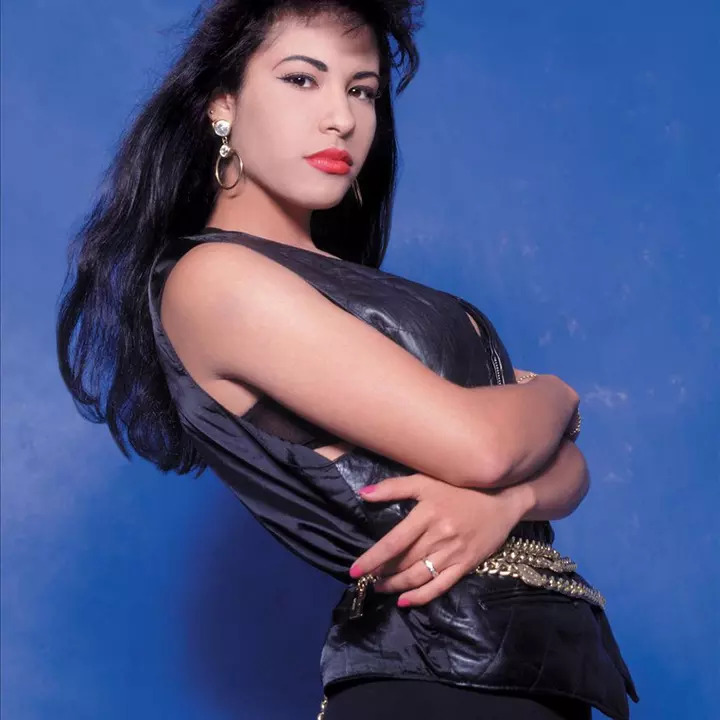
Context
Selena before the song: Lake Jackson, Corpus Christi, Selena y Los Dinos
was born in on April 16, 1971, the youngest of three children of , a former Tejano singer who had played in a 1960s band also called Los Dinos, and Marcella Ofelia Samora. The family spoke English at home; Selena learned to sing in Spanish phonetically, before she could speak the language fluently, because her father wanted her to be able to perform for the Spanish-speaking audiences he knew were the future of the music. By 1980 the Quintanillas were running a restaurant in Lake Jackson called Papa Gayo's and the children were performing there as a family band. The 1980s oil glut pushed the restaurant into bankruptcy. The family moved to in 1981 and reorganized as a working touring band: nine-year-old Selena on lead vocals, her brother A.B. (then sixteen) on bass, her sister Suzette (then thirteen) on drums. They named the group Selena y Los Dinos, after the father's old band.
For most of the 1980s the band played weddings, quinceañeras, county fairs, and the dance halls of South Texas. They recorded for small regional labels (Freddie, Cara, GP) before signing with the new in 1989. Selena was eighteen. By then she had already won the Tejano Music Awards' Female Vocalist of the Year as a fifteen-year-old in 1986 and was on her way to ten consecutive Female Entertainer of the Year wins. Her brother began producing the band's records and writing most of the songs. Her father Abraham Quintanilla Jr. ran the family's recording, management, and merchandising operation, eventually formalized as . Her husband , the band's lead guitarist, joined Selena y Los Dinos in 1990 and married Selena in 1992. The backup vocalist and dancer joined in 1988 and would co-write many of her biggest songs. The band was, throughout her career, almost entirely a family business with a small number of close collaborators.
What Tejano cumbia was: conjunto and polka, the Colombian rhythm, the synthesis of the 1990s
is the Mexican American popular music of South Texas and the Texas-Mexico borderland, with roots reaching back to the meeting of Mexican folk song with the German, Czech, and Polish traditions that European immigrants brought to central Texas and northern Mexico in the late nineteenth century. The earliest recorded Tejano forms are (small ensemble built on and , working class, dance hall), (the bigger horn-and-dance band of the 1940s and 1950s, often middle class and aspirational), and and (the Mexican song traditions absorbed wholesale). What pulled all these threads together into the genre that the 1990s would call "Tejano" was, in part, the arrival of .
Cumbia was Colombian. The framing reading covered its Caribbean-coast Afro-Indigenous roots. By the mid-1940s, Colombian musicians like Luis Carlos Meyer Castandet had taken cumbia to Mexico, where it merged with local big-band practice and over the following decades became the most widely played dance rhythm in Mexican popular music. The Texas-Mexico border absorbed the same wave. By the late 1980s and early 1990s, Tejano cumbia was the most commercially viable strain of Tejano music, and the bands that defined its sound (La Mafia, Mazz, Selena y Los Dinos) were producing cumbia records that fused the Colombian rhythm with Tejano accordion and bajo sexto, mainstream production, , electric guitars, and contemporary and reggae. , the album this listening guide's track is from, sits squarely in that 1990s synthesis: a Tejano cumbia album produced like contemporary pop, sung in Spanish, aimed at a young audience that had grown up bicultural and bilingual.
The recording: a soundcheck in 1992, AMEN Studios in 1993, a four-chord cumbia loop
"Bidi Bidi Bom Bom" started as a soundcheck improvisation. Selena y Los Dinos were touring in 1992 to support Entre a Mi Mundo, the album that had broken Selena commercially. At a soundcheck in Seguin, Texas, with A.B. running a cumbia bass figure and Chris Pérez sketching a guitar part, Selena began improvising in English: "If I was a fish, under the sea, I would swim, swim, swim to you," and "itty bitty bubbles." The "itty bitty bubbles" mutated, over subsequent soundchecks, into "bidi bidi bom bom." Pete Astudillo and Selena rewrote the lyric in Spanish, A.B. arranged it, and the song was tracked at the San Antonio studio of producer Manny Guerra (sometimes called AMEN Studios) over the late summer and fall of 1993, alongside the rest of the album. The producer was A.B.; the engineer was Brian Moore.
Amor Prohibido was released by EMI Latin on March 13, 1994. "Bidi Bidi Bom Bom" was released as the second single on July 31, 1994.
Reception, the Astrodome, and what came after
"Bidi Bidi Bom Bom" reached number one on the Billboard Hot Latin Songs chart on October 22, 1994 and held there for four consecutive weeks, Selena's second consecutive number-one single after the album's title track. The album Amor Prohibido became the first Tejano record to reach number one on the Billboard Top Latin Albums chart and stayed in the top five for ninety-eight consecutive weeks. The song crossed beyond the Tejano core audience: it was the second-most-played song on Latin radio in Los Angeles in October 1994, fifth in New York, sixth in San Francisco, ninth in Washington, D.C. By the end of the year Selena had won four Billboard Latin Music Awards. In March 1995, Selena Live! won the Grammy for Best Mexican-American Album, the first Tejano album by a woman ever to win in the category.
On February 26, 1995, Selena performed at the Houston Astrodome for the Houston Livestock Show and Rodeo before a televised audience of more than 60,000 people. She closed her set with a disco medley, performed in a sequined purple jumpsuit she had designed herself; "Bidi Bidi Bom Bom" was sixteenth in the set. The concert is now known as her last televised performance. On March 31, 1995, five weeks later, Selena was shot and killed at a Days Inn motel in Corpus Christi by Yolanda Saldívar, the former president of her fan club, after a meeting in which the family had confronted Saldívar over financial discrepancies in the boutique she had been managing. Selena was twenty-three years old. The English-language album she had been recording with EMI was completed posthumously and released as Dreaming of You in July 1995. It debuted at number one on the Billboard 200, the first predominantly Spanish-language album by a Latin artist ever to do so. "Bidi Bidi Bom Bom" became, after her death, one of her two or three most-played songs and one of the most widely recognized recordings in late-twentieth-century Latin pop. The song has since been covered by artists across genres and languages, sampled in and tracks, and performed in tribute concerts that draw the same kind of crowd that filled the Astrodome.
Things to listen for
The recording is in the of B-flat , in 4/4 , at a of approximately 90 , the moderate cumbia walking groove. The full runtime is 3 minutes 29 seconds. The harmonic vocabulary is unusually small (a four-chord repeats almost the entire song); the form prompt below works through it in detail.
First, the of Selena's voice against the band. Selena's lead vocal is conversational and direct, sitting in a comfortable mezzo range, with the slight Spanish-language phrasing of a singer who learned to sing in Spanish phonetically before she spoke the language fluently and is therefore careful with each consonant. The voice is unornamented compared with the gospel-trained or operatically-trained voices of other singers across the course (compare with the voice of Celia Cruz on Quimbara, which fills the room with a different kind of declamatory force). Selena's vocal is closer to the speech-derived intimacy of contemporary pop. Behind her, the band's timbre is unmistakable as 1990s Tejano cumbia: synthesizer pads where an earlier Tejano record might have used accordion, an (Chris Pérez's) playing a clean, treble-heavy, slightly surf-tinged figure that is part rock en español and part Tejano lead, and live percussion mixed close together, the cumbia güiro scrape running through the entire track. Listen for what feels traditional in the timbre and what feels like 1994.
Second, the , and specifically the role of the percussion section. The most important rhythmic element in a cumbia is not the drum kit but the güiro scrape, the dragged-and-tapped pattern of a notched stick that gives the cumbia its characteristic "chu-chu-cu-chu" forward motion. On this recording, the güiro is in the foreground throughout, sometimes layered with a cowbell-like accent, sometimes with a synthesizer-flavored hi-hat. The drum-kit pattern underneath is a moderate cumbia walking groove, not a Cuban -anchored pattern, and not a polka downbeat-and-offbeat. Listen for the güiro on every count, listen for how the bass walks through the chord changes (B-flat to E-flat to F to E-flat), and listen for the moments where the percussion suddenly opens up to make space for the vocal . The texture is layered but transparent; you can hear each element doing distinct work.
Third, the and the four-chord loop. The entire song sits on the same I-IV-V-IV ostinato, the same B-flat to E-flat to F to E-flat cycle, with no bridge, no key change, no second harmonic theme. What changes across the song is what is happening on top of that loop: an instrumental introduction, a verse where Selena describes the man passing by and her heart starting to race, a chorus where the band's chorus joins her on the title "bidi bidi bom bom" (the heart's palpitation), a second verse, the chorus again, an instrumental break, a final chorus. This is a structural cousin to the single-vamp form of Puente's "Oye Como Va" and Santana's "Oye Como Va," recorded thirty-two and twenty-four years earlier respectively: a dance-floor song that holds an audience by the strength of its groove and its hook, not by its harmonic motion. The repeating progression is the same harmonic logic that runs through American , and through the polka traditions that Tejano grew out of. Listen for what the song does to keep your attention across three and a half minutes of the same four chords.
Fourth, the of the lyrical hook and what onomatopoeia is doing here. The phrase "bidi bidi bom bom" is not Spanish, English, or any other language. It is the sound the heart makes when the singer sees the man pass by. ("Cada vez que lo veo pasar, mi corazón se enloquece, y me empieza a palpitar / Bidi bidi bom bom.") The choice of a non-linguistic title for a Spanish-language pop song, on a Tejano cumbia record, is doing two things at once. It is reaching for the same universal-readability that English-language nonsense pop syllables ("doo-wop," "shoop shoop," "do re mi") have always done in American pop, and it is grounding the song in the embodied physical fact of a heartbeat, which is the same in any language. The song is sung in Spanish, but it travels, partly because the title is a sound rather than a sentence. Listen for how Selena delivers the title phrase and for what the band's chorus does when they answer her on it; the on "bidi bidi bom bom" is where the song most clearly stops being a verse-with-chorus pop song and starts being a dance-floor singalong.
Reflective question
Selena learned to sing in Spanish before she could speak it fluently, performing a Mexican music for an audience that was Mexican American but spoke English at home. The framing reading argued that bicultural urban experience can itself be a musical condition; the Bataan track on this same module argued that bilingual codeswitching is one of the formal signatures of US Latin pop. "Bidi Bidi Bom Bom" makes a different choice. Its lyric is entirely in Spanish, its title is in no language at all, and its musical surface is a Colombian rhythm processed through a Texas border genre with American pop production. Pick one specific moment in the recording (the güiro scrape, an entrance, the chorus answer, a guitar figure, the way Selena delivers the title phrase) and argue from it about what this song's particular Tejano cumbia synthesis is doing. What does it mean for a Mexican American teenager from Corpus Christi to be the most popular Latin music star in the United States in 1994 with a song built on an onomatopoeia that crosses any language?
Sources for this section
"Bidi Bidi Bom Bom." Wikipedia, accessed 2025. Source for the song's history (origin in 1992 soundchecks during the Entre a Mi Mundo tour, transformation from "itty bitty bubbles" to "bidi bidi bom bom"), the songwriting credit (Selena Quintanilla Pérez and Pete Astudillo), the July 31, 1994 single release date, the four-week run at number one on the Billboard Hot Latin Songs chart starting October 22, 1994, the airplay rankings on Latin radio across major US cities in October 1994, and the genre description (Tejano cumbia with rock en español and reggae influences). Also source for the analytical claim that the song is in B-flat major, in 4/4, at approximately 90 BPM, and built on a I-IV-V-IV ostinato.
"Amor Prohibido." Wikipedia, accessed 2025. Source for the album's release date (March 13, 1994 on EMI Latin), recording location (Manny Guerra's studio in San Antonio, beginning September 1993), six-month recording period, A.B. Quintanilla as producer, and chart performance (first Tejano album to reach number one on Billboard Top Latin Albums, 98 consecutive weeks in the top five).
"Selena." Wikipedia, accessed 2025; "Selena." Britannica; "Selena Quintanilla: The Life and Legacy of the Queen of Tejano Music." Texas State Historical Association Handbook of Texas; "Selena Quintanilla Pérez." Humanities Texas; "Selena." EBSCO Research Starters. Sources for the biographical detail (Lake Jackson birthplace, April 16, 1971; Quintanilla family band history; the 1981 family move to Corpus Christi after Papa Gayo's bankruptcy; her teenage Tejano Music Awards wins; the 1989 EMI Latin signing; the 1992 marriage to Chris Pérez; the February 26, 1995 Houston Astrodome concert; her murder on March 31, 1995; the posthumous release of Dreaming of You in July 1995 and its number-one debut on the Billboard 200).
Patoski, Joe Nick. "The Secret History of Texas Music: Bidi Bidi Bom Bom (1994)." Texas Monthly; "Did Selena Really Write 'Bidi Bidi Bom Bom' at Soundcheck?" MovieMaker, 2021; "Selena Was Inspired By Fish When She Wrote 'Bidi Bidi Bom Bom.'" Various interview-based reconstructions of the soundcheck origin in Seguin, Texas in 1992, with A.B. Quintanilla on bass, Chris Pérez on guitar, and Selena improvising "if I was a fish, under the sea" and "itty bitty bubbles" before Pete Astudillo helped translate the song into Spanish.
"Pete Astudillo." Wikipedia, accessed 2025. Source for the BMI co-writing credit on "Bidi Bidi Bom Bom" and "Amor Prohibido," the 1994 BMI Songwriter of the Year honor, and the 1996 Songwriter of the Year tie with Juan Luis Guerra.
Cumbia, Mexican cumbia, and Cumbia (Colombia) Wikipedia articles, accessed 2025; "A Brief History of Cumbia," LA Phil program note; "Colombian Roots: The Migration and Evolution of Cumbia," Borderlore, 2022; "Cumbia Mexicana: A Brief History," Passion of the Weiss, 2023. Sources for the Colombian Caribbean-coast origins of cumbia, the 1940s migration of cumbia to Mexico through Luis Carlos Meyer Castandet and the orchestras of Rafael de Paz and Tony Camargo, and the development of regional Mexican cumbia variations including the Tejano cumbia that this listening guide's track sits in.
Peña, Manuel. The Texas-Mexican Conjunto: History of a Working-Class Music. Austin: University of Texas Press, 1985. The standard scholarly history of the conjunto and orquesta traditions of South Texas, the institutional and aesthetic ground on which Tejano music developed.
"Selena Live! The Last Concert." Wikipedia, accessed 2025. Source for the February 26, 1995 Houston Astrodome concert (televised on Univision, attendance figures variously reported between 61,000 and 66,994, the disco medley closing the set).
YouTube, "Bidi Bidi Bom Bom" (Selena - Topic, uploaded 2017-03-27, from the Ones compilation, ℗ 1994 UMG Recordings, Inc.). Source for the recording's runtime (3:29), producer credit (A.B. Quintanilla III), and engineer credit (Brian Moore).
Tunebat, "Bidi Bidi Bom Bom" by Selena; SongBPM, "Bidi Bidi Bom Bom - 1994 Version" by Selena; Chordify, "Bidi Bidi Bom Bom" chord analysis. Sources for the technical music-theory parameters (key, tempo, chord progression).