CSU East Bay · Music Department
MUS 302 · What to Listen for in Music
Module 4: Asian American Traditions · Listening Guide · Track 4 of 5
Track 4 Invisibl Skratch Piklz, "Invisibl Skratch Piklz Vs. Da Klamz Uv Deth" (1996)
Context
Daly City and the Filipino American Bay Area
The are a turntablist crew from Daly City and the surrounding Filipino American neighborhoods of San Francisco and the Peninsula. The community they came up in is a specifically post-1965 community. The 1965 Immigration and Nationality Act removed the national-origin quotas that had restricted Filipino immigration to small numbers since the 1934 , and reopened legal on terms that favored family reunification and professional occupations (doctors, nurses, engineers). Filipino immigration to the United States in the half-century after 1965 was the largest national-origin Asian immigration of the period; by the 2020s, Filipinos were the second-largest Asian American group nationally and the largest in California. The Bay Area absorbed a substantial share of that population. Daly City, a small suburb just south of San Francisco, became (and remains) one of the densest Filipino American communities in the United States; in some Daly City neighborhoods, more than half the households are Filipino. Vallejo, Union City, South San Francisco, and parts of San Mateo and Santa Clara counties carry adjacent concentrations.
The post-1965 Filipino American Bay Area of the 1970s and 1980s was a community of recent immigrants and their American-born children. The children, by the time the older ones were teenagers in the late 1970s, were the first second-generation Filipino American Bay Area cohort large enough to constitute a recognizable youth culture. They listened to the radio Black Bay Area listened to (the disco and and early electro of KSOL and KDIA), they were close to the Bronx-rooted that arrived on the West Coast over the late 1970s and early 1980s, and they had access, through their immigrant parents' working incomes, to consumer audio equipment that previous immigrant generations had not. The combination produced what the sociologist Oliver Wang calls "a lived practice through which that community ... came to understand itself, as a community": a Filipino American mobile DJ scene built around speakers, turntables, light systems, vinyl records, and frequent dance parties.
The mobile DJ scene, 1980 to 1990
Wang's Legions of Boom: Filipino American Mobile DJ Crews in the San Francisco Bay Area (Duke University Press, 2015) is the central scholarly account of the scene the Piklz came up inside. are DJs who own portable sound systems and lighting rigs and who travel between events providing the audio and visual production for weddings, baptisms, graduation parties, school dances, and what Wang calls the scene's centerpiece: the multi-crew showcase. By the early 1980s, dozens of Filipino American mobile DJ crews were operating in the Bay Area, with names like Ultimate Creations, Spintronix, Images Inc., Sound Explosion, Electric Sounds, and Non-Stop Boogie. The crews were almost entirely young Filipino American men in their teens and twenties, often pooling speakers and turntables across multiple households' garages. The garage parties Wang describes (the DJ rig set up in a corner of the garage, often on top of a washing machine and dryer; lighting hung from the rafters; a sound system that could fill a backyard) were the scene's training ground. By the mid-1980s, the showcase format had grown into events with multiple crews competing or sharing a stage in front of audiences in the hundreds or low thousands.
The mobile DJ scene was a community institution before it was a music-industry one. Wang's central sociological claim is that the scene "did not 'emerge' out of the Filipino community so much as it was a lived practice through which that community ... came to understand itself, as a community." The scene gave young men opportunities to assert masculinity (the hauling and setup of heavy speakers, the public performance, the competitive jockeying for status between crews), to gain social standing inside their generational cohort, and to build economic relationships that did not depend on the social capital their immigrant parents' generation often lacked. The scene was almost entirely outside the white American music-industry view of what was happening in the Bay Area in the 1980s; few crews appeared in record stores or on the radio, and the mainstream Bay Area press through the late 1980s contains essentially no coverage of it. It was happening in garages, school gyms, hotel ballrooms rented for an evening, and the Filipino American community institutions (church halls, hometown associations) that booked the crews for the steady work of weddings and baptisms. By the early 1990s the scene was beginning to decline: aspiring scratch DJs were splitting off into their own subscene, the showcase format was losing crowd to the emerging single-DJ club format, and the early 1990s economic downturn was reducing the corporate and event spending the mobile crews depended on.
From the mobile scene to scratch DJing, 1989 to 1993
Inside the 1980s mobile crews, a younger generation of DJs was paying close attention to the scratch DJing coming out of New York hip hop: the techniques developed in the in the late 1970s by (the inventor of ), (the inventor of juggling and the punch phrase), and (whose work on Herbie Hancock's "Rockit" in 1983 brought scratch DJing into mainstream visibility). For a generation of teenage Filipino American DJs working inside the mobile scene, scratching offered a different model of what a DJ could be. Where the mobile DJ's role was to play records that audiences danced to, the scratch DJ's role was to manipulate records as instruments themselves: to stop, reverse, repeat, and fragment a sample so that the turntable became a percussion instrument and the records became raw material rather than finished product.
In 1989, three Bay Area scratch DJs from inside that scene, all in their late teens, formed a crew called the Shadow of the Prophet. They were Richard Quitevis (, then 19, from Daly City), Mike Schwartz (, also from the Bay Area), and Apollo Novicio (, who had grown up in the before his family moved to Daly City). All three were Filipino American. By 1993 the crew had been renamed the Invisibl Skratch Piklz. The renaming roughly tracked the moment the crew began to position itself as something other than a hip hop DJ act: not simply DJs supporting an , but a self-contained ensemble in which the turntables were the instruments and the routines themselves were the music. Q-Bert won the US championship in 1991 (the first Asian American DJ and the first Bay Area DJ to do so) and placed second at the world finals; in 1992 Q-Bert, Mike, and Apollo competed as the Rocksteady DJs and took the world team title. They defended successive DMC titles in 1993 and 1994 until the Disco Mix Club asked them to retire from competition because the crew's dominance was discouraging other entrants.
Da Klamz Uv Deth and the 1996 X-Men battle
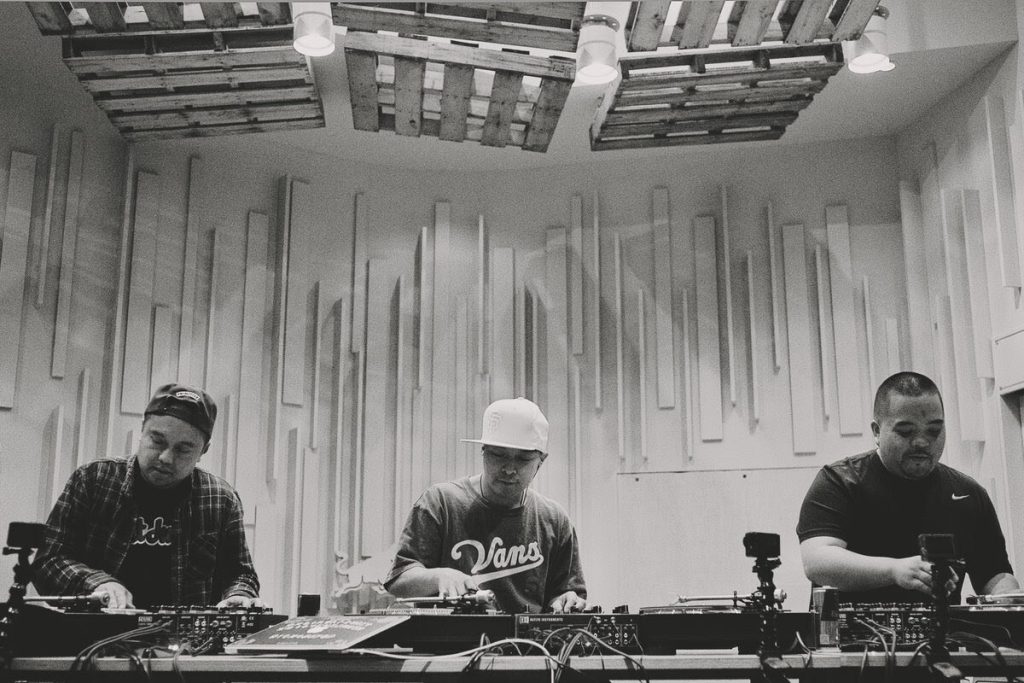
The recording you are about to hear is the studio document of the routine the Piklz performed in their 1996 battle against the X-Men (now the X-Ecutioners), a New York DJ crew that had been the Piklz's closest peers and rivals across the early 1990s competition circuit. The battle took place on July 27, 1996, at the Manhattan Center in New York, as a showcase performance for the founding event of the International Turntablist Federation (a DJ-led alternative to the DMC competition framework). The crew that performed for the Piklz that night was Q-Bert, Mix Master Mike, and Shortkut (Jonathan Cruz, who had joined the crew after Apollo's 1993 departure). The X-Men were Rob Swift, Roc Raida, Total Eclipse, and Mista Sinista. The battle ran across two team rounds plus solo segments; the Piklz's collective routine, performed on three turntables (with each DJ playing one turntable rather than the conventional pair), is what the studio recording captures.
"Invisibl Skratch Piklz Vs. Da Klamz Uv Deth" (Asphodel Records, 12-inch promo 1996, full release 1997) is, in the format the studio version codifies, a roughly fourteen-minute multi-section turntable composition. The piece is built entirely from played on three turntables, without the programmed drums, synthesizers, and studio overdubs that conventional pop production assumes; every sound on the recording is something one of the three DJs is producing in real time on their turntables and mixer. The piece moves through a series of named sub-routines (the "B!tch It's Curtains" segment is the most-discussed section in the crew's later interviews), each demonstrating a different team-DJ technique: one DJ producing a drum pattern by scratching a sample on a kick-and-snare loop, another DJ providing a bass line by scratching a low note on a held vinyl, a third DJ scratching a melodic figure or vocal sample on top. The structural technique the Piklz pioneered was the division of the conventional band's labor across three turntables: a drummer, a bassist, and a soloist, but each playing the turntable rather than a drum kit, an electric bass, or a melodic instrument.
The recording is canonical because it is the rare ISP studio document of work the crew otherwise mostly performed live. The Piklz' working catalog through the late 1990s was dominated by mix tapes (the Shiggar Fraggar Show series, released by the Bay Area independent Hip Hop Slam) and by tool-records they manufactured for other DJs (the breaks records: Battle Breaks, Booger Breaks, Toasted Marshmallow Feet Breaks). "Da Klamz Uv Deth" was one of the few times the crew sat down in a studio and recorded a finished piece of the kind they typically only performed live, in part because the 1996 battle had crystallized a routine the crew thought worth documenting in its complete form. The recording's enduring status inside is partly that it is the studio version of the X-Men battle (the bootleg video of the live performance circulates in DJ communities to this day; the studio recording is its companion document), and partly that it is the central recorded statement of what the mid-1990s ISP could do.
Things to listen for
Unlike the previous tracks in this module, "Da Klamz Uv Deth" is a purely instrumental turntable piece, played live on three turntables and three mixers by Q-Bert, Mix Master Mike, and Shortkut, without sung lyrics, programmed beats, or a fixed song . The piece runs about fourteen minutes in its 12-inch full studio version (shorter edits exist). Every sound on the recording is something one of the three DJs is producing in real time by manipulating a vinyl record on their turntable and routing the resulting signal through their mixer. There is no in the conventional sense, because the piece is not built on a fixed harmonic progression; the pitched material comes from samples whose pitches the DJs alter by hand, on the fly, by speeding up or slowing down the turntable. The is essentially 4/4 throughout, with the shifting between sub-routines but generally sitting in a hip-hop-typical mid-tempo zone (roughly 90 to 100 ) when the crew is playing the breakbeat-derived passages. Listen, on first pass, for how the piece holds together as long-form composition without a chorus to return to; then listen, on second pass, for the four prompts below.
First, the of the scratched sample. Listen to what a sample sounds like when it is scratched. The DJs are taking pre-existing recordings (a horn stab, a vocal phrase, a percussion hit, a figure from some 1970s funk record) and manipulating them in real time by moving the vinyl back and forth under the needle. The resulting sound has a specific timbral signature: the original sample's pitch is bent rapidly upward and downward as the record speeds up and slows down, the sample's attack and decay are chopped into rhythmic fragments by the crossfader, and what was a held melodic note becomes a percussive burst. Compare this to the timbre of the saxophone solos on Jang's recording or the lead vocal on "Crush On You": in those tracks, the timbre is the natural sound of a wind instrument or a singing voice, more or less untouched by post-production. Here, the timbre is a manufactured artifact: the sound of a vinyl sample being physically manipulated. The crew is, in effect, treating the turntable as a percussion instrument that can play any sound recorded on a record, and the timbral question for the listener is what those sounds become once the DJs have pulled them out of their original musical context and into rhythmic isolation. Pay attention to how a sample's character changes between its first appearance (when you can usually hear what record it came from) and its later reuse (when the scratching has fragmented it past recognition).
Second, the and the division of labor across three DJs. The piece's central technical innovation, the one Wang and other turntablism scholars name as the Piklz's signature contribution, is the team-DJ format in which three turntablists divide the conventional band's labor across three turntables. One DJ at any given moment is functionally the drummer (producing a kick-and-snare or breakbeat-derived rhythm by scratching a percussion sample), one is functionally the bassist (producing a sustained or rhythmic low-pitched figure by manipulating a held bass note on a record), and one is functionally the soloist (scratching a melodic figure, a vocal sample, or a horn stab over the top). The three roles rotate across the routine. The DJ who was the drummer in the first sub-section may become the soloist in the second; the DJ who was producing the bass line may pick up the percussion. The texture is, in this sense, three-voice polyphonic , with each voice produced by a single performer working a single instrument (one turntable, one mixer). Compare this to the salsa orchestra on the Cruz recording (where the labor is divided across maybe fifteen musicians playing a dozen different instruments) or the layered Minneapolis-sound production on the Jets recording (where the labor is divided across a programming team and the production is fixed in advance): here the band is three people, the instruments are three turntable rigs, and the parts are being assigned and reassigned in real time. The texture is doing the analytical work of arguing that three DJs constitute an ensemble and that the turntable is an instrument that can take on the role of any other instrument depending on what the DJ chooses to do with it.
Third, the form, and the absence of the verse-chorus structure that organized the previous track. "Da Klamz Uv Deth" is not in form. It is built as a sequence of named sub-routines, each one running roughly thirty seconds to two minutes, separated by transition passages where the texture thins out and one of the DJs sets up the next section. The form is closer to a suite (the long-form structure of the Jang recording, with its sequence of contrasting sections moving between blues home base and freely improvised passages) than to anything in pop. The crew has discussed the routine in interviews as having distinct sections, including the "B!tch It's Curtains" sub-routine that becomes the centerpiece in many later live versions, but no published score or section-by-section timestamp document of the recording exists in the scholarly literature this guide draws on. What you can do as a listener is mark the points at which the texture changes substantially, the points at which the rhythmic pulse shifts, and the points at which one of the DJs steps forward as the soloist while the other two drop into a supporting groove. Each of those transitions is a section boundary. The form's argument is that turntablism can sustain long-form composition: that a fourteen-minute piece can hold listener attention without falling back on song-form repetition, the way an extended jazz piece does, by leaning on the contrast between sub-routines and the rotation of musical roles across the ensemble.
Fourth, the of using rhythmic material as a found object. The samples the Piklz are scratching are largely African American musical material: 1970s funk and records, hip hop vocal phrases, drum breaks, the "Funky Drummer" and "Apache" breakbeats that are foundational to hip hop production. The crew is, in this sense, working with the same African American song forms and rhythmic vocabularies that Jang built his 1984 piece around, and that the framing reading argued was the substrate of all the music in this module. The political and aesthetic question the recording raises (and the question Wang's scholarship and Rob Swift's reflections in interviews keep returning to) is what it means for a Filipino American crew, working inside an art form invented by African American DJs in the South Bronx, to take that art form to the level of formal virtuosity the Piklz brought to it. Rob Swift, the New York DJ who became close to Q-Bert in the early 1990s and who later said the East Coast DJs initially "didn't know there were DJs out there" in the Bay Area, has discussed the cross-coastal and cross-racial dialogue that the 1990s scratch DJ scene constituted. The Piklz' work is built on Black musical material, openly and explicitly, and it is also a Filipino American crew's contribution to the form: the gesture is not an appropriation but a participation, in the same tradition that the Yellow Pearl trio participated in (the protest-folk tradition built primarily by African American and white-American folk-revivalists) and that Jang participated in (the avant-garde jazz tradition built primarily by African American musicians). Listen for which samples are visibly Black vernacular material and which are not, and ask what the recording's relationship to Black hip hop is doing.
Reflective question
The framing reading argued that one mode of political work in Asian American popular music is the building of long, sustained dialogues with African American musical traditions. The Piklz' recording is the clearest case in this module of dialogue-by-virtuosity: a Filipino American crew taking an African American art form to its formal limit, working inside the form rather than alongside it, and being recognized internationally for the work. Pick one sub-routine in the recording (any thirty-second to two-minute passage) and argue for what is happening in that passage that could not happen anywhere else. Some candidates: a moment when the three DJs lock into a polyphonic groove and you can hear the labor division clearly; a moment when one DJ scratches a melodic figure that the other two follow; a moment when the texture thins to a single DJ and the other two drop out; a transition into a new sub-routine where the rhythmic feel changes. Why does this moment work the way it does, and what does it tell you about what turntablism can do as a musical form? The recording is a collective improvisation that is simultaneously a finished composition; pick the moment where you can hear both at once.
Sources for this section
Wang, Oliver. Legions of Boom: Filipino American Mobile DJ Crews in the San Francisco Bay Area. Duke University Press, 2015. The central scholarly account of the Filipino American Bay Area DJ scene, based on Wang's oral history interviews with mobile crew members across more than a decade, and the source for the analytical framing this listening guide depends on (the mobile scene as community-constituting practice, the line from mobile DJ to scratch DJ to ISP, the gendered and class-specific shape of the scene). Wang is associate professor of sociology at California State University, Long Beach.
Wang, Oliver. "Bands of Brothers: Invisibl Skratch Piklz." Asian American Writers' Workshop, 2016. Long-form essay on the Piklz specifically, with detailed treatment of the 1991-94 DMC titles, the 1996 X-Men battle, the team-DJ format, and the cross-coastal dialogue with the X-Men/X-Ecutioners. Source for Q-Bert's 1991 DMC US title (first Asian American and first Bay Area DJ to win), for the 1992 Rocksteady DJs world team title, and for the DMC's request that the crew retire from competition.
Meline, Gabe. "How The Invisibl Skratch Piklz Put San Francisco Turntablism on the DJ Map." KQED, September 19, 2024. Long-form Bay Area public-media history of the crew, drawing on interviews with founding ISP manager Alex Aquino, founding member DJ Apollo, Shortkut, and X-Ecutioners DJ Rob Swift. Source for the prehistory of the crew (the Turntable Dragons, the 1993 Bomb Hip-Hop Party billing as Invisibl Skratch Piklz), for Apollo's account of the late-70s Filipino mobile scene Aquino describes, and for Swift's account of how the East Coast DJs first became aware of Q-Bert in 1991.
Fintoni, Laurent. "How Invisibl Skratch Piklz put together their debut album after 20 years." Fact, September 8, 2016. Interview with Q-Bert, Shortkut, and D-Styles around the release of The 13th Floor (Alpha Pup, 2016), the trio's first studio LP. Useful as a contemporary perspective on the legacy work and the ongoing relationship between the surviving Piklz and the larger turntablism community.
"Invisibl Skratch Piklz." Wikipedia. Source for the founding chronology (1989 as Shadow of the Prophet; 1993 renaming; lineup changes through the 1990s), the discography (Vs. Da Klams Uv Deth 1997 on Asphodel, the Shiggar Fraggar Show series on Hip Hop Slam, The 13th Floor 2016), and the documentation of the Vestax and Ortofon design consultancy work that produced the equipment many present-day turntablists use.
"Invisibl Skratch Piklz Vs. Da Klamz Uv Deth." Discogs. Pressing-by-pressing catalog data across the 1996 promo 12-inch and the 1997 full Asphodel release; source for the personnel attribution (Q-Bert, Mix Master Mike, Shortkut) and for the recording's status as a studio document of the 1996 battle.
DJ Q-Bert. "Invisibl Skratch Piklz Vs. Da Klamz Uv Deth (Digital)." djqbert.com. Q-Bert's own first-person framing of the 1996 ITF battle and the recording: "Performed on 3 turntables, this is a must hear composition for all skratchers and skratch lovers!" Source for the three-turntable performance specification (one turntable per DJ, rather than the conventional two per DJ) the crew used for this routine.
Pray, Doug, dir. Scratch. Palm Pictures, 2001. The documentary film that put the 1990s scratch DJ scene, including extensive Piklz footage, into mainstream visibility. Useful background for the Piklz's place in the larger turntablism story, even though it is not a primary source for the 1996 recording.