CSU East Bay · Music Department
MUS 302 · What to Listen for in Music
Module 5: European American Immigrant and Working-Class Traditions · Listening Guide · Track 1 of 5
Track 1 Frankie Lymon and the Teenagers, "Why Do Fools Fall in Love" (1956)
Context
Five boys, three blocks, one school
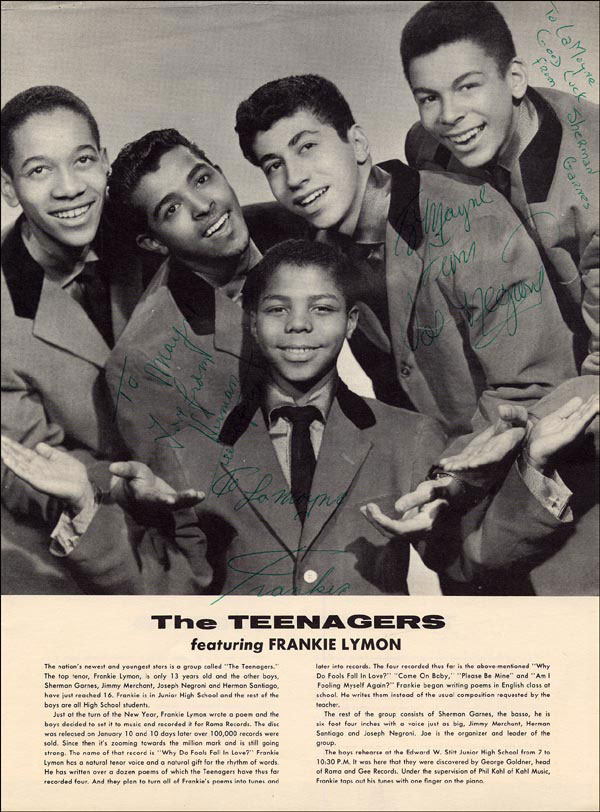
The group that made this record came out of three square blocks in , the working-class neighborhood at the northern tip of Manhattan, in the early and mid 1950s. All five members went to the same school, Edward W. Stitt Junior High School on West 164th Street, and rehearsed in the school auditorium and in apartment-building hallways with the heavy-painted plaster walls that gave the harmonies the small natural reverb the city's singers had been working with since the late 1940s. The original four (before Lymon joined) called themselves first the Ermines, then the Coupe de Villes, then the Premiers, and the original lineup was already an early example of the cross-ethnic neighborhood integration this module is about. (a first , born 1941, Puerto Rican, lived on 164th Street) and (a baritone, born 1940, Puerto Rican) had been singing together in another local group called the Ermines; (a second tenor, born 1940, Black, from the ) and (a bass, born 1940, Black, six feet four inches tall and the group's organizer) had been singing in another local group called the Earth Angels. The four came together in 1954 as the Premiers. By the convention of mid-1950s New York they would have been described as an integrated group not because anyone in 1954 was making a political point about it but because the kids on West 164th Street did not have separate streets to rehearse in.
was the youngest. He was born in Washington Heights on September 30, 1942, the son of a truck driver and a maid who sang in the local group the Harlemaires; Frankie and his brothers Howie, Lewis, and Timmy sang with the Harlemaire Juniors as a children's gospel-quartet act before he was ten. By 1954, at twelve, Lymon was also playing in a group his older brother Howie led called the Esquires, with Howie on congas (the group played the Apollo Theater's Amateur Night at least once); the Esquires were scheduled to play a talent show at Stitt Junior High that year and Lymon walked into the same school auditorium where the Premiers were rehearsing. He asked to sing along. He had a high, light voice that sat naturally above the four older boys' parts, an exuberant performing instinct from the Harlemaire Juniors gospel act, and (from the Esquires) a comfortable working ear for the Latin-rhythm side of the upper-Manhattan music scene Santiago and Negroni had grown up in. Over the course of 1955 he became a regular sixth (and then, when Santiago took on more of the harmony arrangement work, the regular fifth and lead) member of the group.
The audition, the song, and the recording
"Why Do Fools Fall in Love" came out of a stack of love letters. A neighbor in the building where Sherman Garnes lived gave the group a packet of letters his girlfriend had written to him in verse form, hoping the boys would find something to set to music. They pulled the phrase "Why do birds sing so gay?" out of one of them. ("Gay" here carries its older nineteenth- and early-twentieth-century meaning: lighthearted, cheerful, full of joy. The word would not begin to be used widely as a term for same-sex orientation in mainstream American English until roughly the late 1960s and 1970s. To a 1955 listener, the line read as "Why do birds sing so happily?".) Herman Santiago, who had been writing songs using a 1-6-2-5 chord pattern (a four-chord cycle close to the one this song settled into), worked the line up into a song originally called "Why Do Birds Sing So Gay?" with himself singing lead. , the lead singer of another New York doo-wop group called the Valentines, was working as a talent scout for the producer 's Rama and Gee Records, and brought the Premiers in to audition for Goldner in late 1955. Santiago was sick that day, and Lymon, who knew everyone's parts because he had been at every rehearsal, stepped in. Goldner heard Lymon's high tenor on the lead and immediately told the group that Lymon should keep the part. The lyrics were rewritten over the next several weeks (the title shifted from "Why Do Birds Sing So Gay" to "Why Do Fools Fall in Love"; some of the verse lines were rewritten to fit Lymon's range), the group renamed itself the Teenagers at the suggestion of the session's saxophone leader , and the song was recorded at in Manhattan in November 1955.
was a small independent New York label that Goldner had founded the year before. Goldner himself was the son of Eastern European Jewish immigrants (his mother Rose from Poland, his father Adolph from Austria) who had arrived in New York during the long 1881-1924 wave of Jewish migration the framing reading traces; he grew up in the Turtle Bay neighborhood on Manhattan's east side, attended Stuyvesant High School, and entered the entertainment industries in his twenties through dance halls and ballroom promotion, then Latin-music recording (, 1948), then small-label R&B (Rama and Gee, 1953-54), along the same route the framing reading's Thread 2 traces from the late nineteenth-century Lower East Side through , Broadway, and the . The label sat inside a larger cluster of small New York independents (Tico, Rama, Gee, and later End, Gone, and Roulette) that Goldner ran out of an office on Tenth Avenue. After the Teenagers' success Goldner moved his offices to 1650 Broadway, on the same Broadway block as the Brill Building proper at 1619, and in May 1958 the same 1650 Broadway address would house the new offices of , the publishing company at the center of the Brill Building songwriting generation Track 3 of this module anchors on. Goldner specialized in young Black and Latino vocal groups; his roster across the mid 1950s included the Valentines, the Crows, the Cleftones, the Wrens, the Heartbeats, Little Anthony and the Imperials, the Flamingos, and many others. The Teenagers were Goldner's biggest commercial success. He produced the session himself and put his own name on the song's songwriting credit alongside Lymon's, cutting Santiago and Merchant out of the credit they had earned. The session band was led by tenor saxophonist Jimmy Wright, the leader for Goldner's labels through the mid 1950s; the brief, jumping in the middle of "Why Do Fools Fall in Love" is Wright himself. The single was released on January 10, 1956, as Gee 1002, backed by "Please Be Mine." It reached number one on Billboard's R&B chart and number six on the , then number one in the United Kingdom in July. Sales reached roughly two million copies worldwide inside eighteen months.
Doo-wop as a Module 5 story
Three of the five members of the Teenagers were African American (Lymon, Merchant, Garnes) and two were Puerto Rican (Santiago, Negroni). None were the Italian, Irish, or Polish American working-class kids the module's third thread is built around. Doo-wop belongs in this module anyway, because the doo-wop story is at one and the same time a Black music story (which Module 2 carries) and a Puerto Rican music story (which Module 3 carries) and an Italian, Irish, and Polish American urban working-class story this module picks up while keeping the first two visible. The recording is not a self-contained Black and Puerto Rican production. It is a meeting of two of the four threads the framing reading lays out, with Black and Puerto Rican vocal labor as the material that both threads operated on. Thread 2, the Eastern European Jewish small-label music industry that ran from the late nineteenth-century Lower East Side through Tin Pan Alley and the Brill Building, is the production side of the recording: Goldner produced it, took the songwriting credit, and built his commercial career on it. Thread 3, the Italian, Irish, and Polish American urban Catholic working-class neighborhoods, is both the wider scene the recording came out of and the wider audience the recording reached.
The production-side pattern operates at the level of structural argument. The racialized credit and royalty dynamics that ran through the Tin Pan Alley industry and the Brill Building system meant that white-owned publishing companies and the songwriters they kept under contract retained most of the rights and most of the income while Black musicians did much of the actual making. "Why Do Fools Fall in Love" is a textbook case of that pattern at the small-label scale. Herman Santiago and Jimmy Merchant wrote the song. Goldner told the group at the recording session that "only two names could be listed on the copyright" (an industry-standard lie used to extract credit from inexperienced young artists), filed the copyright in 1956 listing himself and Lymon as the song's two authors, and cut Santiago and Merchant out of the writing credit entirely. The five Teenagers received roughly one thousand dollars total, split among them, for a recording that would sell more than three million copies. Goldner, an inveterate gambler, sold the song's rights in 1964 to Morris Levy, a mob-adjacent record-label owner who specialized in attaching his name to other people's compositions (the published credit on Levy's catalogue includes songs actually written by , Tommy James, and many others); from a 1965 copyright amendment forward, the published credit on "Why Do Fools Fall in Love" reads "Frank Lymon and Morris Levy." Levy collected one hundred percent of the song's royalties on the 1973 American Graffiti soundtrack and on the 1981 Diana Ross hit version. Santiago and Merchant tried to get royalties out of Goldner and Levy through the 1960s, got nothing, and were afraid to press the claims because Levy's mob ties made the threats of pressing such claims credible. The 1987 lawsuit Santiago and Merchant filed against Levy's estate, Big Seven Music, and Roulette Records won at the federal district court level in 1992 (the jury found the two had been cheated of their share; the lawyer Carl Person estimated the unpaid royalties at roughly four million dollars), and was reversed on appeal in 1996 on a statute-of-limitations technicality. The published credit today still reads "Frank Lymon and Morris Levy." The five Teenagers, the two Puerto Rican and three African American teenage boys whose voices made the recording and whose songwriting made the song, were paid the original thousand dollars and were paid no royalties.
Through the early and mid 1950s, the same urban Catholic working-class neighborhoods that had produced the Italian American tradition a generation earlier ( came up in Astoria, Queens; Sinatra in Hoboken; and a generation of Italian American singers in the same arc of Northeast cities) were now producing white street-corner harmony groups working in the same idiom the Premiers were working in. The Belmont Avenue neighborhood of the Bronx, a few miles south of the Teenagers' Washington Heights blocks, produced , four Italian American teenagers (Dion DiMucci, Angelo D'Aleo, Fred Milano, and Carlo Mastrangelo) named after the avenue itself, who would become the first Italian American rock-and-roll vocal group to break through nationally in the doo-wop idiom with "I Wonder Why" in 1958 and "A Teenager in Love" in 1959. South Philadelphia produced a parallel cluster of mostly Italian American groups ('s pre-Four Seasons groups the Variatones and the Four Lovers, and Fabian and Bobby Rydell on Cameo-Parkway). Bensonhurst and Bay Ridge in Brooklyn produced a third cluster. These groups overlapped with the Black and Puerto Rican doo-wop singers on radio playlists, on television (American Bandstand beamed out of Philadelphia from 1957 forward), on Alan Freed's package tours, and on the same record labels Goldner ran. The doors the Teenagers' commercial success cracked open in 1956 were the doors the Italian American doo-wop wave of 1958-1962 would walk through, and Goldner's extraction of value from young Black and Puerto Rican vocal groups was the business model that kept those doors open.
The audience completes the picture. The two million copies of "Why Do Fools Fall in Love" sold worldwide in the song's first eighteen months were bought disproportionately by teenagers in the same Italian, Irish, Polish, and Jewish American working-class Northeastern neighborhoods where the doo-wop groups themselves were rehearsing. The doo-wop scholars Anthony Gribin and Matthew Schiff have argued that the cross-ethnic urban scene the record came out of and the cross-ethnic urban audience it spoke to were structurally the same scene, defined less by who was singing on any given recording than by the racially mixed working-class urban neighborhoods of the Northeast as a coherent cultural unit.
The teen-idol career and the long aftermath
For about eighteen months Lymon was the most famous Black thirteen-year-old in the United States. The group toured constantly across 1956 and 1957: package tours organized by the disc jockey (who had given its public name and was Goldner's main promotional partner), television appearances on The Ed Sullivan Show and American Bandstand, a featured spot in Freed's 1956 film Rock, Rock, Rock!, and four more top-ten R&B singles in 1956 alone ("I Want You to Be My Girl," "I Promise to Remember," "The ABC's of Love," and "I'm Not a Juvenile Delinquent"). Lymon went solo in mid 1957 at Goldner's encouragement; Goldner had judged, correctly in commercial terms and disastrously in human terms, that Lymon was the marketable element and that the group around him was not. Within a year Lymon's voice had changed; the high tenor was gone; the hits stopped. He spent most of the next decade cycling through addiction, multiple short marriages, attempted comebacks, and military service. He was found dead of a heroin overdose at his grandmother's apartment in Harlem on February 27, 1968, at the age of twenty-five. Sherman Garnes died of complications from heart surgery in 1977 at thirty-six; Joe Negroni died of a brain hemorrhage in 1978 at thirty-seven. Herman Santiago and Jimmy Merchant lived into their seventies, performed sporadically together as the surviving Teenagers, and spent decades in court trying to recover the songwriting credits the previous section traced.
The recording itself has stayed in heavy circulation since 1956. It was inducted into the Grammy Hall of Fame in 2001 and ranks at number 314 on Rolling Stone's 500 Greatest Songs of All Time list. Within the next decade after its release, the song was being covered by white singers (Gale Storm, the Diamonds), by British singers (Alma Cogan), and across Latin American and Caribbean Spanish-language doo-wop scenes; Diana Ross took her recording of the song to number seven on the pop chart in 1981 as her tribute to Lymon as her own teenage vocal model. Ronnie Spector and Diana Ross both later said in print that the high light voice they had used as teenage singers in the early 1960s was directly modeled on what they had heard Lymon do on this recording, and George Clinton has said the same about the formation of the Parliaments. and Billy Joel have named Lymon as an influence in interviews, and Berry Gordy modeled the Jackson 5's vocal-group format on the Teenagers, with Michael in the Frankie Lymon role. Inside the Italian American doo-wop tradition, the connection ran particularly close: Dion DiMucci has said that learning of Lymon's death in 1968 was the moment he himself decided to get clean of heroin. The Module 3 track ("Gypsy Woman," 1967) carries the same neighborhood-doo-wop inheritance forward into the of the late 1960s; Bataan grew up in East Harlem, about sixty blocks south of Lymon's Washington Heights, idolized Lymon as a teenager, and modeled his own voice on Lymon's.
Things to listen for
The song is in the of D-flat , in , at a of about 174 at the fast eighth-note level (or about 87 BPM if you feel the slower underlying doo-wop pulse, two beats to a bar). The harmonic vocabulary is a single four-chord cycle that repeats almost continuously: a I-vi-IV-V progression (in D-flat: D-flat, B-flat minor, G-flat, A-flat), the chord pattern so closely identified with mid-1950s doo-wop that musicians now call it the "doo-wop changes" or the "fifties progression." The runtime is 2 minutes 21 seconds. Personnel: Frankie Lymon (lead vocal), Herman Santiago and Jimmy Merchant (tenor harmony), Joe Negroni (baritone), Sherman Garnes (bass and the bass-vocal lines), plus Jimmy Wright (tenor saxophone) and his small band of piano, bass, and drums. Bear in mind across these prompts that the tempo is fast for a doo-wop ballad and that the song's most striking feature is how much vocal information Lymon, at thirteen, is carrying alone on the lead.
First, the of Lymon's voice. Lymon was thirteen at the recording session. His voice is a high, light tenor (the upper register adults call "boy soprano," though the term is misleading; this is a pre-pubescent boy's natural chest voice rather than an adult ), and the timbre is a particular one you can hear all the way through this recording. Listen to how Lymon attacks the front of each phrase. There is no audible breath catch and no warm-up ; the voice is just suddenly there on the note, fully formed, with a forward placement that lets the syllables cut through the harmony group behind him. There is also a slight rasp at the top of his range, a quality you would not hear in a classically trained boy soprano and that comes from the gospel-quartet singing of his childhood. The combination, light forward tone plus gospel-trained edge, is what Ronnie Spector and Diana Ross both spent their teenage years trying to learn from this recording. The timbre is also part of what makes the song's lyric work the way it does. A grown man singing "Why does my heart skip a crazy beat, for I know it will reach defeat" is a different song from what Lymon sings; the lyric is about romantic disappointment, the singer is thirteen, and the gap between the world-weary lyric and the boy's voice is part of the joke and part of the charm.
Second, the , and specifically the role of the bass singer at the song's two outer ends. The recording is built on the standard mid-1950s doo-wop texture: a lead voice out front, three or four backing voices on close , a small horn-and-rhythm-section band underneath them. What the recording does that not every doo-wop record of the period does is foreground the at structural moments. Sherman Garnes opens the track. The first thing you hear is not Lymon and not the band; it is Garnes singing the descending nonsense-syllable bass figure "oo-wah, oo-wah, oo-wah, oo-wah" underneath the four-chord cycle, with the higher harmony voices coming in on top of him on the second pass through. The bass figure returns to close the song. Compare this to the texture of the Cooke recording in Module 1's Track 1, where the bass vocal sits low in the mix as a foundation; here the bass vocal is a structural feature, the song's bookends. Jimmy Wright's saxophone solo in the middle is the second structural foregrounding: about a minute and a half in, the vocal group steps back and Wright takes a short tenor solo over the same chord cycle, a feature that ties this recording to the tradition: the Black saxophone-led R&B style of the late 1940s and early 1950s, where the tenor saxophone solo was the recording's center of gravity. The texture sits in the middle of three traditions at once: the gospel-quartet harmony tradition, the jump-blues saxophone tradition, and the brand-new commercial vocal-group format that doo-wop was just settling into.
Third, the , and what the song does with it. The song is in form, sort of. More precisely it is a strophic-with-bridge form built almost entirely on the I-vi-IV-V chord cycle, with the cycle repeating across verses, choruses, the saxophone solo, and the outro. Track the cycle as you listen: every four bars the chord pattern returns to the top, and every form section (the bass-singer intro, the first verse, the title-line chorus, the second verse, the bridge, the sax solo, the final chorus, the outro) sits on top of the same cycle. This is one reason the song is so easy to sing along with: there is one chord pattern and it never changes. It is also one reason the song became the template for an enormous number of subsequent doo-wop records and, later, for the early-1960s pop records that the rest of this module touches: once you know the I-vi-IV-V cycle you can sing along to "Earth Angel," "In the Still of the Night," "Sh-Boom," "Stand by Me," "Every Breath You Take," and several thousand other songs. The song's one departure from pure repetition is the bridge ("Why does my heart skip a crazy beat, for I know it will reach defeat"), which uses the same chord cycle but in a slightly altered melodic shape over its second half, so that the return to the chorus feels like a small relief. The form is, in this sense, the song's most direct argument that a complicated thing can be built out of a simple thing repeated many times.
Fourth, the of the integrated lineup as it is audible on the recording, and what that integration sounded like to the audience the record reached. The Teenagers' lineup was, in 1955, racially mixed in a way that had almost no parallel in mainstream American commercial culture: three Black members and two Puerto Rican members, all five teenagers, all five from the same handful of blocks at the northern tip of Manhattan. The gesture is audible in the recording itself. Listen for the close harmony in the choruses. The two tenor voices behind Lymon (Santiago and Merchant) sit so tightly together in pitch and timbre that even an experienced listener has to work to hear them as two separate parts; the baritone (Negroni) is just below them; Garnes anchors the bottom. The harmonization itself, in other words, is the gesture: five voices sounding so close to one voice that the boundaries between them disappear. The political content of the song is nowhere in the lyrics; the lyrics are about romantic confusion. The political content is in the texture, in the fact that this is what the song sounds like when five teenage boys, three Black and two Puerto Rican, from one street in upper Manhattan in 1955, sing together.
The same gesture has a second audible life outside the recording, in the audience that received it. The two million copies of "Why Do Fools Fall in Love" that sold worldwide between 1956 and 1958 were bought in disproportionate numbers by the Italian, Irish, Polish, and Jewish American teenagers in the working-class Northeastern and Midwestern neighborhoods this module is about. Those white European-immigrant teenagers were learning, by listening to this record, that the music their cohort was making sounded like five Black and Puerto Rican voices from Washington Heights. The lesson stuck. Within two years the Italian American doo-wop wave was on the radio: Dion and the Belmonts' "I Wonder Why" in 1958 was in a vocal style audibly modeled on what Lymon's group had been doing, the same was true of Valli's pre-Four-Seasons records out of Newark, and the racially mixed audiences at the Brooklyn Paramount that Alan Freed's package tours drew were hearing Lymon, Dion, and Little Anthony on the same bill and absorbing the cross-ethnic urban scene as a coherent thing. The 1957 incident in which Lymon, on Alan Freed's ABC television show The Big Beat, was filmed dancing with a white teenage girl in the studio audience, and the immediate cancellation of the show by ABC under Southern affiliate pressure, is the moment the same audible gesture turned visible and politically unacceptable to white segregationist America. The recording could be heard but not seen. When it was seen, the country that had bought two million copies of the record turned the show off.
Reflective question
The framing reading argued that doo-wop in mid-1950s New York was, structurally, an integrated music: not because the singers thought of themselves as making a political point but because the urban neighborhoods they were making it in had Black, Puerto Rican, Italian American, and Jewish American teenagers on the same streets. "Why Do Fools Fall in Love" is the most famous example. Pick one specific moment in the recording (Sherman Garnes's bass-singer "oo-wah" intro, Lymon's first entrance on "Why do fools fall in love," the way the harmony group sits behind him on the title line of the chorus, Jimmy Wright's saxophone solo, the bridge where Lymon's voice strains slightly at the top of his range, the bass-singer return at the end) and make an argument for what that moment is doing musically and what it is doing socially. What is the moment teaching a 1956 listener about how a song can sound? What is the moment teaching the same listener, less directly, about who can sing together and who can be heard together? And does the political work of the moment depend on the listener knowing in advance who the five singers are, or does the sound itself carry the argument whether or not the listener knows?
Sources for this section
Warner, Jay. The Billboard Book of American Singing Groups: A History, 1940-1990. Billboard Books, 1992. The standard reference work on American vocal groups across the doo-wop era; the chapter on the Teenagers is a primary source for the group's pre-Lymon history (the Ermines, the Coupe de Villes, the Premiers) and the audition story.
Gribin, Anthony J., and Matthew M. Schiff. Doo-wop: The Forgotten Third of Rock 'n' Roll. Krause Publications, 1992. The most comprehensive scholarly survey of the doo-wop period; treats the Teenagers as one of three or four anchor groups of the New York scene, is the source for the chord-progression and texture analysis used here, and is the source for the cross-ethnic Northeastern urban scene claim (the racially mixed working-class neighborhoods of New York, Philadelphia, and other Northeastern cities as the structural setting for both the Black and Latino doo-wop groups and the Italian, Irish, and Polish American doo-wop groups that came up alongside them).
Jackson, John A. Big Beat Heat: Alan Freed and the Early Years of Rock & Roll. Schirmer Books, 1991. The standard biography of Alan Freed; covers the package-tour and television-appearance circuit through which Goldner's roster (including the Teenagers) reached a national white audience in 1956 and 1957, and is the source for the 1957 Big Beat ABC-television cancellation after Lymon was filmed dancing with a white teenage girl in the studio audience.
Scherman, Tony. “George Goldner, Record Man: Winning Big, Losing Bigger.” tonyscherman.substack.com, December 2023. Long-form profile of Goldner; source for the biographical details of his Jewish-immigrant family (Polish mother, Austrian father, Turtle Bay childhood, Stuyvesant High School, garment-district start), his small-label trajectory (Tico, Rama, Gee, End, Gone, Roulette, Red Bird), the move from Tenth Avenue to 1650 Broadway after the Teenagers' success, and the long downward arc into Morris Levy's mob-adjacent orbit. Incorporates Calvin Trillin's earlier reporting on the Teenagers' management.
DiMucci, Dion. The Wanderer: Dion's Story. With Davin Seay. Beech Tree Books / William Morrow, 1988. Reissued by Aurum Press, 2011. Dion DiMucci's memoir; source for the Belmont Avenue neighborhood, the formation of Dion and the Belmonts in 1957, his account of “Why Do Fools Fall in Love” as a foundational record for the Italian American Bronx doo-wop scene, and his account of getting clean of heroin after learning of Lymon's death in 1968.
Selvin, Joel, et al. “The First Italian American Rock and Roll.” Britannica entry on Dion and the Belmonts. britannica.com. Source for the claim that Dion and the Belmonts were the first Italian American rock-and-roll vocal group to break through nationally in the doo-wop idiom, and for the group's lineup and Belmont Avenue origin.
“The Four Seasons.” Vocal Group Hall of Fame, vocalgroup.org. Source for Frankie Valli's pre-Four-Seasons groups (the Variety Trio in 1951, the Variatones in 1954, the Four Lovers signing with RCA Victor in 1956 and releasing “You're the Apple of My Eye”), all working out of the same Newark Italian American street-corner scene.
Wang, Oliver. Legions of Boom: Filipino American Mobile DJ Crews in the San Francisco Bay Area. Duke University Press, 2015. Background on the broader Latino and Asian American teenage reception of mid-1950s New York doo-wop; not directly about the Teenagers but useful on the cross-ethnic circulation of the recording into Latin American and Filipino American teenage musical life.
Span, Paula. “The Long Wait for a Hit to Turn Gold.” The Washington Post, November 27, 1992. Long-form reporting on the Merchant and Santiago lawsuit against Morris Levy and his companies, the 1989 widow ruling on Emira Lymon, and the wider Goldner-and-Levy royalty system; source for the chronology of the 1980s and 1990s lawsuits.
Merchant v. Lymon, 828 F. Supp. 1048 (S.D.N.Y. 1993). The federal district court ruling that found Merchant and Santiago to be co-authors of "Why Do Fools Fall in Love" with Lymon; primary source for the "only two names could be listed on the copyright" detail Goldner gave the group at the recording session, the 1956 copyright filing in Goldner's and Lymon's names, the 1965 amendment transferring credit to Lymon and Levy, and the testimony that Merchant and Santiago feared Levy's mob ties. Reversed on appeal in 1996 (Second Circuit) on statute-of-limitations grounds.
Associated Press. “Jury Rules for Teenagers' Members in 'Fools Fall in Love' Lawsuit.” December 1992 wire report, archived at jonimitchell.com. Source for the 1992 jury finding in favor of Santiago and Merchant, the testimony that the group had received only one thousand dollars total for the recording, the recording's sales (more than three million copies), and the lawyer Carl Person's estimate of roughly four million dollars in unpaid royalties.
Michigan Rock and Roll Legends. “Frankie Lymon's Tombstone Blues, Part 6: The Decisions.” michiganrockandrolllegends.com, April 2021. Detailed chronology of the 1980s-1990s litigation, including the 1965 Goldner letter to the Copyright Office reassigning the songwriting credit to Levy, the 1984 Emira Lymon lawsuit, the 1987 Merchant and Santiago filing, and the 1996 appeal.
WERS 88.9FM. “Frankie Lymon (and the Teenagers): The Vault of Soul.” wers.org, 2022. Source for the list of singers and producers who have named Lymon as a vocal-model influence (Michael Jackson, Ronnie Spector, Diana Ross, the Beach Boys, Billy Joel) and for Berry Gordy's modeling of the Jackson 5's vocal-group format on the Teenagers.
“Why Do Fools Fall in Love (song).” Wikipedia. The article is well-cited and is the consolidated source for the song's chart history, the writing-credit lawsuit (Santiago and Merchant v. the Lymon and Levy estate, 1987-1996), the Grammy Hall of Fame induction in 2001, and the song's appearance in later films and on later recordings.
“Frankie Lymon.” Wikipedia. Source for Lymon's birth date (September 30, 1942, Washington Heights), the family's Harlemaires gospel-group background, the chronology of the group's name changes, and the circumstances of Lymon's death (February 27, 1968, Harlem, heroin overdose, age 25).
TeachRock. “Frankie Lymon: Why Do Fools Fall in Love?” teachrock.org. The Rock and Roll Hall of Fame's curriculum project; source for the detail that saxophonist Jimmy Wright gave the group its name, and for the song's release date of January 10, 1956.
Songfacts. “Why Do Fools Fall in Love? by Frankie Lymon & the Teenagers.” songfacts.com. Source for the audition detail (Santiago sick, Lymon stepping in to sing the lead), the Bell Sound Studios recording session, and Goldner's role in the songwriting-credit displacement.
Internet Archive. “Why Do Fools Fall in Love” 78-rpm single, Gee 1002, 1956. archive.org. The digitized original 78-rpm single is the source for the runtime, the personnel credit (“Frankie Lymon and the Teenagers with Jimmy Wright and his Orchestra”), and the matrix number (76083-A).