CSU East Bay · Music Department
MUS 302 · What to Listen for in Music
Module 5: European American Immigrant and Working-Class Traditions · Listening Guide · Track 2 of 5
Track 2 Joan Baez, "Mary Hamilton" (1960)
Context
At the Manhattan Towers Ballroom
In July 1960, went into the Manhattan Towers Hotel Ballroom on Broadway in upper Manhattan to record her debut album. The recording was made on the cheap, across four nights. The label was , a small independent established in 1950 by the brothers , who had founded it as a classical-music label and were just then opening a folk-music division. The producer, Vanguard co-owner Maynard Solomon, doubled as the album's liner-note writer. The recording engineer was Marc Aubort. The second guitar on six of the album's thirteen tracks was Fred Hellerman of the recently blacklisted folk group ; Hellerman does not play on "Mary Hamilton." It is just Baez on guitar and voice, alone in a room not built for recording, sitting on a chair.
Baez told Kurt Loder in 1983: "It took four nights. We were in some big, smelly ballroom at a hotel on Broadway, way up by the river. We couldn't record on Wednesday nights because they played bingo there. I would be down there on this dirty old rug with two microphones, one for the voice and one for the guitar. I just did my set; it was probably all I knew. Just put 'em down. I did 'Mary Hamilton' once, that was it. That's the way we made 'em in the old days. As long as a dog didn't run through the room or something, you had it." The recording she "did once" runs almost six minutes; it is the longest track on the album and the deepest commitment to a single ballad anywhere in her first three records. The album, Joan Baez, was released by Vanguard in October 1960 as VRS-9078 in mono and as VSD-2077 in stereo. It went gold (over 500,000 copies sold), stayed on the bestseller charts for more than two years, and was inducted into the Library of Congress in 2015, recognized for its "cultural, artistic and/or historical significance to American society and the nation's audio legacy."
Where the ballad came from
The framing reading places "Mary Hamilton" inside the Ulster Scots ballad tradition and inside 's nineteenth-century catalogue. The song is in that catalogue, one of the most popular ballads Child collected: he gathered twenty-eight distinct textual variants, more than for almost any other ballad in his five volumes. The story those variants tell is grim. Mary Hamilton, a personal attendant to the queen, has secretly given birth to a baby fathered by the king. She has drowned the baby. The crime is discovered. She is sentenced to hang. The opening stanzas describe her situation in the third person; a long middle section gives Mary her own voice in dialogue; a closing run of four to six stanzas hands the song over to Mary entirely, in first-person death speech, as she addresses her parents, the sailors who might carry news home, the women of the town as she rides to the gallows, and the queen herself with quiet defiance. The famous closing stanza:
Last night the queen had four Maries,
Tonight she'll have but three:
There was Mary Beaton and Mary Seaton
And Mary Carmichael and me.
The shift from third-person narration to first-person death speech is structural to the ballad. By the time Mary speaks that closing stanza naming the four Maries, the singer is no longer reporting on her; the singer is her. That first-person turn is one of the features that distinguishes Child 173 from neighboring ballads in the catalogue and one of the features Baez's recording will lean on.
The "Four Maries" reference invites a reading of the ballad as a historical narrative about , whose four child companions and ladies-in-waiting were indeed called the Four Maries (Mary Beaton, Mary Fleming, Mary Livingston, and Mary Seton). The historical record does not support that reading. None of the four Maries was named Hamilton; none was executed; the song's specific incident has no documented sixteenth-century Scottish parallel. One alternative origin theory, first proposed in the nineteenth century and still in circulation, locates the story instead in the court of Tsar Peter the Great in St. Petersburg in 1719, where one Mary Hamilton (a descendant of Scottish settlers in Russia, lady-in-waiting to the Empress and reportedly the tsar's mistress) was executed for infanticide. The most careful contemporary scholarship treats the ballad as a fictional composite: a story stitched together over time from fragments of more than one real incident, with the names, settings, and details drifting as different singers passed it along, until the version we now read in Child's catalogue is something no single historical event ever quite matched.
Two things made it possible for a 1960 American singer to record a Scottish ballad first written down in the eighteenth century. The first was the practice that Child belonged to. From the late eighteenth century through the early twentieth, a generation of scholars went out into rural communities to write down the songs people there were actually singing. The earlier collectors worked with pen and notebook; they would sit with a singer for an afternoon, ask her to sing a ballad through more than once, transcribe the words and the tune by ear, and note who had taught her the song and where she had learned it. Child himself never did fieldwork. He assembled his catalogue from earlier collectors' transcriptions and from printed broadsides, and worked from the Harvard library. walked the Appalachian hollows between 1916 and 1918 still using the pen-and-notebook method, transcribing songs by ear from the singers (he tried a phonograph and rejected it as too cumbersome and too intimidating to the singers). It was 's generation, a decade or two later, that brought portable recording technology into the practice; Lomax carried disc cutters and microphones through the rural American South for the Library of Congress in the 1930s and 1940s, recording singers who could not have visited a studio. The goal across all of these collectors was preservation: catch the songs and their singers before the radio and the gramophone reshaped what rural people sang. The output was a published canon: Child's five volumes, Sharp's Appalachian collections, the Lomax field recordings. By 1960, the canon was what an urban folk-revival singer reached for.
The second thing was that Child 173 was, as it turned out, not heavily preserved on the American oral side of the canon. Sharp's Appalachian expeditions did not turn up a version of "Mary Hamilton": the song was apparently not in active circulation in the mountain communities his guides led him to. "Mary Hamilton" reached American singers through other transmissions. Alan Lomax recorded Texas Gladden of Salem, Virginia, singing the ballad in August 1941 for the Library of Congress. The Scottish traveller singer of Aberdeen recorded a version in 1955, released on her 1956 Riverside album Songs of a Scots Tinker Lady and later anthologized on Caedmon's The Child Ballads 2 in 1961. The American folk singer Cynthia Gooding recorded a version in 1957 on the extended reissue of her Queen of Hearts album on Elektra. Baez has not, to my knowledge, named a single source for her version; her arrangement combines verse selections from several traditional texts and sets the action in Glasgow, where most published versions place it in Edinburgh. The Glasgow setting is one of Baez's small editorial decisions, of a piece with the way every folk-revival singer at the time worked: traditional ballads were treated as a shared repertoire that each interpreter could shape.
The Ulster Scots thread, the folk revival, and the urban Northeast
Students have read the long version of the thread in the framing reading: the early-eighteenth-century migration of Lowland Scots and Northern Irish Protestants into the backcountry the twentieth century would call , the ballad and traditions they carried with them, and the continuous and often-uncredited exchange with Black musical practice that reshaped those traditions into Appalachian old-time music, (the lineage Module 1 anchors with 's "I'm So Lonesome I Could Cry"), and . The point worth underlining for this listening guide is that the 1960 Baez recording is not an Appalachian recording. Baez did not grow up inside the Appalachian ballad tradition, and her version of "Mary Hamilton" did not come to her through family or community transmission. The recording reaches the thread from a different direction.
That different direction is the : an urban, mostly Northern, mostly college-educated movement of the late 1940s through the late 1960s, in which the ballad and song collections of the previous half-century were revisited and turned into the soundtrack of left political organizing. The revival came up in three cohorts separated by the McCarthy-era blacklist, and Baez recorded inside the third.
The first generation was born in the 1910s and rose to public attention in the late 1930s and 1940s through the Depression-era topical-song movement: writing songs about the Dust Bowl and labor organizing; co-founding the Almanac Singers with Guthrie in 1940 and the Weavers in 1948; the Weavers' "Goodnight, Irene" topping the charts in 1950. Their politics were openly left, and their songs supported labor unions, civil rights, and racial integration well before any of those positions were mainstream. In 1953, at the height of the postwar anti-communist panic, the first generation was effectively banned from American commercial radio and television. The mechanism was the publishing of Red Channels, a 1950 pamphlet from a private newsletter (Counterattack) run by three former FBI agents, which listed 151 entertainers and journalists with alleged Communist sympathies. Pete Seeger was named in it. Sponsors pulled advertising, the Weavers' planned television variety show was cancelled, their recording contract was dropped in 1951, and by 1953 the group could not book most concert venues and disbanded. Seeger himself was subpoenaed by the House Un-American Activities Committee in 1955 and convicted of contempt of Congress in 1961. Through the rest of the 1950s the first generation continued working at children's concerts, on college campuses, in union halls, on the Folkways Records label run by Moses Asch (who pointedly disregarded the blacklist), but they were shut out of the commercial mainstream of American popular music.
A bridge generation rose at the back end of the blacklist years. , born in 1930, was the central figure of this cohort: classically trained in Los Angeles, she turned to folk in 1950, and her 1956 debut album Odetta Sings Ballads and Blues was the recording that converted the next generation of young white folk-revival singers to folk music. Bob Dylan said directly that hearing Odetta in 1958 was what made him put down his and pick up an acoustic one. Joan Baez named her as a primary influence. The bridge cohort was small ('s folk-circuit work also belongs here), but their work made the next generation possible.
The second generation was born in the late 1930s and early 1940s, came of age between 1958 and 1965, and benefited from a fully built folk-revival infrastructure the older two cohorts had paid the political cost to establish. , Joan Baez, , and the commercially manufactured trio were the central names of the cohort. The cultural geography ran through Greenwich Village in New York and Harvard Square in Cambridge, with anchor venues like Folk City and Gerde's in the Village and in Cambridge (where Baez performed regularly across 1958 and 1959). The instrumental conventions were lean: acoustic guitar, , fiddle, , sometimes mandolin or upright bass, foregrounded lyrics, simple chord progressions, and a deliberate distance from the production gloss of commercial popular music. The annual , founded in 1959 by the impresario George Wein as a folk-music counterpart to the Newport Jazz Festival he had already established, became the revival's central national gathering. Baez first sang there in 1959, as a guest of Bob Gibson, and at her own headline set in 1960 she launched her national career.
The second-generation revival singers were urban Northerners reaching back through Sharp's published collections, the Lomax field recordings, the new commercial folk-revival LP catalogue, and (in this case, since Sharp had not collected Child 173 himself) the older Child catalogue directly, to a musical inheritance most of them did not grow up inside. The dynamic produced a particular kind of authenticity claim, criticized at the time and since, in which middle-class college students learned to sing rural ballads in a register that signified rural-mountain authenticity to their largely urban audiences. Bob Dylan, raised in a Jewish family in Hibbing, Minnesota, became the most famous practitioner of that mode (he recorded under a name he had taken from the Welsh poet Dylan Thomas; his birth name was Robert Zimmerman). Baez, born in Staten Island in 1941 to a Mexican father and a Scottish-English mother, raised across the country as her father's physicist career moved the family, was another. The Appalachian musical inheritance that came to her through the folk-revival pipeline was as much a chosen tradition as an inherited one. The arrangement she made of "Mary Hamilton," in this sense, sits one step further from the song's eighteenth-century Scottish source than a Texas Gladden or a Jeannie Robertson version (both of whom had learned their songs from family); Baez learned it from the books and records the revival had compiled.
Baez's heritage, Quakerism, and civil rights
Joan Chandos Baez was born on January 9, 1941, in Staten Island, New York, the second of three sisters (the youngest, Mimi Fariña, would later have her own folk-music career). Her father, Albert Baez, was a physicist born in Puebla, Mexico, who emigrated as a child with his minister father; he held a Stanford PhD and was a co-inventor of the X-ray microscope. Her mother, Joan Bridge, was the daughter of a Scottish-English Anglican priest. Both sides of the family carried strong religious traditions; the parents converted to during Joan's early childhood, and the daughters were raised inside a faith committed to pacifism and social action. Baez would identify with Quaker convictions for the rest of her life.
The biographical detail most relevant to this listening guide is the mismatch between Baez's outward folk-revival image (the "all-American girl" register her debut album was widely understood to occupy in 1960) and the Mexican American family she came from. She was racialized as Mexican by other American children well before she was a folksinger. She told Pete Seeger in conversation that as a girl "the only image I had of myself was of an ugly Mexican," and her childhood experience of school taunts and exclusion is described in her 1968 autobiography Daybreak as direct and continuous. Her later political consciousness came from the Quaker household and from the racism she experienced as a darker-skinned Mexican-American girl in mid-century California schools, in equal measure. Albert Baez was a working pacifist (he refused defense-industry employment and took the family to Iraq in 1951 on a UNESCO posting); the household was conscientiously anti-war; as a teenager Baez attended Quaker-meeting talks by the West Coast pacifist Ira Sandperl. By the time of the recording in July 1960, Baez was two years out of high school, and her commitments were in place.
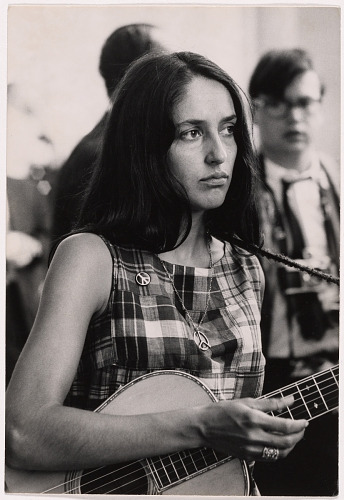
The continuity between the recording and the activism is visible even before the album was released. Baez had already decided, by the time she signed with Vanguard, that she would not play . When she toured the American South in the early 1960s, she played only at historically Black colleges; by 1963 she had appeared with Martin Luther King Jr. at multiple civil-rights events; on August 28, 1963, she sang from the steps of the Lincoln Memorial at the where King delivered "I Have a Dream"; in 1965 she founded the Institute for the Study of Nonviolence in Carmel, California; in 1964 she had already begun withholding the war-spending portion of her federal income taxes; in 1967 she was arrested at the Armed Forces Induction Center in Oakland for blocking the entrance and served a month in the Santa Rita Jail. The recording of "Mary Hamilton" in July 1960 is the work of a singer who, three years later, would be on the Lincoln Memorial steps in the photograph above. The song is not, on its surface, a political song. The political work it does is in the kind of music a Mexican American Quaker pacifist living in Boston in 1960 chose to make her career.
The choice itself is part of what this listening guide is asking students to think about. A performer with this particular family heritage could have made many different first records. Her father's Mexican-immigrant family and her mother's Scottish-English Anglican family both gave her access to musical traditions she might have anchored on. The album she made anchored on the Anglo-Scottish ballad tradition and on its American folk-revival reactivation, with a single Spanish-language song ("El Preso Número Nueve") at the end as the only direct nod to her father's family. The framing reading's central argument about Module 5 (that the European American musical traditions covered here are inseparable from the long American process by which their carriers came to be understood as white) lands with unusual force on this particular recording. Baez's standing inside that process (a Mexican American woman who would be photographed, written about, and remembered by mainstream American culture as the "Madonna of folk music," the white-image of the folk revival) is one of the cleaner examples in the module of how American whiteness gets made through musical practice as much as through politics.
Things to listen for
The recording is in the of B as performed on the album (published guitar arrangements occasionally transpose it to C or D for easier playing, but the actual recorded pitch is B). It is in slow at a of around 72 , with the guitar arpeggiating four notes per bar in an even, unhurried pattern. The runtime is 5 minutes 54 seconds, making this the longest track on the album and one of the longest popular-record performances of its release year. Personnel: Joan Baez, lead vocal and acoustic guitar, alone. The producer Maynard Solomon, recording engineer Marc Aubort, and second guitarist Fred Hellerman are all on the album as a whole; on this track it is just Baez, two microphones, and the Manhattan Towers Ballroom rug. As you listen, count nine verses across the six minutes. The ballad has no chorus and no instrumental break; the music repeats one melody nine times under nine different stanzas of lyric, and what you are listening for is what stays the same and what changes across the repetitions.
First, the of Baez's voice. Baez sings in the upper part of a soprano range, with a fast, narrow that runs continuously through every sustained note. The vibrato is part of what made her voice instantly recognizable in 1960 and is part of what has divided listeners about her work since: some hear it as a near-operatic technical achievement (a young singer with extraordinary breath control and pitch placement), and others hear it as too polished for a folk ballad about a peasant woman going to the gallows. Both readings have stayed in critical conversation about Baez for more than sixty years. Pay attention also to the diction. Each consonant is articulated cleanly; each word ending is shaped precisely; the vowels are placed forward in the mouth and stay open rather than collapsing into a regional or rural accent. The voice does not try to sound like a Scottish or Appalachian traditional singer (Texas Gladden's 1941 Library of Congress recording, for comparison, has a regional Virginia inflection and a much rougher tonal grain). Baez's voice is, instead, a finished concert instrument applied to a traditional text, and the gap between the instrument and the story is one of the recording's defining features.
Second, the . The texture is the thinnest available to popular recording: one voice, one acoustic guitar, room sound. The guitar plays a steady (the thumb on the bass note, the fingers picking out the upper notes of the chord in a flowing pattern), four notes per bar, with the chords changing every one or two bars. Baez's voice sits above the guitar at a clear dynamic distance; the two-microphone setup picks each up separately, with the voice noticeably forward in the stereo image and the guitar slightly back. Listen for the moments where the guitar fingerpicking changes register: at the start of each verse, the pattern resets on the chord (B major); at the half-verse point, the harmony pivots through the relative minor (G-sharp minor) and the (E major) before returning home. There is no second instrument and no harmony voice. Compare this to the texture of Track 1's recording, where five voices and a small horn-and-rhythm band crowd the same vocal space; here the recording leaves the singer almost alone in the room. The thin texture is part of what made the folk-revival aesthetic legible as authentic to its audience: this is what music sounds like, the recording argues, when the gloss of commercial production has been removed.
Third, the . The song is a strophic ballad: one melodic pattern repeated under each successive verse, with no chorus, no bridge, no instrumental break, and no key change. There are nine verses. Each is a four-line stanza of roughly the same metrical shape, set to roughly the same melody, with small variations in the melodic contour according to the syllable count of each line. The story unfolds across the nine verses as a narrative sequence: word reaches the queen of Mary's hidden baby (verse 1); the queen confronts Mary (verse 2); Mary admits to drowning the baby at sea (verse 3); the queen tells Mary to dress for a wedding in Glasgow (verse 4); Mary dresses in white (verse 5); the women of the town weep for her as she rides through Glasgow (verses 6 and 7); Mary asks for a kerchief over her face on the gallows (verse 8); the famous closing stanza names the four Maries (verse 9). Strophic form is the dominant form of the European narrative ballad and one of the oldest forms in Anglo-Scottish vernacular music; its logic is that the music's job is to carry the story, and that the listener's attention should be on what changes in the text from verse to verse rather than on what changes in the music. The recording's six-minute duration is itself a feature of strophic form: by 1960 commercial popular records ran around two to three minutes (Track 1 of this module, the Teenagers' "Why Do Fools Fall in Love," runs 2:21); a six-minute single-melody ballad was a deliberate departure from that commercial expectation and a signal that this was a different kind of recording, addressed to a different kind of audience and asking for a different kind of attention.
Fourth, the of restraint. The lyric is melodramatic: a young woman is hanged for infanticide; the king's child is dead; the queen presides over the execution; the dying woman's last words trail across the gallows and out to sea. Almost every other recorded popular form available to a 1960 singer would have made the singer's emotional response to the material part of the recording: the doo-wop lead's vocal break, the country singer's catch on the high note, the singer's bent pitch, the Broadway belt's escalating volume across a number's emotional arc, the singer's with a choir. Baez's recording does almost none of that. The vibrato stays steady through the dramatic high points; the volume holds across the six minutes; the tempo holds at the hanging; ornamentation stays minimal at the closing stanza. The gesture is one of withdrawal: the singer presents the story without commenting on it. The political content of the recording (if it has any) sits in that withdrawal. The recording leaves the work of interpretation to the listener: it presents Mary Hamilton's story in the first person, lets the verses pass at their own pace, and waits to see where the listener's sympathies arrive.
The restraint is also a political statement of a particular kind, even if "Mary Hamilton" is not on its surface a political song. The folk-revival aesthetic, as it was settling into its mature form by 1960, treated polished commercial popular music as something the revival was leaving behind, and treated unadorned traditional singing as a moral as well as an aesthetic choice. Baez's restraint inherits that aesthetic argument, and it inherits with it the politics the argument was attached to: a left-democratic politics of the people's own song against the music industry's product. By 1963 Baez would be on the Lincoln Memorial steps singing "We Shall Overcome." The recording in front of you, three years earlier, is by the same person making the same kind of musical choice, on a different repertoire, with the politics still mostly implicit. Listen for the way the music's reserve carries an argument the lyric does not name.
Reflective question
This listening guide has argued that Baez's restraint in "Mary Hamilton" is itself a kind of statement, and that her debut album anchors on the Anglo-Scottish ballad tradition rather than on her father's Mexican family or her mother's Scottish-English Anglican family. Take a position on one of these two questions and defend it from specific moments in the recording. First option: does the restraint of Baez's delivery serve the ballad, or does it hold the listener at a distance the ballad's emotional content does not deserve? Cite at least one specific verse or moment as your evidence. Second option: what would have changed if Baez had anchored her debut album on a different inheritance (the corridos and rancheras of her father's family, say, or contemporary topical songwriting in the mode Bob Dylan was about to introduce, or the gospel and rhythm-and-blues she could have heard on the radio in 1960)? What kind of folk-revival singer would she have become, and what would the 1960 album have lost or gained?
Sources for this section
Baez, Joan. And a Voice to Sing With: A Memoir. Summit Books, 1987. Reissued by Simon & Schuster, 2009 and 2012. Baez's autobiography; source for her account of the Quaker upbringing, the racism she experienced in school as a Mexican-American girl, her early activism, the Pete Seeger concert that catalyzed her decision to become a singer, the Boston University and Club 47 years, the recording of the first album, and her segregation-refusal touring policy. Also the source for the biographical details of Baez's parents (Albert V. Baez of Puebla, Mexico, co-inventor of the X-ray microscope; Joan Bridge of Scottish-English descent), the family's Quaker conversion during Joan's early childhood, the family's move to Cambridge for Albert's MIT position, and the 1959 Newport Folk Festival debut as Bob Gibson's guest.
Library of Congress National Recording Preservation Board. "Joan Baez (1960)." Essay accompanying the album's induction into the National Recording Registry, by Rick Massimo, published May 3, 2019. loc.gov. Source for the recording-history details (Vanguard's classical-to-folk pivot, John Hammond's lost bid to sign Baez to Columbia, the four-night ballroom-floor session, Hellerman's second-guitar contribution on selected tracks, Maynard Solomon's liner-note authorship), for the Baez quote "the only image I had of myself was of an ugly Mexican" as told to Pete Seeger, and for the institutional documentation of the album's release (October 1960; Vanguard VRS-9078 mono and VSD-2077 stereo), its 140-week run on the Billboard 200 peaking at number 20 after the 1963 commercial breakthrough of Joan Baez in Concert, the gold-record certification, and the 2015 National Recording Registry induction.
Loder, Kurt. "Joan Baez Interview." Rolling Stone, issue no. 393, April 14, 1983. Source for Baez's account of the Manhattan Towers Hotel Ballroom recording session ("It took four nights... two microphones, one for the voice and one for the guitar... I did 'Mary Hamilton' once, that was it"). Subsequently quoted in the LOC Recording Registry essay, the Analog Planet 2018 review, and most discussions of the album's recording history.
Hajdu, David. Positively 4th Street: The Lives and Times of Joan Baez, Bob Dylan, Richard Fariña, and Mimi Baez Fariña. Farrar, Straus and Giroux, 2001. The standard cultural history of the early-1960s folk revival as a personal and professional network; source for the Cambridge and Greenwich Village scene context, the Newport Folk Festival circuit, Baez's relationship to Bob Dylan and the Fariña circle, and the broader social-class and racial dynamics of the urban folk revival as a college-educated Northern movement.
Cantwell, Robert. When We Were Good: The Folk Revival. Harvard University Press, 1996. The standard scholarly cultural history of the postwar American folk revival. Source for the revival's institutional geography (Cambridge, Greenwich Village, Newport), the authenticity-claim apparatus through which urban Northern performers reactivated rural Anglo-Scottish and Appalachian repertoire, and the ideological commitments (left-democratic, anti-commercial, populist) that ran through the revival as a movement.
Child, Francis James. The English and Scottish Popular Ballads. 5 vols. Houghton Mifflin, 1882-1898. The canonical ballad collection. "Mary Hamilton" is Child 173, presented with twenty-eight textual variants (A through Bb in Child's catalogue). Source for the textual history of the ballad and the "Yestreen the queen had four Maries..." closing stanza in its earliest printed forms.
Lyle, Emily B., ed. Scottish Ballads. Canongate Classics, 1994; reprint Birlinn, 2001. Edited collection of the major Scottish ballads with scholarly apparatus. Source for the 1719 St. Petersburg execution of a Scottish-descended Mary Hamilton at Peter the Great's court as a possible source for the ballad; for the scholarly consensus that the surviving versions are a fictional composite rather than a record of any single historical event (the historical Mary Stuart's actual Four Maries being Beaton, Fleming, Livingston, and Seton, none of them Hamilton, and the 1565 Darnley marriage followed twenty months later by his murder leaving no plausible window for the song's "babe to the highest Stuart of all" infanticide); and for Baez's setting of the action in Glasgow where most published versions place it in Edinburgh.
"Mary Hamilton / The Four Marys (Roud 79; Child 173)." mainlynorfolk.info. The standard contemporary online reference for the ballad's recorded history. Source for the Texas Gladden 1941 Lomax field recording, the Jeannie Robertson 1955 / 1956 Riverside recording and its later anthologization on Caedmon's The Child Ballads 2 (1961) and Topic's reissue (1968), and the Cynthia Gooding 1957 Elektra recording.
English Folk Dance and Song Society. "Cecil Sharp" (introductory essay) and "Cecil Sharp's Appalachian diaries" (online resource). efdss.org. Source for Sharp's working method (transcription by ear with pen and notebook, the rejected experiment with the phonograph as too cumbersome and too intimidating to singers), his three Appalachian expeditions from 1916 to 1918 with Maud Karpeles, and the racially restrictive selection criteria his project applied to the communities he visited.
Association for Cultural Equity. "Lomax Digital Archive." archive.culturalequity.org. The complete John and Alan Lomax fieldwork collections, including the 1933-1942 instantaneous-disc recordings made for the Library of Congress's Archive of Folk Song (Lead Belly, Muddy Waters, Jelly Roll Morton, Vera Hall, Texas Gladden, Honeyboy Edwards, and many others), Alan Lomax's open-reel tape recordings from 1946 through 1991, fieldwork photographs, radio program transcriptions, and late-career film clips. Free public access; institutional home at Hunter College, City University of New York.
Garman, Bryan K. A Race of Singers: Whitman's Working-Class Hero from Guthrie to Springsteen. University of North Carolina Press, 2000. Background on the cultural politics of authenticity in the postwar American folk revival and the folk-into-rock tradition that follows; useful for understanding the folk revival's commitments to "the people's song" as a moral as well as an aesthetic stance.
National Portrait Gallery, Smithsonian Institution. "Joan Baez," NPG.94.245. Gelatin silver print by Ivan Massar (1924-2014), 1963; © Massar Studios LLC. Source for the hero photograph and its dating to the March on Washington for Jobs and Freedom on August 28, 1963. Photo used here under educational fair use with full attribution.
Bruce Eder. Review of Joan Baez. AllMusic. allmusic.com. Source for the critical characterization of the album's "most reserved and least confrontational" position inside the folk revival and the singling out of "East Virginia" and "Mary Hamilton" as the album's defining traditional-ballad performances.