CSU East Bay · Music Department
MUS 302 · What to Listen for in Music
Module 5: European American Immigrant and Working-Class Traditions · Listening Guide · Track 4 of 5
Track 4 Wendy Carlos, "Switched-On Bach" (1968)
Context
Switched-On Bach, and the piece this guide is built around
The album Carlos, , and recorded across 1967 and 1968 is a forty-minute selection of ten pieces by , performed on the and released by Columbia Masterworks in October 1968. The pieces were not all written at the same moment in Bach's life. Bach lived sixty-five years (1685 to 1750), worked in four major German cities (Arnstadt, Weimar, Köthen, and from 1723 until his death Leipzig), and produced an enormous body of work across nearly every musical genre of his time except opera. The ten pieces Carlos selected for the album range across roughly thirteen years of his output, from the Brandenburg Concerto No. 3 of 1721 to the Sinfonia from Cantata 29 and the cantata original of the Wachet Auf chorale prelude, both from 1731. Some of the pieces are sacred (the Cantata 29 Sinfonia, Jesu, Joy of Man's Desiring, Wachet Auf), some are pedagogical (the three Two-Part Inventions, the two preludes and fugues from The Well-Tempered Clavier), and some are courtly instrumental music (the Air on the G String, Brandenburg 3). What they share is the clarity that made Bach's music, by Carlos's own account, the ideal repertoire for the new instrument: each piece is built on independent melodic lines that the Moog could realize one at a time and then layer into a finished texture.
| Track | Piece | Composed |
|---|---|---|
| 1 | Sinfonia to Cantata No. 29, BWV 29 | 1731 (Leipzig) |
| 2 | Air on the G String, from Orchestral Suite No. 3, BWV 1068 | ca. 1730 (Leipzig) |
| 3 | Two-Part Invention in F major, BWV 779 | 1723 (Köthen / Leipzig) |
| 4 | Two-Part Invention in B-flat major, BWV 785 | 1723 |
| 5 | Two-Part Invention in D minor, BWV 775 | 1723 |
| 6 | Jesu, Joy of Man's Desiring, from Cantata BWV 147 | 1723 (Leipzig) |
| 7 | Prelude and Fugue No. 7 in E-flat major, from The Well-Tempered Clavier Book I, BWV 852 | 1722 (Köthen) |
| 8 | Prelude and Fugue No. 2 in C minor, from The Well-Tempered Clavier Book I, BWV 847 | 1722 |
| 9 | Chorale Prelude "Wachet Auf, ruft uns die Stimme," BWV 645 | cantata source 1731, chorale prelude published 1748 |
| 10 | Brandenburg Concerto No. 3 in G major, BWV 1048 (three movements) | 1721 (Köthen) |
This listening guide is built around the album's closing piece, Brandenburg Concerto No. 3 in G major, BWV 1048. Carlos and Folkman placed it last on the album because it was the longest, most ambitious, and most commercially attention-getting of the ten realizations. Bach sent the manuscript of the Brandenburg Concertos from his post in the small German court town of Köthen to the Margrave Christian Ludwig of Brandenburg-Schwedt in Berlin in March 1721, with a French-language dedication offering "six concertos with several instruments" for the Margrave's consideration. The package was, in effect, a job application from one of the most accomplished working musicians in Europe to a noble patron with a private orchestra. The Margrave never replied. The six concertos were filed in the Brandenburg court library, played there at most once or twice, and only rediscovered in the nineteenth century, by which point the genre they belonged to was already a museum object. Today they are widely regarded as some of the most consequential pieces of orchestral music ever composed, and one of the clearest distillations of the late style.
The third concerto in the set, , BWV 1048, is structurally unusual even by Bach's standards. It is scored for nine string parts (three violins, three violas, three cellos) plus on and bass. There are no winds and no designated solo instrument: the nine upper strings circulate between the roles of (small soloistic group) and (full ensemble) throughout the piece, with the lines passed in and out of small instrumental sub-groups inside the larger ensemble. The first and third movements are fast and built on (a recurring full-ensemble passage alternating with episodes of more soloistic development). The middle movement is two chords. Bach wrote, literally, an Adagio of two chords, a from A minor to B major, with a over the second. He intended the performers to improvise something in between. Modern performances handle the two-chord adagio in widely different ways, from a minimal pause on the cadence to extended cadenza-length improvisations of a minute or more.
The piece's two outer movements are built on tight counterpoint: independent melodic lines moving simultaneously, weaving in and out of each other, each line a complete musical idea on its own. Counterpoint is the central organizing principle of Bach's compositional thinking and the central feature of his style that makes him a particular kind of difficult to perform well: each line has to be heard as a complete musical statement, and all the lines together have to add up to a coherent harmonic and rhythmic argument. The texture is sometimes described as horizontal music, in the sense that the lines run side by side across time rather than stacking vertically as chords. In a live performance, the difficulty is real-time coordination among nine string players. In Carlos's 1968 recording, the difficulty is different and is the subject of the first part of this guide.
Carlos before the album
The musician who made the recording is , born in Pawtucket, Rhode Island on November 14, 1939, and raised in a Massachusetts working-class household with no professional musical background. She built her first electronic instrument at fourteen, a small monophonic oscillator from a magazine schematic, and entered in 1958 on a double major in music and physics, graduating in 1962. She then enrolled in the master's program in music composition at Columbia University in New York, where she studied with and at the and took her degree in 1965. Carlos was inside the most established American institution for academic electronic music at the moment when the discipline was still defined by the , a room-sized programmable that produced sounds via punched paper-tape control, and by the European-influenced compositional aesthetic the center's senior figures had inherited from their training. Most of what came out of Columbia-Princeton in the early 1960s sounded, to the public ear, deliberately strange and difficult; the avant-garde aesthetic summarized in his 1958 essay "Who Cares If You Listen?" was the dominant institutional voice. Carlos found the aesthetic alienating from the start.
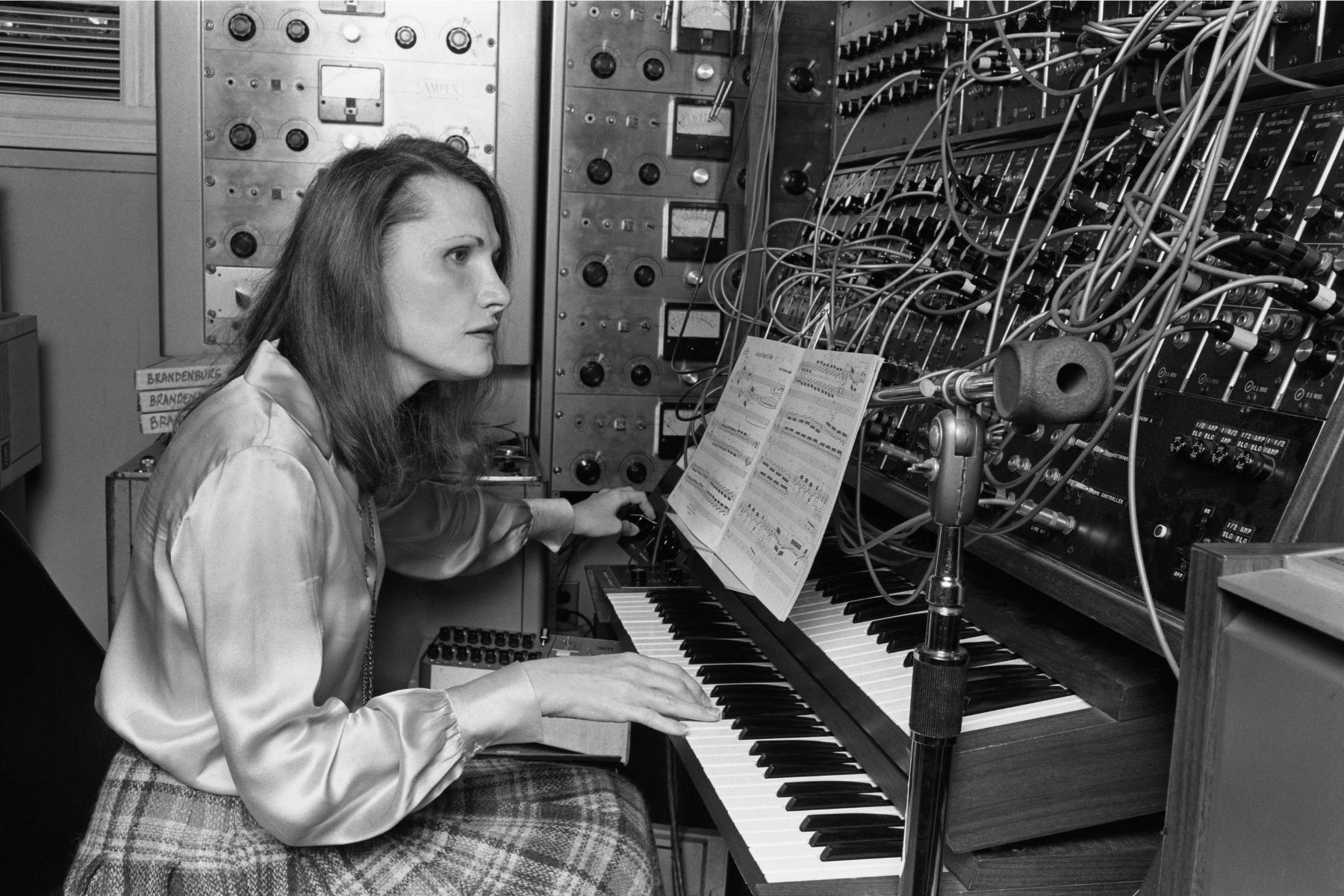
While she was completing her Columbia degree, Carlos was also working as a recording engineer at Gotham Recording Studios in Manhattan, which is where she met Rachel Elkind, a former singer and the executive secretary to president Goddard Lieberson, who lived in the same Upper West Side apartment building. In October 1964 Carlos attended the Audio Engineering Society convention at the New York Hilton, where the engineer was demonstrating prototype modules of a new he had begun building in his shop in Trumansburg, New York. Carlos and Moog began a correspondence, and across 1966 and 1967 Carlos worked as one of Moog's principal early customer-collaborators, suggesting modifications to the instrument's design, testing prototypes, and acquiring modules as she could afford them. By 1967 her home studio in her Upper West Side apartment contained a custom-built Moog modular synthesizer Moog had assembled to her specifications. Elkind heard Carlos's early synthesizer experiments at home, including a Moog realization of Bach's in F major, and proposed making a full album. Elkind became the album's producer and brought the project to Columbia Records' classical-music division.
The Bach choice was strategic. Carlos has said in interviews across the decades that she chose Bach because Bach's music was already canonical, because it was contrapuntal (independent melodic lines, well suited to a synthesizer that could only play one line at a time), because Baroque articulation was crisp and bright in a way that suited the Moog's available timbres, and because the music was orchestrationally neutral: Bach himself routinely transcribed his own pieces for different instrumental forces, and a Moog realization was conceptually within that tradition. The goal, as Carlos has put it, was to demonstrate that "appealing music you could really listen to" was possible on the new instrument, in implicit contrast to the "ugly" institutional electronic music she had spent three years inside at Columbia-Princeton. The Brandenburg Concerto No. 3 was one of the first pieces realized for the album and the piece Elkind first heard at home; it became the album's closing track and the piece Robert Moog himself selected, in October 1968, to play to the Audio Engineering Society convention as the public unveiling of what the synthesizer could now do.
The studio in her apartment
The Moog of 1967 was a instrument, meaning that it could play only one note at a time. Pressing a key produced a single voltage that controlled a single set of , , and , and the resulting signal came out of the instrument's output as one line of sound. Carlos and her collaborator Benjamin Folkman (a musicologist friend who assisted on the project) faced an immediate structural problem: Bach's nine string parts could not be played live on the Moog. The solution was . Each of the nine string parts was recorded as a separate onto a custom-built eight-track tape machine Carlos had assembled in the apartment, with the parts and combined across tracks to fit Bach's full texture inside the machine's eight available tracks. Each part was then itself recorded one note at a time, since the Moog's monophonic output meant a single melodic line was the maximum unit of real-time performance.
The labor required is the structural fact of the recording. Carlos has estimated, in interviews, that Switched-On Bach required more than a thousand hours in the studio to complete. The Moog's continuously, and the studio had to be retuned to the original 1968 reference between most takes; Carlos has reported, in Switched-On Bach's reissue commentary, occasionally hitting the synthesizer with a hammer to seat loose connections before recording. The monophonic constraint meant that each note had to be released before the next note could begin, which forced a deliberate detached on every line; Carlos has said the experience was disturbing because it required playing with a feeling counter to the legato Bach lines themselves seemed to want. Every dynamic shaping (every , every dip in volume) had to be hand-controlled note by note. Every (the configuration of oscillators and filters that produced a particular sound) had to be re-recorded in writing or photographed for each instrument-voice timbre and reloaded by hand for any later overdub.
The recording's reception
Switched-On Bach was released by Columbia Masterworks on October 22, 1968. The label's expectations were modest. Classical-music releases of this scale and packaging typically sold in the low tens of thousands; the synthesizer-realization concept was so unprecedented that the label's marketing department had no comparable reference point. Robert Moog premiered the third movement of the Brandenburg Concerto No. 3 at the Audio Engineering Society convention three weeks before release, and he later recalled the recording getting a standing ovation from a room full of professional audio engineers, most of whom had previously thought electronic music meant the "bloops and beeps" of the institutional avant-garde. The album reached the Top 40 of the Billboard 200 in early 1969, peaked at number 10, stayed on the chart for fifty-nine weeks, and topped Billboard's Classical Albums chart for three consecutive years from 1969 through 1972. By June 1974 it had passed one million copies sold; in 1986 it became only the second classical recording in history to be certified . At the 1969 Grammy Awards, it won three of the seven classical categories: Best Classical Album, Best Classical Performance by an Instrumental Soloist, and Best Engineered Classical Recording. The Library of Congress added it to the in 2005.
The pianist , one of the most influential Bach interpreters of the twentieth century, reviewed the album for High Fidelity magazine and called Carlos's realization of Brandenburg 4 "the finest performance of any of the Brandenburgs, live, canned, or intuited, I've ever heard." The wider critical reception was more divided: some classical critics treated the album as a novelty or as a kind of mechanized Bach without expressive content, while others (including Ivan Berger's 1969 review in Saturday Review) argued that the album's importance lay precisely in its demonstration that electronic music had crossed the threshold from "studio technique" into "performing art" and could now be heard alongside conventional instrumental performance rather than in opposition to it. Robert Moog, in interviews across the rest of his life, identified Switched-On Bach as the single most important event in his synthesizer's reception: the album made the Moog a commercially viable instrument and turned the synthesizer from a laboratory device into something working musicians began ordering for live performance and studio work. Within five years, the synthesizer was on records by (the late-1960s sessions), (the long run from Music of My Mind in 1972 forward), Sly Stone, Herbie Hancock, Kraftwerk, and the disco production teams whose Black-music traditions the framing reading flagged as the synthesizer's most significant downstream destination. By the early 1980s, the synthesizer had become as basic to American popular music as the . The instrument that had made all of that possible at scale was, on Carlos's recording, being asked to play Bach.
Where this track sits in Module 5
Of all the listening guides in this module, this one is the hardest to gather under a single immigrant-or-working-class frame. in Track 3 are an African American vocal group working inside a songwriting and producing system that ran on Jewish, Italian, and African American labor in ways the prose names directly. Baez in Track 2 is the American-born daughter of a Mexican-immigrant physicist and a Scottish-immigrant mother, working a transatlantic tradition with explicit civil-rights politics. Springsteen in the still-to-come Track 5 will be the Italian-and-Irish-American grandson of two working-class New Jersey immigrant families, writing about post-industrial Monmouth County in 1980. Carlos's case is more diffuse. The frame the module's framing reading provides for this track is the synthesizer-pioneer thread, and that thread does not converge on a single ethnic-immigration history. It converges on an institutional and engineering history with several specific immigrant and refugee genealogies running through it.
The teachers Carlos studied with at Columbia-Princeton carried much of that history. Vladimir Ussachevsky was born in 1911 in Hailar, Manchuria, to a Russian Imperial Army officer's family stationed there to guard Trans-Siberian Railway interests; the family emigrated to California in 1930, and Ussachevsky reached Columbia by 1947 after wartime intelligence work for the U.S. Army. Otto Luening was American-born in 1900 in Milwaukee to German-immigrant parents, trained in composition in Munich and Zürich under in the 1910s and 1920s, and brought a European art-music inheritance back to Columbia after his return. Milton Babbitt was American-born in 1916 in Philadelphia to Eastern European Jewish parents, raised in Jackson, Mississippi, and shaped at Princeton by the Austrian-Jewish composer 's twelve-tone technique, which reached the United States in the 1930s with Schoenberg's own flight from Nazi Germany after the regime dismissed him from his Berlin academy post in 1933. The institutional electronic music Carlos absorbed and aesthetically departed from at Columbia-Princeton was, at the genealogical level, a transatlantic transplant: the postwar American academic avant-garde was where the European modernist tradition continued after Europe stopped being safe for it.
Robert Moog, the engineer Carlos collaborated with on the instrument, carries a different and equally module-specific genealogy. Moog was born in 1934 in Flushing, Queens, to George Moog, an electrical engineer at Consolidated Edison, and Shirley Jacobs Moog, of Polish-Jewish descent. He learned electronics from his father in the family basement workshop, built his first at fourteen from plans in a 1949 hobbyist magazine, attended the Bronx High School of Science, and built the entire R.A. Moog Company out of theremin kits sold through hobbyist magazines before any of his synthesizer modules existed. Moog's biography is the homegrown American tinkerer-engineer half of the synthesizer-pioneer thread (a lineage the framing reading traces back through , , and ), and his specific family history is the same kind of Eastern European Jewish immigration history that the framing reading names as a Module 5 thread in its own right. The voltage-controlled synthesizer was assembled, at the level of institutional history, from a European refugee academic tradition on one side and a Jewish-American electrical-engineering hobbyist tradition on the other, meeting in New York in the early 1960s.
Carlos herself is the working-class American-born point where those two streams come together on a finished recording for the first time. The household she was raised in had no professional musical background; she got into Brown on her own determination, paid for graduate school at Columbia partly through engineering work at Gotham Recording Studios, built her first electronic instrument at fourteen, and assembled the custom Moog modular synthesizer she used on the album from 1964 forward through direct correspondence and module orders with Moog's small Trumansburg, New York shop while she could afford each next module. The European modernist inheritance reached her through Ussachevsky, Luening, and Babbitt at Columbia; the American engineer-hobbyist inheritance reached her through Moog and through her own boyhood-and-teenage-hood electronics work. Neither inheritance is quite Carlos's own ethnic story; both of them shaped the technical and intellectual conditions in which she made the album. The Module 5 frame names this convergence and asks how a recording built from it was made.
The long unequal dialogue with African American music runs through this track in a specific direction, and the synthesizer-pioneer thread's most significant downstream destination was Black popular music: Stevie Wonder used the Moog and the ARP across the run of albums from Music of My Mind in 1972 through Songs in the Key of Life in 1976; Sly and the Family Stone used the synthesizer aggressively from There's a Riot Goin' On in 1971; Herbie Hancock built the Headhunters' 1973-1976 jazz-funk around the Mini-Moog and ARP synthesizers; Bernie Worrell of Parliament-Funkadelic developed an entire keyboard vocabulary on the Moog through the same decade; and the pioneers (Juan Atkins, Derrick May, and Kevin Saunderson, the Belleville Three) built the entire genre on inexpensive Roland and Korg synthesizers in the early 1980s, in a city whose Black auto-industry workforce was being hollowed out by the same Springsteen will be writing about in Track 5. The synthesizer that Carlos's 1968 album commercially unlocked for popular music was, within a few years, doing some of its most consequential work inside Black American music. The unusual feature of the synthesizer thread, relative to the rest of Module 5, is that the dialogue with Black music here runs forward in time from the immigrant-and-working-class moment rather than backward into a history of debts unacknowledged. The instrument was new, the genealogy was European-American and Jewish-American, and the genres that took it up most consequentially were Black American genres that had to wait for the instrument to exist before they could remake it for their own purposes.
Things to listen for
The piece is Brandenburg Concerto No. 3 in G major, BWV 1048, written by Johann Sebastian Bach in or before 1721 and realized for the Moog synthesizer by Wendy Carlos with Benjamin Folkman in 1967-1968. It runs about ten minutes on the recording across three movements: a fast Allegro in G major in at a of about 116 on Carlos's reading (most acoustic Bach performances run a little slower, around 95 to 110 BPM); a roughly fifteen-second Adagio that holds Bach's two-chord Phrygian cadence and lets the synthesizer's slow envelope shape do the connective work; and a final Allegro in G major in at about 132 BPM, a fast dance feel with three subdivisions per (the same compound feel as a jig). Personnel: Wendy Carlos played and engineered the Moog synthesizer; Benjamin Folkman assisted with arrangement and engineering; Rachel Elkind produced. The instrument throughout is a single custom Moog modular synthesizer in Carlos's Upper West Side apartment. Two things to bear in mind across these prompts: there is no live ensemble, and there is no single performance moment, in the conventional sense; what you are hearing is a year of patch-by-patch, note-by-note layering, assembled into a stereo master mix.
First, the of the Moog. Bach wrote the concerto for nine string instruments plus harpsichord and bass continuo. Carlos's recording uses none of those instruments; every sound on the recording came out of an oscillator inside the Moog. What you hear instead is a vocabulary of synthetic timbres Carlos and Folkman designed in advance for each of Bach's musical roles. Some of the timbres are loosely string-like in the sense that they have a sustained body and a recognizable melodic shape; others are more obviously electronic, with the sharp-attack-and-quick-decay envelope of a plucked instrument or with the breathy hollow quality of a flute. Listen at the opening of the first movement: the leading line is carried by a bright, sustained voice with a slight nasal edge that the ear can read either as a synthetic violin or as something more abstract, sitting on top of darker rounder voices below. Each timbre in the recording is a particular configuration of Moog modules (the oscillator's , the filter's and , the envelope generator's attack and decay shape) that Carlos designed, photographed, and reloaded by hand for each pass. The result, across the three movements, is a deliberately differentiated palette: the recording sounds like an ensemble of nine separate instruments not because nine separate instruments were used but because Carlos designed nine distinct timbral identities and assigned one to each Bach voice. Compare this to Hank Williams on Module 1's Track 4: there, timbre carries cultural information (Williams's voice carries the southern white-rural-poor working-class inheritance of the early circuit). Here, timbre carries something different. Each Moog patch is a designed object, made by an engineer-composer who chose every parameter of the sound from scratch, and the cultural information the timbres carry is information about the moment of their making, in 1967, by a synthesizer-pioneer in her home studio.
Second, the , and the strangeness of hearing nine independent lines from a single keyboardist. The first movement of Brandenburg 3 is built on contrapuntal interplay between three sub-groups of three instruments each (the three violins, the three violas, the three cellos), with the lines passed back and forth in ritornello-style episodes alternating with full-ensemble passages. Listen at about thirty seconds into the first movement, where the opening galloping figure has been stated and the violins begin to pass a smaller motive back and forth: each new entry in the recording is a separate overdub onto Carlos's tape machine, played as a single monophonic line, on a Moog patch chosen specifically for that voice. The texture is, by any conventional definition, : multiple independent melodic lines moving simultaneously. The texture is also doing something a live performance of Bach cannot do, because every line has been engineered independently in the studio rather than being negotiated in real time by nine string players in a room. Listen specifically for the moments of : voices appear at slightly different positions across the stereo image, and the placement is itself a compositional choice Carlos made at the mixdown stage. Some passages put the three violin lines on the left, the three violas in the center, and the three cellos on the right, giving the listener an unusually clear spatial sense of who is playing what. The texture is Bach's; the spatial separation of the texture is Carlos's. Compare again to Track 3's "Up on the Roof" texture, where 's sat on top of a vocal group and a that were doing different things simultaneously, with each layer recorded by separate musicians in the same room. Here the layering is more radical: every layer is the same musician, and the layering itself is the recording.
Third, the , and how the recording lets you hear the architecture of a Baroque concerto more clearly than a live performance can. The first movement runs through Bach's ritornello structure as written: an opening tutti statement of the main figure, a series of solo episodes that develop a smaller motive, and a return of the tutti at the close. In a conventional performance, the listener has to follow the form by ear across an ensemble whose instruments all share similar timbres (nine string players sound, at some level of resolution, like one large string ensemble). On Carlos's recording, the timbre Carlos assigned to each voice acts as a structural marker: the ear can follow a given motive through the ensemble more easily because each voice carries an identifiable color. Listen to the second movement specifically. The two-chord Phrygian half cadence Bach wrote (A minor to B major, with a fermata over the B) is, in Carlos's recording, given a few seconds of slow envelope shaping that lets the cadence resolve itself across the synthesizer's available timbres, without an extended improvisation. The decision is interpretive and unusual; many acoustic performances of Brandenburg 3 fill the middle movement with a substantial cadenza, sometimes a minute or longer. Carlos's restraint at this moment is a reading of Bach: the two chords are the link, the listener is meant to hear them as the structural pivot between the two outer movements, and additional improvised material would obscure rather than reveal what is happening. The third movement then opens in 12/8 compound meter, a fast triple-subdivided dance feel, and runs to a confident G-major close. On the recording, the form of the concerto is unusually audible because the timbres tell you what role each voice is playing at each moment.
Fourth, the of the recording as a particular kind of historical event. The synthesizer-pioneer tradition's significance, as the Module 5 sub-section above argued, was less about a particular community than about the dialogues it staged: between European refugees and American tinkerer-engineers, between academic electronic music and popular-music industry techniques, between the European art-music canon and a homegrown American synthesis-pioneer tradition that ran outside the academy. Carlos's 1968 recording is the moment at which those dialogues briefly cohered into a single forty-minute artifact. The notes are Bach's. The discipline (the patient layering, the formal seriousness, the willingness to spend a year on a single album) is the institutional electronic music tradition Carlos absorbed at Columbia-Princeton and is now redirecting toward a different aesthetic destination. The instrument is the homegrown engineer tradition's synthesizer, designed by a Trumansburg engineer with no academic appointment, configured by Carlos through direct correspondence with him. The studio approach is the industry's multi-track overdub method, repurposed for a single performer building a Baroque ensemble out of one keyboard. Inside the recording, no one of these traditions has the last word. The Bach is real Bach, the engineering is real engineering, and the layering is real popular-music studio craft, all simultaneously, on a forty-minute Columbia Masterworks LP that an American Top 40 audience bought a million copies of in the next five years. The recording's gesture is the moment at which the synthesizer crossed from a laboratory instrument into a popular-music instrument, on the strength of a record that asked the new technology to play the oldest music the canon had. What gets carried into popular music after this moment (the rock synthesizer of Pink Floyd and Yes, the synthesizer of Stevie Wonder and Sly Stone, the disco synthesizer of Giorgio Moroder, the synthesizer of the early Bronx, the techno synthesizer of Detroit) all runs through the demonstration this recording made.
Reflective question
Pick one specific moment in Carlos's recording (the opening galloping figure of the first movement, the staggered entries of the three violin voices about thirty seconds in, the two-chord Phrygian cadence at the center of the piece, the moment at which the three cellos answer the violins in the third movement, the final tutti close on the G-major cadence) and make an argument for what that moment is doing musically and what it is doing historically. What is the moment teaching a 1968 listener about what a synthesizer can sound like, and about how European art-music can travel into American popular music? Does it change your hearing of the moment to know that there is no live ensemble, that what you hear is one keyboardist's year of layered overdubs on a single custom-built instrument in a Manhattan apartment, and that the audience for the album included a million people who had not previously bought a classical record?
Sources for this section
Niebur, Louis. "Switched-On Bach: Wendy Carlos." Library of Congress National Recording Registry essay, 2005. The Library of Congress's official essay on the album as inducted into the National Recording Registry; source for the recording's production history (the more-than-a-thousand-hour studio time estimate, the hammer story, the eight-track tape machine), the chart performance and Grammy results, the Audio Engineering Society convention premiere of the third movement of Brandenburg 3, the institutional reception, and the framing of the album's significance for the synthesizer's subsequent popular-music career.
Pinch, Trevor, and Frank Trocco. Analog Days: The Invention and Impact of the Moog Synthesizer. Harvard University Press, 2002. The standard scholarly history of the Moog synthesizer's development and early reception; substantial attention to Carlos's role as one of Robert Moog's principal early customer-collaborators and to the technical context of the Switched-On Bach sessions, including the monophonic constraint, the oscillator-tuning problem, and the multi-track overdub approach Carlos developed in her home studio.
Kheshti, Roshanak. Switched-On Bach. 33 1/3 series. Bloomsbury Academic, 2019. A book-length scholarly study of the album in its musical, technical, and cultural context, with particular attention to Carlos's relationship with Robert Moog and to the home-studio recording practices Carlos developed for the project; consulted for the framing of Carlos as a synthesizer-pioneer-as-engineer and for the broader argument that the album prefigured the DIY home-studio recording culture of later decades.
Berger, Ivan. "The 'Switched-On Bach' Story." Saturday Review, January 25, 1969 (reprinted at thereminvox.com). A contemporary review by a working audio-technology journalist within the album's first months of release; source for the early critical reception and for the framing of the recording as the moment at which electronic music crossed from "studio technique" into "performing art."
Moog, Robert. "Some New Comments by Bob Moog." Liner essay for the 1999 East Side Digital remastered edition of Switched-On Bach (ESD 81602), reproduced on Carlos's official website wendycarlos.com. Source for Moog's own account of the album's significance for the synthesizer's subsequent popular-music adoption, and for the framing of Carlos as the figure whose 1968 recording opened the commercial door for the instrument he had been building since 1964.
Carlos, Wendy. "Remember When...? (A Classic Returns)." Liner essay for the 1999 East Side Digital remastered edition of Switched-On Bach, reproduced on wendycarlos.com. Carlos's own account, written more than thirty years after the original sessions, of why she chose Bach (canonical, contrapuntal, suited to the Moog's available timbres, orchestrationally neutral), of the institutional aesthetic she was departing from at Columbia-Princeton, and of the studio process that produced the album.
Netherlands Bach Society. Program notes for Brandenburg Concerto No. 3, BWV 1048. bachvereniging.nl. Source for the technical analysis of Brandenburg 3's structure: the 3-x-3 string scoring, the absence of distinct soloist roles, the ritornello-form outer movements, and the Phrygian half-cadence Adagio. The Society's "All of Bach" project hosts a complete performance of the concerto with detailed program notes and a video performance by their period-instrument ensemble.
Los Angeles Philharmonic. Program notes for Brandenburg Concerto No. 3 in G major, BWV 1048 (laphil.com/musicdb). Source for the historical context of Bach's 1721 dedication of the manuscript to Margrave Christian Ludwig of Brandenburg-Schwedt, for the scoring (three violins, three violas, three cellos, basso continuo), for the standard structural analysis of the outer movements as ritornello-form, for the two-chord Adagio as a moment of intended improvisation, and for the relationship between the concerto's instrumental forces and the broader concerto grosso tradition.
Encyclopaedia Britannica. "Switched-On Bach" and "Wendy Carlos." Britannica.com. Reference-level confirmation of biographical and album-history facts: Carlos's training at Brown and Columbia, her work at the Columbia-Princeton Electronic Music Center, the role of the eight-track recorder in producing the layered texture, and the standard chronology of the album's release and reception.
Bach Vereniging (Netherlands Bach Society). Performance and program notes for the Brandenburg Concerto No. 3 in G major, BWV 1048, directed by Shunske Sato. The performance and its scholarly apparatus are the reference acoustic recording against which Carlos's 1968 realization can be compared; consulted for the acoustic-ensemble baseline of tempo, articulation, and the standard period-instrument approach to the two-chord Adagio.
Babbitt, Milton. "Who Cares If You Listen?" High Fidelity, February 1958. The brief essay (originally titled "The Composer as Specialist," but retitled by the magazine without Babbitt's permission) became the canonical statement of the postwar American academic avant-garde's stance on its public reception; consulted for the institutional aesthetic Carlos has described herself, in subsequent interviews, as having been trained inside and as having departed from with Switched-On Bach.
Library of Congress National Recording Preservation Board. National Recording Registry citation for "Switched-On Bach" (Wendy Carlos, 1968), added to the registry in 2005. Source for the album's official institutional designation as a "culturally, historically, or aesthetically significant" American sound recording, and for the brief curatorial framing the Library uses in its public listing.
Carlos, Wendy. wendycarlos.com (personal website). Carlos's authoritative public-facing site, maintained by Carlos herself; consulted across multiple pages for technical details of the original 1967-1968 sessions, for the 1999 ESD remastering project, and for Carlos's own published commentary on her work. Carlos's personal site is the closest available approximation of a primary source for her own account of her career and her preferred framing of her work.