CSU East Bay · Music Department
MUS 302 · What to Listen for in Music
Module 3: Latin Diasporic Traditions · Reading
Framing Reading Many Roots, Shared Routes
This module covers a family of traditions, not a single one. Cuban music in New York and Miami; Puerto Rican music in El Barrio and the ; Mexican-American music in Texas and California; Dominican, Panamanian, and Colombian music as it moved north and east into US cities; the contemporary Latin , reggaeton, and that reach a global streaming audience. The communities that made this music are distinct. Their histories, their migration routes, their relationships to their homelands, and their musical inheritances all differ. They share a few important things: a long history of producing American popular music in Spanish, a sustained dialogue with African American music that runs from the early twentieth century to the present, and the specific experience of bilingual urban life as a musical condition.
Module 2's framing reading borrowed Paul Gilroy's roots and routes formulation to trace how a single tradition develops over time. This module borrows the same formulation and uses it differently. The roots of Latin diasporic music in the United States are plural: West African rhythmic practice surviving in Cuban and Puerto Rican Afro-Caribbean traditions; mestizo musical forms from rural Mexico that absorbed German and Czech and on the way north; ballad traditions, harmony, phrasing, and the recording practices of New York's commercial music industry. The routes are shared: the same New York neighborhoods, the same Bay Area scenes, the same Texas-Mexico borderland and Miami and global streaming platforms. Many roots, shared routes. The reading walks through six things you need before the listening guides: what "Latin diasporic" means here, the Caribbean-and-Mexican substrate the music came out of, the migrations that brought it into the United States, the institutional infrastructure that recorded and circulated it, the long dialogue with African American music, and the modes of political work this music has done.
What "Latin diasporic" means here
The word Latin as it applies to music in the United States is a category of convenience, and you will find it used in different ways by different writers. In this course it covers the popular musics produced by Spanish-speaking communities in the United States and their immediate descendants, with roots in Latin America and the Caribbean. That is a loose definition, and it has to be, because the communities it covers do not share a single national origin, a single migration history, a single relationship to the United States, or a single musical tradition. A Cuban exile musician arriving in Miami in 1961, a Mexican-American teenager growing up in in the 1980s, a Puerto Rican rapper coming up in the underground scene in San Juan in the late 1990s, and an Afro-Panamanian singer in Río Abajo in 1989 are all Latin musicians in this course's sense, and what they have in common is real but it is not a single tradition.
The word diasporic matters too. Module 1's framing reading defined diaspora as the condition of a community that has spread out from a homeland and continues to maintain ties to it. For Latin music in the United States, the diasporic condition takes specific forms. Cuban musicians who left after 1959 maintained a relationship to a Cuba they could not return to, sometimes for decades. Puerto Rican musicians moved between New York and the island within a single national sovereignty, since Puerto Rico has been a US territory since 1898 and Puerto Ricans have been US citizens since 1917. Mexican-American musicians in Texas and California live in places that were Mexican territory until the in 1848, which means the diasporic relationship runs in reverse: it is not that the community moved, it is that the border moved. Dominican, Panamanian, and Colombian musicians have their own arrival stories, often more recent. The word diasporic is doing different work for each of these communities, and part of the pedagogical point of this module is to hear those different relationships at work in the music itself.
You will also see two other terms worth flagging. Latinx and Latine are gender-inclusive alternatives to "Latino/Latina" that have become common in academic writing and among younger Spanish-speaking communities in the United States; usage varies, and not all the communities this module covers use these terms about themselves. Hispanic is a US census category created in the 1970s that emphasizes Spanish-language heritage and includes Spain, while excluding non-Spanish-speaking parts of Latin America like Brazil. None of these terms is neutral, and the choice between them often signals a political position. This course uses Latin and Latin diasporic as the most workable umbrella terms for the music it covers, with the understanding that any umbrella term flattens distinctions the music itself does not.
Roots: the Caribbean-and-Mexican substrate
To hear what Latin music in the United States is doing, you need a brief picture of where it comes from. This section sketches three bodies of musical practice that the rest of the module assumes: the Afro-Cuban tradition that runs through Havana and the Cuban countryside, the Afro-Puerto Rican tradition that runs through and Ponce, and the mestizo Mexican tradition that runs through northern Mexico and Texas. The first two share Spanish colonial and Atlantic slave-trade roots, but they developed distinct genres and ensemble practices on their own islands long before either reached the United States, which is why this section treats them separately. All three substrates have been in continuous dialogue with the African American musical practice covered in Module 2 from the early twentieth century forward; that dialogue is the subject of Section 5 and runs through every listening guide in this module. None of what follows is a complete history. It is the working knowledge you need to listen.
The Afro-Cuban tradition starts with the same that produced the African American tradition in Module 2. Spanish colonial ships brought enslaved West and Central Africans to Cuba, Puerto Rico, the Dominican Republic, and elsewhere across the Caribbean from the early sixteenth century through the nineteenth. Cuba's enslaved population, in particular, retained sustained and detailed contact with , partly because the Cuban slave trade continued legally until 1867 and unofficially until later. The result, by the early twentieth century, was a constellation of distinctly genres that carried clear continuities with West African drumming and song traditions: the (a percussion-and-voice form with Yoruba and Bantu roots, danced and sung in working-class Black neighborhoods in Havana and Matanzas); the (a guitar-and-percussion song form that emerged in the eastern Cuban countryside and reached Havana in the early twentieth century, becoming the foundation of Cuban popular music); the (the national dance of Cuba from the late nineteenth century forward); and the religious drum-and-song traditions of Yoruba-derived , including the drum. Out of these forms, in the 1930s and 1940s, came and , the dance-orchestra genres that travelled north into New York's mid-century Latin music scene. The rhythm that ran through 's "St. Louis Blues" in Module 2 is part of this same family of Afro-Cuban rhythmic patterns, traveling through the nineteenth-century New Orleans connection into early jazz and the blues.
Puerto Rico's Afro-Caribbean tradition has its own forms, distinct from Cuba's even though the two islands share a Spanish colonial and African heritage. is the oldest, a drum-and-dance tradition rooted in the Black communities along Puerto Rico's coast, particularly in Loíza on the northeast coast where enslaved Africans were concentrated through the colonial period. is a younger form, emerged in the early twentieth century in working-class neighborhoods in Ponce, sometimes called the "newspaper of the people" because its lyrics commented on current events and local life. Both forms are still alive today; both inform the work of Puerto Rican musicians in the United States, including (often invisibly) the percussion practice that runs through and reggaeton. When the Afro-Puerto Rican rapper names Loíza explicitly in his music and brings bomba percussion into , he is making the connection back to this tradition deliberately. His 2002 recording "Pa' Que Retozen," the fifth anchor track of this module, comes from the album El Abayarde, the reggaeton breakthrough that established Tego as the politically and artistically substantive figure of the genre's first commercial wave.
What followed Tego is one of the most consequential commercial arcs in twenty-first-century popular music. 's 2004 album Barrio Fino and its single "Gasolina" took reggaeton out of the Puerto Rican mixtape circuit and onto international pop charts; "Gasolina" remains one of the most recognizable Spanish-language pop singles ever recorded and is widely cited as the song that established reggaeton as a global commercial form. Don Omar, Wisin & Yandel, and the second wave of Puerto Rican reggaeton performers (Ivy Queen as the most prominent female figure) carried the form through the late 2000s and early 2010s. The Latin trap that emerged alongside reggaeton from the mid-2010s forward (Anuel AA, Ozuna, Bryant Myers, the early SoundCloud releases) brought a new generation onto the scene; Bad Bunny's 2018 debut album X 100PRE, his 2020 pandemic trilogy (YHLQMDLG, Las Que No Iban a Salir, El Último Tour del Mundo), and his 2022 Un Verano Sin Ti (the most-streamed Spotify album of 2022 and the first Spanish-language album nominated for the Grammy Album of the Year) made him the most globally successful Latin music artist of the 2020s. His 2025 Debí Tirar Más Fotos won the 2026 Grammy for Album of the Year, the first Spanish-language album to win the category, and he headlined the 2026 Super Bowl halftime show. The genre's arc from Tego in 2002 to Bad Bunny in the 2020s is one of the central commercial and political stories in contemporary American popular music, and the leaves-out section below treats it in more detail.
The Mexican substrate is different, and most of it does not run through the Atlantic slave trade at all. Mexican popular music traditions carry colonial Spanish musical inheritance (the tradition of song with guitar accompaniment), musical practice from the various pre-Columbian societies the Spanish encountered, and (especially in northern Mexico from the late nineteenth century onward) European immigrant traditions absorbed from the German, Czech, and Polish settlers who arrived in northern Mexico and south Texas in the 1800s. The , the narrative ballad form that recounts deeds and historical events, is the Mexican song tradition with the deepest roots, going back to medieval Spanish ballads and developed extensively in the borderland regions during and after the (1910-1920). The is the genre most associated with rural Mexican identity, with mariachi accompaniment as its most familiar form. itself developed in the Jalisco region in the nineteenth century and was promoted as a national symbol by the Mexican state in the twentieth. and the related traditions developed along the Texas-Mexico border in the early to mid-twentieth century and are the direct ancestors of the music you will hear in this module's fourth track. The -and- ensemble that is the signature sound of conjunto came out of the meeting of Mexican folk song with the polkas and waltzes of late-nineteenth-century German and Czech immigrants who settled in central Texas and northern Mexico. Tejano, in other words, is already a fusion music when it begins.
One thing to notice across all three substrates: each of them was already in conversation with other musics before any of them reached the United States. Afro-Cuban music drew on multiple West African source traditions and on Spanish colonial inheritance; Puerto Rican bomba drew on West African and Caribbean forms; Mexican conjunto drew on Spanish ballad tradition and German polka. None of these are pure source traditions. The musics that arrive in the United States are already compound, already mixed, already in dialogue. What happens when they reach New York, El Barrio, San Antonio, the , and Miami is another round of dialogue, not a first encounter.
Routes: the migrations into the United States
The musics this module covers travel north and east through several distinct migration histories. Each one made its own kind of community in its own US cities, and each community shaped what its music could become. This section walks through the four migrations the listening guides depend on, in roughly the order they reach their peak.
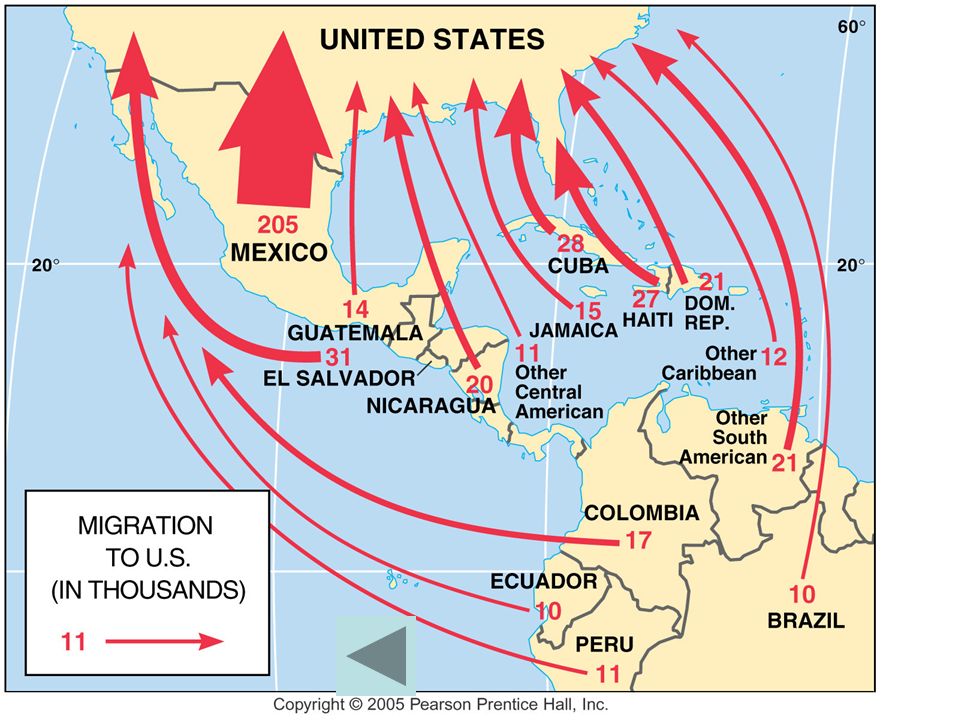
The Mexican migration is the oldest and the largest. It is also the one where the language of "migration" is most strained, because the southwestern United States from California to Texas was Mexican territory until the 1848 Treaty of Guadalupe Hidalgo ended the and transferred that territory to the United States. Mexican-descent communities in San Antonio, Los Angeles, Albuquerque, and the Central Valley have continuous histories that predate the border. On top of that older population sit several waves of twentieth-century migration north: refugees from the Mexican Revolution (1910-1920); the contracted laborers of the (1942-1964), which brought millions of Mexican workers into US agriculture and railroad work; the steady migration of working families through the second half of the twentieth century; and the growing Mexican-American populations in the urban and suburban Southwest in the 1970s and 1980s, which is the immediate context for the Tejano music of and her contemporaries. Selena's 1994 recording "Bidi Bidi Bom Bom", the fourth anchor track of this module, was made when she was twenty-two and at the height of her career; she was murdered the following year at twenty-three. Mexican-American musicians produced popular music in Texas, California, the Midwest (significant Mexican-American communities in Chicago and Detroit), and the Pacific Northwest. The geographic dispersal matters: there is no single Mexican-American music capital the way there is a Cuban-American music capital in Miami or a Puerto Rican music capital in New York.
The Puerto Rican migration is the second-oldest and the one that reshaped New York. Puerto Ricans have been US citizens since the of 1917, which made the legal category of "migration" the formal one (this is internal movement within the United States, not immigration), even though the experience was an immigrant experience in every other respect. The first significant numbers arrived in New York in the 1920s and 1930s, settling in (East Harlem) and the Lower East Side, with smaller communities in Brooklyn working at the Navy Yard. The mass migration came after World War II. Between roughly 1946 and the mid-1960s, an estimated 470,000 Puerto Ricans moved to the mainland, the great majority of them to New York City. In 1940 the city had roughly 61,000 Puerto Ricans; by 1970 it had over 800,000, more than 10 percent of the city's total population. This was, the Library of Congress notes, the first great airborne mass migration in US history; the economic restructuring of Puerto Rico, beginning in the late 1940s and running through the 1950s and beyond, and the steady availability of cheap flights from San Juan to New York were what made it possible. The neighborhoods this migration built (El Barrio in East Harlem, the South Bronx, Williamsburg in Brooklyn, the Lower East Side renamed ) are the ones where mambo, , salsa, and 's Latin element all developed. The musicians on Module 1's Cruz/Fania track and on this module's first three tracks all worked in those neighborhoods.
The Cuban migration begins in earnest in 1959, the year of the . Earlier Cuban musicians had certainly worked in the United States (, the Afro-Cuban arranger and trumpeter who was central to the postwar mambo era in New York, arrived in 1930), but the mass exodus of Cubans began with the post-revolutionary waves: roughly 250,000 early exiles between 1959 and 1962, mostly white, professional, and politically opposed to the Castro government; the of 1965-1973, another 260,000 Cubans on twice-daily charter flights between Varadero and Miami; the of April-October 1980, when the Cuban government opened the port of Mariel and 125,000 Cubans crossed the Florida Straits, including for the first time a significant Afro-Cuban population; and the Balsero (rafter) crisis of the 1990s during the post-Soviet "Special Period" of economic collapse. Cuban-Americans concentrated in Miami, where they built and the Calle Ocho commercial district, and where the demographics of Miami itself were transformed: from a Southern resort city in 1959 to a Latin American capital city by the 1980s. Cuban music in the United States after 1959 worked within a politicized condition, with the homeland increasingly inaccessible. The Cruz track in Module 1 covered one of the central figures of this exile.
The more recent migrations from elsewhere in Latin America and the Caribbean are differently shaped. Dominican migration to New York grew sharply after 1965, when the US ended the immigration quota system that had favored Northern Europeans, and Dominicans built communities in and the Bronx that would become central to the development of and in the United States, and later to reggaeton's New York reception. Panamanian migration, smaller in scale, brought to New York many of the Afro-Antillean Panamanians whose families had worked on the Panama Canal; their children and their children's children carried the Spanish-language reggae of their Panama City neighborhoods into the same cities where Puerto Rican reggaeton would later flourish. Colombian migration grew in the late twentieth century, primarily to New York and Miami, and would prove central to the rise of contemporary Latin pop and reggaeton (Shakira, , Karol G are all Colombian). What these later migrations share with the older ones is the same New York and Miami urban infrastructure: the same commercial neighborhoods, the same radio stations and record stores, the same dense Spanish-speaking labor markets and family networks. Many roots, shared routes.
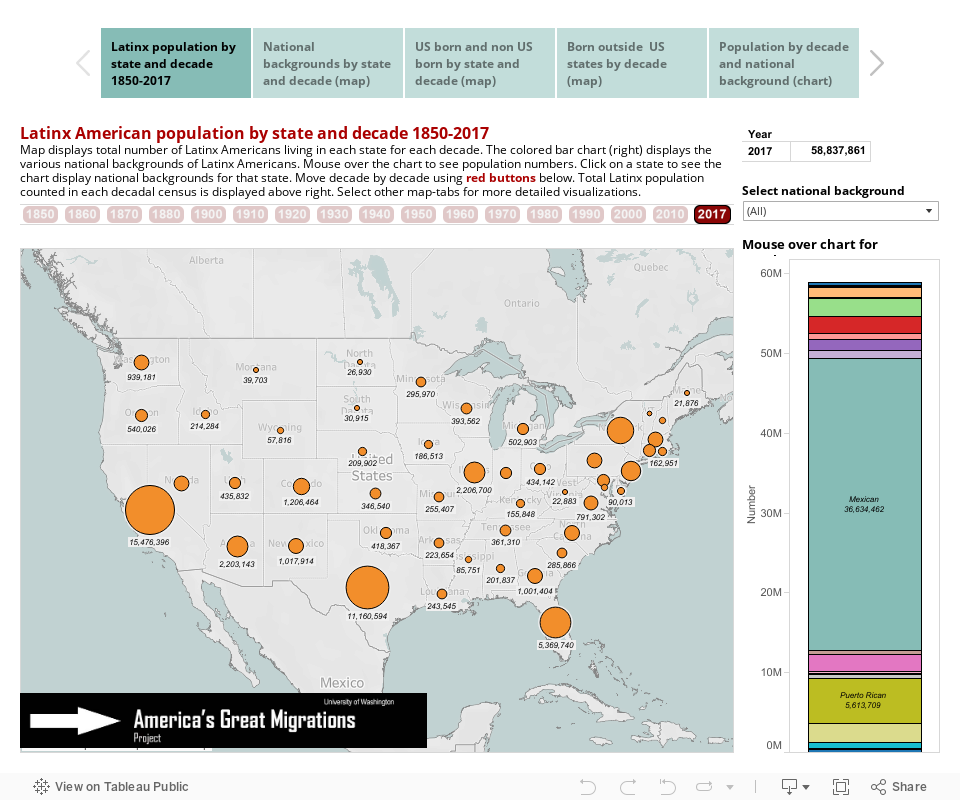
If you want to spend more time with the migration data, the University of Washington's Latinx Great Migrations project lets you explore it interactively. The visualization below is one slide from the project; the full project includes additional slides on origin countries, destination cities, and demographic shifts over time. Click through and see what stands out to you.
The labels that built the industry
Latin music in the United States has been recorded and circulated by an institutional infrastructure that ran in parallel with the African American "race records" infrastructure covered in Module 2, sometimes overlapping with it and sometimes operating separately. The list below names twelve labels and institutions that shaped what got recorded, what circulated, and what reached audiences. Some were owned by Latin musicians or businesspeople; most were not. Some are still operating; most are not. The geography matters: the labels concentrate in New York, Miami, and South Texas, mirroring the migration map.
| Label | Notable artists | Why it matters |
|---|---|---|
| Decca Latin American series |
Don Azpiazu, Alberto Socarrás | One of the earliest sustained efforts by a major US label to record and market Cuban and other Latin music in the United States. |
| Discos Falcon |
Conjunto Bernal, Lydia Mendoza, Freddy Fender | Founded by Arnaldo Ramírez in the Rio Grande Valley; one of the first labels to record Tejano and Tex-Mex music seriously, and a foundational institution of borderland Mexican-American popular music. |
| Tico Records |
Tito Puente, Tito Rodríguez, Joe Cuba Sextet, La Lupe, Eddie Palmieri (early) | Founded by George Goldner; recorded the New York mambo era at the Palladium and most of the major Latin music of the 1950s and early 1960s. Eventually absorbed into Fania. |
| Alegre Records |
Charlie Palmieri, Eddie Palmieri, Johnny Pacheco | Founded by Al Santiago at his Casalegre record store in the Bronx; the label that pushed New York Cuban-style charanga and pachanga forward and developed the early Pacheco sound that would become Fania. |
| Fania Records |
Celia Cruz, Willie Colón, Héctor Lavoe, Rubén Blades, Ray Barretto, Ismael Miranda, the Fania All-Stars | Founded by Johnny Pacheco and the lawyer Jerry Masucci, the label became the central institution of the 1970s salsa boom. Released the Fania All-Stars' Cheetah Club concerts and the Live in Africa concerts. Treated in detail in Module 1's Cruz track. |
| Salsoul Records |
The Salsoul Orchestra, Joe Bataan, others | Founded by the Cayre brothers as an offshoot of their Latin music distribution; pivoted toward the disco and dance market of the late 1970s. The label that named the salsa-soul fusion the music had already been doing. |
| RMM Records |
Tito Puente (later career), Marc Anthony, La India, Tito Nieves, Celia Cruz (later career) | Founded by the concert promoter Ralph Mercado; the label of the 1990s salsa romántica era and the launching pad for Marc Anthony as a Latin pop star. |
| Q-Productions |
Selena, Selena y Los Dinos | Founded by Abraham Quintanilla as the recording, management, and merchandising operation behind his daughter Selena's career. A family business that built the institutional infrastructure of Selena's career and continues to manage her catalog. |
| EMI Latin |
Selena (from 1989), Thalía, Maná, Juanes | The Latin division of the major label EMI. Selena signed with EMI Latin in 1989 and recorded most of her hit albums there, including Amor Prohibido (1994). The major-label infrastructure that scaled Tejano music nationally. |
| The Noise / DJ Playero mixtapes |
, DJ Negro, , the early underground reggaeton scene | The Puerto Rican mixtape scene of the early 1990s, sold from car trunks and at record stores in San Juan, that developed reggaeton out of Panamanian reggae en español, hip hop, and Jamaican dancehall. Daddy Yankee, Don Omar, Tego Calderón all came up through this scene before they had labels. |
| Tego Calderón, Tempo, DJ Playero (later) | Founded by ; the Puerto Rican label that brought reggaeton out of the underground mixtape circuit and onto major-label distribution. Released Tego Calderón's El Abayarde in 2002, the album this module's fifth track comes from. | |
| VI Music / El Cartel Records |
Daddy Yankee (El Cartel, his own label), Don Omar (VI Music) | The Puerto Rican labels that scaled reggaeton commercially after Tego's El Abayarde. Daddy Yankee's Barrio Fino (2004), with the breakthrough single "Gasolina," was released on El Cartel and reached the international audience that established reggaeton as a global pop genre. |
The dialogue with African American music
One of the most consistent stories in Latin diasporic music in the United States is the running conversation it has had with African American music. The conversation began before either tradition was American: the West African roots of Afro-Cuban and Afro-Puerto Rican rhythmic practice and the West African roots of African American rhythmic practice come from overlapping but not identical regions of West Africa, transmitted through the same Atlantic slave trade. The conversation continued in nineteenth-century New Orleans, where Cuban musicians performed and where the habanera rhythm worked its way into the music that would become jazz and the blues. By the early twentieth century, the two traditions were close enough in their commercial and geographic contexts that musicians from each were continually working with the other, recording with the other, and developing forms in dialogue.
Module 2's framing reading made this point in passing: the habanera in the bridge of W.C. Handy's "St. Louis Blues" is one moment of this dialogue, and the listening guide for the Bessie Smith track unpacks it. Across the twentieth century, the moments multiply. The mambo era at the in midtown Manhattan in the late 1940s and 1950s put Cuban-Puerto Rican Latin orchestras (, , ) on the same stages and in the same recording sessions as musicians (Dizzy Gillespie, Charlie Parker), with the cross-tradition fusion known as emerging directly from these encounters. Puente's 1962 recording of his own composition "Oye Como Va", the first anchor track of this module, is a mambo-into-cha-cha-chá node from the tail end of this scene. The boogaloo and of the mid-1960s — the genre 's 1967 recording of "Gypsy Woman" sits in, the second anchor track of this module — was a deliberate Black-and-Latin musical fusion made by mostly Puerto Rican musicians in El Barrio, recorded with English and Spanish lyrics on the same tracks and aimed at the bicultural teenage audience the neighborhood produced; Bataan, a Filipino and African American singer raised in a Puerto Rican cultural setting, covered 's 1961 hit on the recording.
The dialogue intensified in the post-civil-rights decades. Salsa proper, in the 1970s, drew jazz harmony, brass arranging conventions, and practice from the Black music industry it shared neighborhoods with. in the Bay Area, in the same period, processed Black rhythm-and-blues, gospel-derived organ playing, and the blues-rock vocabulary into a Latin-percussion-anchored ensemble sound; 's 1970 recording of Puente's "Oye Como Va," the third anchor track of this module, is the canonical document of that fusion: a direct cover of Track 1, recorded eight years later by a Mexican-American band from San Francisco's Mission District. Reggaeton, two decades later, built directly on hip hop's rhythmic and structural conventions, its practice, and its lyrical address to the city.
The dialogue runs the other way as well. African American musicians have drawn from Latin music throughout the same century: Jelly Roll Morton's "Spanish tinge" in early jazz; Dizzy Gillespie's collaboration with Chano Pozo; the Latin percussion lines that travel through and ; the use of Latin rhythmic patterns in early hip hop production. Module 2's "The Message" came out of a South Bronx neighborhood whose hip hop scene was Black and Latin from the start; the breakdancers, graffiti artists, and DJs who built hip hop in the late 1970s included Puerto Rican and Dominican kids alongside Black ones. Some of the figures we now place in the African American Module 2 narrative were also Latin. Some of the figures we will place in the Latin Module 3 narrative were also Black. The categories the course uses are useful for organizing the listening, but they should not be confused with the people, who often did not honor the categories.
The pedagogical point: Latin music in the United States is not a separate stream alongside African American music, kept neatly to its own side of the river. The two have run together throughout the twentieth century and into the present, in shared neighborhoods and shared studios and shared bandstands and shared audiences. The listening guides will keep pointing this out. When you hear it, what you are hearing is not coincidence; it is the structure of the music's history.
Latin music as political work
Module 2's framing reading named three modes by which a song can do political work: content (what a song says), form (how a song is built), and presence (who is in the room and what they sound like). The same three modes apply here, though they take different shapes in this music.
Content. Some Latin music does political work in its lyrics, naming the political conditions of the communities it speaks for. The protest tradition runs through the Mexican corrido as a long-standing form (the corridos of the Mexican Revolution and of border-crossing labor and of more recent migrant experience), through the politically explicit salsa lyrics of 's "Pedro Navaja" and 's collaborations with Blades on Siembra, through the social-realist verses of Tego Calderón's reggaeton (Black Puerto Rican identity, police violence, the legacy of slavery in the Caribbean, the politics of racial mixing), and into the contemporary Latin trap of Bad Bunny (Puerto Rican statehood, hurricane response, gender politics) and the broader 2010s and 2020s Latin trap and reggaeton scene. Lyrics that take political positions are one mode, and a familiar one.
The 1970s salsa political moment that Blades and Colón anchor deserves more space than that one sentence gives it. Salsa as Fania built it in New York in the late 1960s and 1970s was already doing political work at the level of form (the Pan-Latin ensemble identity discussed below), but the lyric tradition that came in with Blades pushed the political content explicitly to the foreground. Siembra, released by Fania on September 7, 1978, recorded at La Tierra Sound Studios in New York across 1977 and 1978, sold over three million copies worldwide and remained the best-selling salsa album in the genre's history until 's 1990s salsa-pop records overtook it. The album was the second of four collaborations between Blades and Colón. Its centerpiece, "Pedro Navaja," is a six-and-a-half-minute narrative ballad about a street hustler shot dead in the barrio, modeled on Bertolt Brecht's The Threepenny Opera (specifically the "Moritat von Mackie Messer" that English-speaking listeners know as "Mack the Knife"); the arrangement layers in street noise, police sirens, and a sardonic background chorus singing the "I like to live in America" line from West Side Story, turning the canonical Broadway-Latin number into a commentary on what living in America actually means for the song's protagonists. "Plástico," the album's opening track, begins with a deceptive disco groove before pivoting into a salsa number that critiques superficiality and calls for Pan-Latin solidarity. "Buscando Guayaba," "Dime," and the title track "Siembra" carry similar themes. The album's commercial success was not despite its political content but because of it: at the moment Fania was reaching peak commercial scale, Blades's lyrics gave the genre a stature beyond dance music and a vocabulary that subsequent generations of Latin popular musicians (from Marc Anthony's salsa-pop work to Bad Bunny's contemporary reggaeton) have continued to draw on. 's 1970s output (the politically explicit La Libertad: Lógico in 1972, Sentido in 1973, the Grammy-winning The Sun of Latin Music in 1974) sits alongside Blades and Colón as the other major locus of politically explicit salsa lyrics in this period, and Palmieri's career-long advocacy for Puerto Rican statehood and against the carceral system has continued into the present. , Colón's vocalist before Blades and the singer most identified with Fania's commercial peak, did less explicitly political work in his lyrics but anchored the Pan-Latin identity Fania was building; his story, including his addiction and his 1993 death from AIDS-related complications, is a final-project subject in its own right.
Form. Some Latin music does political work in how it is built. The very fact of a Spanish-language hit on US Top 40 radio is a formal political act in a country whose dominant musical infrastructure has long assumed English-language commercial product. The Pan-Latin ensemble model that the built (musicians from Cuba, Puerto Rico, the Dominican Republic, Panama, Venezuela, the United States, all on one stage, sharing one collective identity that was never reducible to a national one) is a political form. The mestizo-fusion form of Tejano (Mexican folk song plus German polka plus US pop) is a political form too: it claims a borderland identity that neither the Mexican nation nor the US nation has wanted to honor as a category of its own. The way reggaeton built its genre underground, on mixtapes, outside the major-label system that had ignored it, is a formal political act of self-organization. Form does political work even when the lyrics are about love or dancing or the body.
Presence. The third mode is who is in the room. A young Mexican-American woman from Corpus Christi headlining the Astrodome in Houston in front of more than 60,000 people (Selena) is doing political work by being there, regardless of what she sings. An Afro-Puerto Rican rapper rhyming in Spanish about Loíza, on a song produced in San Juan and distributed to the world (Tego Calderón), is doing political work by being audible at all. A Bay Area Mexican-American guitarist standing on the Woodstock stage in 1969 as the bill's only Latin act (Carlos Santana) is doing political work by claiming that space. The listening guides will keep returning to this question (who is in the room, what the room expects them to sound like, what they sound like instead) because so much of what this music argues, it argues by being there.
The five anchor tracks span forty years and several distinct strands of the Latin diasporic family. They are arranged chronologically (Puente 1962, Bataan 1967, Santana 1970, Selena 1994, Tego 2002), but they are not a single story; each one teaches a different facet, and the dialogues between them are several rather than one. You can complete the listening guides in any order.
The Latin LGBTQ+ thread
Latin diasporic popular music and queer Latin life have been entangled across the period this module covers, and the entanglement deserves its own section here in parallel with the queer Black thread Module 2 traces. The thread runs through the same Caribbean dance-music network that Module 2 names: the disco scene at the Loft and in New York, the early-1980s Chicago house scene at 's Warehouse, and the broader queer Black-and-Latino dance-music culture were always multi-ethnic and multi-lingual on the floor and in the booth. 's Paradise Garage drew an audience of Puerto Rican and Dominican dancers from the same New York neighborhoods this module covers, and the salsa-disco crossover records Levan played at the Garage (recordings by , the Fania All-Stars, Rubén Blades, and others, often in remixes that lengthened the percussion breaks for the dance floor) were part of how queer Latin New Yorkers heard their own musical tradition reflected back in a space that welcomed them.
The salsa-era closet was, by most accounts, dense and dangerous. The major figures of Fania's commercial peak did not come out publicly during their careers; the social and religious conditions of the salsa world, and of the broader Latin American Catholic culture salsa lived inside, made coming out almost unthinkable. Héctor Lavoe is the figure most often named in this discussion. Oral histories of his bisexuality have circulated among musicians and writers who knew the salsa world directly, and the 2006 biopic El Cantante alludes to past flirtations and relationships with men on screen, but Lavoe never spoke about his sexuality publicly and the historical record on this question consists, as the journalist Mathew Rodriguez has put it in LGBTQ Nation (October 11, 2023), of "whispers" rather than documented relationships. The point this section is making is not a categorical claim about Lavoe's identity; it is that the salsa scene of the 1970s and 1980s made even those whispers into the most one could safely say. The Latin that took Lavoe in 1993, and that this module's Module 2 counterpart describes for the parallel Black American scene, ran through the salsa and reggaetón communities throughout the 1980s and 1990s, and the silence inside the genre about its queer dead is part of what later artists have had to write through.
The wave broke commercially in 2010. On March 29, 2010, the Puerto Rican pop star (who had risen through the Puerto Rican boy band Menudo in the 1980s, become a global crossover star with the 1999 English-language single "Livin' la Vida Loca," and faced years of public speculation about his sexuality) posted a statement on his personal website declaring himself "a fortunate homosexual man." Martin's coming out was the first by a Latin pop star at his commercial scale and was widely understood, both inside Puerto Rico and across Spanish-speaking audiences globally, as a watershed for Latin LGBTQ+ visibility; the Puerto Rican LGBTQ+ activist Pedro Julio Serrano described the day in interviews as "a glorious day for the Puerto Rican LGBT communities." Six years later, on Valentine's Day 2016, the Puerto Rican singer-songwriter (born 1982 in Toa Baja, Latin Grammy Best New Artist 2008) posted an Instagram message announcing her relationship with her partner Jocelyn Troche, in what was widely treated by Spanish-language press as the first major coming-out by a Latin Grammy-winning woman in the contemporary scene; García married Troche in 2019 and has since been one of the most vocal Latin LGBTQ+ advocates in Puerto Rico, including a public 2020 letter to the Puerto Rican senate supporting Senate Bill 184 to ban conversion therapy.
The contemporary scene is broader than any one figure. The Dominican rapper (born 1996 in Santo Domingo) is openly bisexual and has made queer sexuality central to her and Latin trap recordings since her 2018 breakthrough; her 2021 collaborations with Rosalía ("Linda") and Madonna ("Hung Up on Tokischa," 2022) brought a substantially explicit queer Latin sexuality into the global pop mainstream at a scale no previous Latin artist had attempted. Bad Bunny has refused fixed categories around his sexuality and gender presentation since the early years of his career; his videos and stage appearances have used drag, queer fashion vocabulary, and same-gender kisses (including the 2020 "Yo Perreo Sola" video, in which he appeared in drag) as part of a broader public position on gender as a constructed and performable category. The producer and vocalist (born Alejandra Ghersi in Caracas, 1989), who came out as a trans woman in 2018 and whose work spans avant-pop, reggaetón, and contemporary classical, has been a central figure in the contemporary Latin queer underground; her collaborations with Björk, , Kanye West, and the broader experimental-electronic community have made queer Latin musical experimentation legible at the highest commercial scale. Beyond these named figures, the broader contemporary scene (the Mexican pop singers Christian Chávez and Aleks Syntek, the Chilean Javiera Mena, the Argentine Susy Shock, the Cuban-American singer Ana Macho, the Puerto Rican rapper Villano Antillano, the Dominican producer Riobamba) is a substantial Latin LGBTQ+ tradition that ten years ago could not have been pulled together under a single banner and that today is part of how the tradition this module covers is being remade.
What this module leaves out
Five anchor tracks cannot cover Latin diasporic music in the United States. The lineup this module follows traces a particular path (the New York Cuban-Puerto Rican axis through bicultural Latin soul into Bay Area Latin rock, then the Tejano breakthrough, then the reggaeton breakthrough) and the choices the lineup makes leave out a great deal. Four areas in particular are worth naming, because each is a defensible and rich subject for the final project ahead of you.
Mexican regional music past Tejano. Selena anchors the Tejano-and-cumbia-and-pop node of Mexican-American music, but the broader Mexican regional music tradition is enormous and runs much wider than Track 4 can carry. , the accordion-driven music of the Mexican north and the borderland (distinct from but adjacent to Tejano: Los Tigres del Norte's career from the 1970s forward, with their politically explicit migrant-experience corridos, is the canonical reference; Los Tucanes de Tijuana, Intocable, Ramón Ayala) is a popular tradition in its own right with deep Mexican-American roots. , the brass-band tradition of Sinaloa with its associated dance-floor culture (Banda El Recodo running from 1938 forward, Banda Machos, Banda MS) and its 1990s technobanda offshoot, has been a major Mexican-American popular form for forty years and does not appear here. The contemporary moment (Natanael Cano's 2019 Corridos Tumbados album, Peso Pluma's 2023 commercial breakthrough, Junior H, Fuerza Regida, Eslabón Armado, the Los Angeles independent label Rancho Humilde that built the institutional infrastructure for the genre) fuses traditional corrido narrative with trap and hip-hop production and has been the most commercially successful Latin music in the United States since 2022; it is not on this lineup. Mariachi-pop (Vicente Fernández, Pedro Infante in earlier generations; Christian Nodal in the present), ranchera as a continuous tradition (Lola Beltrán, Lucha Villa, the contemporary work of Ángela Aguilar), and the Mexican-American mariachi scene that runs through Los Angeles and San Antonio music programs would all reward a final project. Helena Simonett's Banda (2001), Cathy Ragland's Música Norteña (2009), and the contemporary journalism of Leila Cobo and Suzy Exposito at Billboard and Rolling Stone are the standard accounts.
The Afro-Caribbean US diaspora past Cuba and Puerto Rico. The framing reading above named the Dominican, Panamanian, and Colombian migrations briefly, but Tracks 1 through 5 of this module sit on the Cuban and Puerto Rican music traditions almost exclusively. The Dominican-American musical world is its own substantial tradition: merengue as the national music of the Dominican Republic and the soundtrack of Dominican-American Washington Heights from the 1970s forward (Wilfrido Vargas, Juan Luis Guerra, Johnny Ventura, Milly Quezada); bachata as the rural Dominican guitar music that came up through the same New York neighborhoods to become a global Latin pop genre (Aventura, the band that ran from the late 1990s through 2009 and produced Romeo Santos, who went on to one of the largest Latin music careers of the 2010s; Prince Royce; the contemporary work of Yandel and others). The Brazilian American musical world is also entirely off this module's lineup: the Brazilian samba and bossa nova traditions reshaped American jazz and pop in the 1960s through the Antônio Carlos Jobim collaborations with Stan Getz and (the 1967 Francis Albert Sinatra & Antônio Carlos Jobim album), Brazilian funk and the contemporary baile funk of Rio (Anitta is the recent crossover figure), and the long history of Brazilian American musicians in New York, Miami, and Los Angeles. Cuban exile music in Miami after 1959 (Celia Cruz's pre-Fania career, the nueva trova tradition that the Cuban Revolution produced and that Miami exile audiences received in complicated ways, Gloria Estefan and Miami Sound Machine's 1980s pop crossover, the Cuban-American art-music tradition) is also its own thread.
Latin hip hop and contemporary Latin pop crossover between Bataan in 1967 and Tego in 2002. The thirty-five years between Track 2 and Track 5 are the period in which Latin hip hop developed in the United States, and almost none of that development sits on this module's anchor lineup. Mellow Man Ace's 1989 "Mentirosa" was the first Spanish-language hip hop song to chart on the US Top 40; his brother Sen Dog joined Cypress Hill, the Cuban-and-Mexican-American Los Angeles group whose 1991 self-titled album sold two million copies and brought Latin hip hop into the mainstream commercial frame. Kid Frost's 1990 "La Raza" was a foundational hip-hop record. Big Pun, the Bronx-born Puerto Rican rapper whose 1998 Capital Punishment was the first Latin hip-hop album to go platinum, sat at the intersection of mainstream East Coast hip-hop and Latin diasporic identity in ways that anticipated what reggaeton would later globalize. The late-1990s Latin pop crossover boom (Marc Anthony's 1999 self-titled English-language album; Ricky Martin's 1999 "Livin' la Vida Loca"; Shakira's 2001 Laundry Service; Enrique Iglesias) brought Spanish-language and bilingual artists into the US commercial pop mainstream at a scale none of the earlier waves had reached. Raquel Z. Rivera's New York Ricans from the Hip Hop Zone (2003) and the contemporary work of Petra Rivera-Rideau (Remixing Reggaetón, 2015) are the standard scholarly accounts of Latin hip hop and reggaeton respectively.
The Latin trap that ran alongside reggaeton from the early 2010s forward (Anuel AA's pre-prison and post-prison work, Ozuna, Bryant Myers) is the immediate musical world the contemporary Latin pop mainstream sits inside. The artist who has done the most with that musical world is the Puerto Rican rapper and singer Bad Bunny (Benito Antonio Martínez Ocasio), whose breakthrough album X 100PRE in 2018 was followed by the 2020 trilogy of pandemic-era albums (YHLQMDLG, Las Que No Iban a Salir, El Último Tour del Mundo) and the 2022 Un Verano Sin Ti, the most-streamed album on Spotify in 2022 and the first Spanish-language album to be nominated for the Grammy Album of the Year. Bad Bunny's recording "El Apagón" on Un Verano Sin Ti sits at the intersection of reggaeton, salsa, and political address: the title means "the blackout," referring to the prolonged power outages Puerto Rico has lived through since Hurricane María in 2017, and the song's accompanying short film by the Puerto Rican filmmaker Bianca Graulau combines the dance track with an investigative documentary about displacement and gentrification on the island. The whole arc of Bad Bunny's work, including his vocal advocacy on Puerto Rican statehood, hurricane response, and gender politics, sits squarely inside the reggaeton tradition this module's fifth track introduces, and is a defensible and rich subject for the final project.
Sources for this section
Aparicio, Frances R. Listening to Salsa: Gender, Latin Popular Music, and Puerto Rican Cultures. Hanover, NH: Wesleyan University Press, 1998. The foundational scholarly study of salsa as a cultural practice in Puerto Rican communities, with attention to gender, language, and the bicultural urban experience.
Berríos-Miranda, Marisol; Dudley, Shannon; and Habell-Pallán, Michelle. American Sabor: Latinos and Latinas in US Popular Music. Seattle: University of Washington Press, 2017. The companion book to the Smithsonian-traveled exhibition of the same name; the closest analog to what this module is doing pedagogically and the most useful single overview source for the territory.
Flores, Juan. From Bomba to Hip-Hop: Puerto Rican Culture and Latino Identity. New York: Columbia University Press, 2000. Essays on the long arc of Puerto Rican popular music in New York, from bomba and plena through salsa to hip hop's Latin elements.
García, María Cristina. Havana USA: Cuban Exiles and Cuban Americans in South Florida, 1959-1994. Berkeley: University of California Press, 1996. The standard scholarly account of the post-1959 Cuban migration and the cultural and political transformation of Miami.
Gilroy, Paul. The Black Atlantic: Modernity and Double Consciousness. Cambridge, MA: Harvard University Press, 1993. The source of the "roots and routes" formulation borrowed (and modified) for the framing of this module and Module 2.
Library of Congress. Immigration and Relocation in U.S. History: Puerto Rican / Cuban. Online classroom materials. The Library's overview of Puerto Rican and Cuban migration to the United States, with primary documents and historical photographs.
Marshall, Wayne; Rivera, Raquel Z.; and Pacini Hernandez, Deborah, editors. Reggaeton. Durham, NC: Duke University Press, 2009. The foundational scholarly anthology on reggaeton, covering the Panamanian roots, the Puerto Rican underground emergence, the dembow rhythm, and the genre's global circulation.
Peña, Manuel. The Texas-Mexican Conjunto: History of a Working-Class Music. Austin: University of Texas Press, 1985. The standard scholarly history of the conjunto and orquesta traditions of South Texas, the institutional and aesthetic ground on which Tejano music developed.
Rivera, Raquel Z. New York Ricans from the Hip Hop Zone. New York: Palgrave Macmillan, 2003. The study that recovered the central role of Puerto Rican musicians and dancers in the development of New York hip hop.
Sánchez Korrol, Virginia E. From Colonia to Community: The History of Puerto Ricans in New York City. Berkeley: University of California Press, 1983. The foundational social history of Puerto Rican New York from the early twentieth century through the Great Migration.
Washburne, Christopher. Sounding Salsa: Performing Latin Music in New York City. Philadelphia: Temple University Press, 2008. An ethnographic study of New York salsa from a working musician's perspective, with detail on the institutional history of Fania and its successors.
Cepeda, Eddie. "Tu Pum Pum: Panamanian Artists Helped Birth Reggaeton, Then the Industry Left Them Behind." Remezcla, 2017. Long-form journalistic account of the Panamanian origins of reggae en español and the Panama-to-Puerto-Rico transmission, with extensive interviews with El General and Renato.
Center for Puerto Rican Studies, Hunter College. The Story of US Puerto Ricans. Online history resource. Quantitative and narrative material on the Great Migration of the 1940s-60s and on Puerto Rican settlement patterns across the US.
Wikipedia. "Puerto Ricans in New York City"; "Mariel boatlift"; "El General"; "El Abayarde"; "Treaty of Guadalupe Hidalgo"; "Operation Bootstrap"; "Bracero Program"; "Jones-Shafroth Act." Useful for cross-checking dates, demographic figures, and the broad outlines of migration and political history. Where Wikipedia entries cite specific scholarly sources, I have pulled the underlying source where available.